
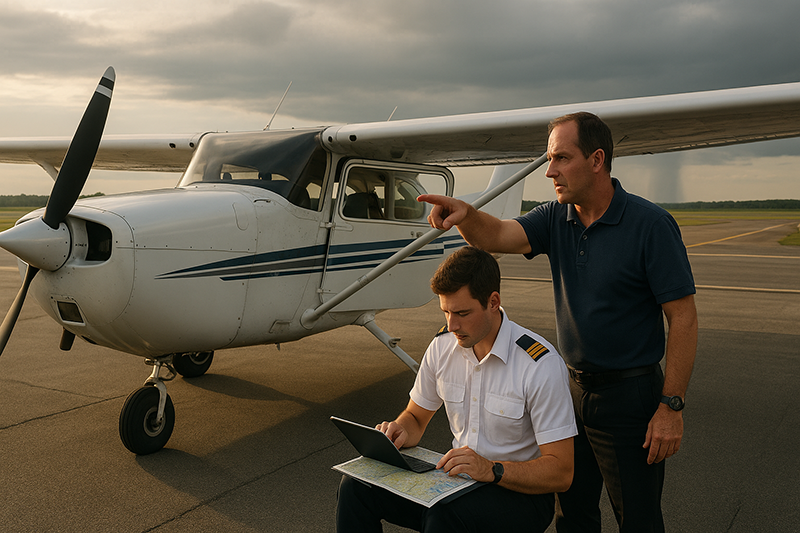
Weather decision-making for short cross-country flights is one of the most important judgment skills a pilot can develop. A short trip can feel routine because the route is familiar, the airplane is simple, and the destination is close. That familiarity is exactly why weather can catch pilots off guard. A 70-mile flight may cross a frontal boundary, move from clear air into lowering ceilings, encounter terrain-driven visibility changes, or arrive at an airport where surface winds are stronger than expected.
For student pilots, private pilots, flight instructors, and aviation professionals, the lesson is the same: distance does not determine weather risk. Weather risk is determined by the interaction between the pilot, the aircraft, the route, the terrain, the time of day, the forecast, and the options available when conditions change. This article explains how to think through short cross-country weather decisions in practical cockpit terms, without turning aeronautical decision-making into a rote checklist.
Why Short Cross-Country Weather Decisions Are Different
A short cross-country flight often occupies a mental gray area. It is more complex than local pattern work, but it may not receive the same planning discipline as a longer trip. The pilot may know the departure airport well, may have flown to the destination before, and may expect the flight to take less than an hour. That can create a false sense of simplicity.
Short routes can be especially vulnerable to compressed decision time. On a longer flight, a pilot may have more time to monitor trends, compare updated weather information, and evaluate diversion options. On a short flight, the airplane can reach changing conditions quickly. A cloud deck that looked distant during preflight can become relevant within minutes after departure. A developing rain shower near the destination can close the gap between forecast and reality before the pilot has settled into cruise.
Another challenge is that short trips are often flown at lower altitudes in training aircraft. Lower altitudes can increase exposure to terrain, obstacles, towers, local wind effects, haze, smoke, localized showers, and reduced visibility near the surface. The airspace may also be busier near terminal areas, which adds workload at the same time the pilot is trying to interpret weather and navigate.
The best weather decisions for short cross-country flights begin with humility. The pilot should not ask only, 'Is the weather legal?' A better question is, 'Does the weather provide enough margin for this pilot, this aircraft, this route, and this plan today?'
Start With the Big Weather Picture
Effective weather decision-making starts before looking at the destination METAR or a single terminal forecast. Pilots should first understand the larger weather pattern. Is a cold front moving through the area? Is moist air being lifted over terrain? Is high pressure producing calm but hazy conditions? Are scattered thunderstorms possible later in the day? Is fog expected to form after sunset?
The big picture matters because individual observations and forecasts can be misleading when viewed in isolation. A departure airport may show good VFR conditions while the route ahead is trending toward marginal weather. A destination may report acceptable conditions now, but the cause of deterioration may be moving toward it. A forecast may appear favorable, yet nearby stations may show ceilings lowering faster than expected.
For practical planning, pilots should compare the departure, destination, route, and alternate areas as one connected system. The question is not simply whether each airport looks acceptable. The question is whether the entire flight path has workable ceilings, visibility, winds, and escape options from takeoff through landing.
For a short cross-country, this big-picture review does not need to be complicated, but it should be deliberate. Look at the synoptic pattern, radar trends if precipitation is present, visible or infrared satellite imagery when useful, current observations along the route, terminal forecasts where available, and pilot reports when relevant. The goal is not to become a meteorologist. The goal is to understand what the atmosphere is doing and whether it is becoming more favorable, less favorable, or uncertain.
Ceilings, Visibility, and the VFR Trap
For VFR pilots, ceilings and visibility deserve special attention. A flight may be technically possible under applicable rules while still offering poor safety margins. This is especially true when ceilings are lowering, visibility is uneven, terrain is rising, or the route passes near controlled airspace with specific weather and clearance considerations.
Visibility can be difficult to judge from the cockpit, particularly in haze, smoke, mist, precipitation, or low sun angles. A pilot may see the ground below and assume the flight is comfortable, while forward visibility is gradually decreasing. In marginal conditions, navigation becomes more demanding, traffic detection becomes harder, and terrain avoidance margins may shrink. A pilot who continues because the destination is only a few minutes away can drift into a situation where turning around becomes more complicated than expected.
Ceilings also require a route-based view. A reported ceiling at the departure airport does not guarantee the same ceiling over ridges, valleys, water, or a destination airport with different terrain and exposure. If the planned cruise altitude depends on squeezing between clouds and terrain, the plan may already be too fragile for a low-workload VFR flight.
In flight training, instructors should emphasize that VFR weather judgment is not just a question of cloud clearance and visibility numbers. It is a question of workload, orientation, escape routes, and pilot capacity. A student pilot who can safely conduct a dual cross-country in marginal conditions with an instructor may not have the same margin when flying solo. Likewise, a proficient instrument-rated pilot flying a properly equipped aircraft may have more options than a VFR-only pilot, but only if the pilot is current, prepared, and operating within aircraft and regulatory limits.
Wind, Turbulence, and Surface Conditions
Short cross-country flights often involve multiple airports with different runway alignments. A wind that is manageable at departure may produce a challenging crosswind at the destination. Gusty winds can also increase approach workload, affect landing distance, and make go-around decisions more likely. For student pilots and renters, crosswind capability should be considered in relation to personal proficiency, instructor limitations, aircraft guidance, and any school or operator policies.
Surface wind reports are only part of the story. Wind aloft can influence groundspeed, fuel planning, turbulence, and arrival timing. Low-level wind shear, mechanical turbulence near terrain or buildings, and convective outflow boundaries can all make a short flight feel very different from the forecast summary. Even on a clear day, strong winds over ridgelines or uneven terrain can create moderate discomfort and increased workload for less experienced pilots.
Runway condition is another practical consideration. After rain, snow, frost, or freezing precipitation, pilots must consider aircraft performance, braking action, contamination, and airport services. For many light-aircraft operations, the smartest weather decision may be made before engine start by recognizing that the destination runway, taxiways, or ramp conditions are outside the pilot's comfort or the operator's policy.
Wind planning also affects alternates. If the wind favors only one runway at the destination and that runway is unavailable, occupied, or unsuitable, the pilot needs a realistic backup. On short flights, pilots sometimes assume they can simply return home. That may be true, but only if the departure airport remains suitable and the weather behind the aircraft has not changed.
Convective Weather and Short Routes
Thunderstorms and convective showers deserve a conservative mindset. A short flight does not make convective weather less significant. In fact, short trips can tempt pilots into launching between cells or trying to beat weather because the flight appears quick. That thinking can be hazardous. Convective weather can change rapidly and may involve turbulence, heavy precipitation, lightning, hail, strong downdrafts, and abrupt wind shifts.
For general aviation pilots, a practical rule is to avoid building a plan that depends on threading narrow gaps, racing a storm, or relying on a single radar image. Weather radar, datalink displays, and apps are valuable tools, but pilots must understand latency, coverage limitations, and interpretation errors. The cockpit display may not show the atmosphere exactly as it exists outside the windshield at that moment.
When convection is possible, timing is everything. A morning training flight may be reasonable before afternoon development, while the same route later in the day may not be. The pilot should evaluate forecast convective timing, current radar trends, cloud buildup, temperature and moisture conditions, and available escape airports. If the plan requires a perfect departure time, perfect aircraft dispatch, perfect enroute speed, and no delays, the margin is probably too thin.
Short cross-country planning should also account for the destination phase. It is one thing to depart in clear air with storms building 40 miles away. It is another to arrive at a non-towered airport with gusty outflow winds, reduced visibility in rain, and other traffic making weather-driven decisions at the same time. A good weather decision includes the arrival environment, not just the enroute segment.
Instrument Conditions, Marginal VFR, and Personal Minimums
Instrument meteorological conditions and marginal VFR require disciplined planning. A VFR-only pilot should treat lowering ceilings, widespread reduced visibility, and uncertain route conditions as serious hazards, even when the flight is short. A pilot who is instrument rated but not current, not proficient, or not flying an appropriately equipped and maintained aircraft should not assume an instrument rating automatically solves the weather problem.
Personal minimums are one of the most useful tools for short cross-country weather decision-making. They translate broad safety concepts into practical go, delay, divert, or cancel decisions. Personal minimums may include minimum ceilings and visibility for day VFR, higher values for night, crosswind limits based on recent proficiency, minimum fuel reserves above regulatory requirements or operator policies, and limits for convective weather proximity. These values should be conservative for student pilots and should expand only with training, experience, and instructor guidance.
The key is to set personal minimums before emotional pressure appears. Once passengers are waiting, the aircraft is booked, the instructor's schedule is tight, or the pilot wants to complete a solo requirement, judgment can become biased. A written set of personal minimums gives the pilot a decision anchor. It helps convert a vague feeling into a clear conclusion: launch, wait, change the route, file IFR if appropriate, take an instructor, or cancel.
For instructors, personal minimums are also a teaching tool. Rather than simply telling a student that the weather is good or bad, the instructor can ask the student to compare actual and forecast conditions against pre-established criteria. This builds judgment and encourages the student to explain risk in aviation terms.
Why This Matters in Real-World Aviation
Weather decisions on short cross-country flights influence more than one lesson or one weekend trip. They shape the pilot's long-term risk habits. A pilot who repeatedly launches into marginal conditions because previous flights worked out may start confusing experience with validation. The problem is that weather tolerance can drift gradually. What once felt questionable can become normal if nothing bad happens.
Real-world aviation rewards pilots who preserve options. The safest pilots are not the ones who never encounter changing weather. They are the ones who detect changes early, make decisions while they still have good choices, and avoid turning manageable uncertainty into urgency. In a short cross-country, that may mean delaying departure by an hour, choosing a route with better terrain clearance, selecting an intermediate airport as a decision point, or canceling a flight that does not support the training objective.
Weather decision-making also affects passenger confidence and professionalism. A private pilot explaining a conservative delay in plain language demonstrates command judgment. A flight instructor who cancels a lesson because the weather is legal but not educationally useful teaches the student that safety and learning quality matter. An aviation operator that encourages thoughtful weather calls builds a stronger safety culture than one that treats cancellation as failure.
The real-world lesson is simple: a short flight still deserves a complete decision. Good pilots do not reduce planning because the distance is short. They scale the planning to the risk, not to the mileage.
How Pilots Should Understand the Weather Briefing
A useful weather briefing is not just a collection of products. It is a structured interpretation of risk. Pilots should move from the general to the specific, then from the specific to a decision. Start with the broad pattern, then evaluate departure, route, destination, alternates, timing, and escape options.
Current observations show what is happening now, but they do not guarantee what will happen next. Forecasts provide expectations, but they are not promises. Radar and satellite imagery show trends, but they require interpretation. Pilot reports can be valuable, especially for cloud tops, turbulence, icing, and visibility, but they are time and location dependent. The pilot's job is to integrate these pieces into a practical operational picture.
One effective method is to identify the limiting factor. On some days, the limiting factor is ceiling. On others, it is visibility, crosswind, convective timing, turbulence, icing potential, or night operations over sparse terrain. Once the limiting factor is clear, the decision becomes more focused. If ceilings are the issue, evaluate route altitude, terrain, escape airports, and forecast trend. If wind is the issue, evaluate runway alignment, gust factor, proficiency, and alternatives. If convection is the issue, evaluate timing, movement, avoidance options, and whether the flight has any real need to go.
Pilots should also distinguish between improving, stable, and deteriorating conditions. Stable good weather usually offers more margin than weather that is barely acceptable and trending downward. Deteriorating conditions deserve special caution because they reduce the pilot's options over time. In a short flight, a trend can matter more than the current report.
Common Mistakes or Misunderstandings
One common mistake is treating short distance as low risk. A flight that lasts 35 minutes can still include a weather-related diversion, an unplanned encounter with marginal visibility, or a landing in gusty crosswinds. The airplane does not care that the destination is nearby.
Another mistake is focusing only on the departure and destination airports. Weather between airports can be the deciding factor, especially in areas with terrain, water, localized fog, lake effects, smoke, or scattered precipitation. A route that looks fine on a straight line may pass over the worst visibility or the lowest ceilings in the area.
A third misunderstanding is relying too heavily on a single app color, icon, or summary. Aviation weather products are tools, not decisions. A green symbol at the destination does not answer whether the route is suitable, whether the wind is within the pilot's personal minimums, or whether the forecast is deteriorating. Pilots should use weather apps intelligently, but not passively.
Many pilots also underestimate night weather risk. At night, clouds can be harder to see, unlit terrain is less forgiving, and visual references may be limited. Haze, mist, and scattered cloud layers can be more disorienting than they appear during preflight. A night VFR short cross-country should receive a higher level of planning and more conservative personal minimums.
Finally, pilots sometimes delay the diversion decision too long. The best diversion is usually made before the situation feels urgent. If the weather ahead is uncertain, the pilot should consider turning around or landing at a suitable airport while conditions are still clearly manageable. Waiting until the airplane is close to weather, low on options, or inside a narrowing corridor creates unnecessary pressure.
Practical Example: A 90-Mile Training Flight
Consider a student pilot planning a daytime solo cross-country of about 90 nautical miles in a typical training airplane. The departure airport is reporting good VFR conditions with light winds. The destination is also VFR, but the ceiling is lower, the temperature and dew point are close, and nearby stations show visibility varying in haze. A forecast suggests conditions may improve by late morning, but the trend over the last hour has not clearly improved yet.
A weak temptation appears: the flight is short, the student has a schedule block, and the destination is familiar. The aircraft is ready. The direct route crosses an area with few good emergency landing fields and limited intermediate airports. The student could legally depart if all applicable requirements are satisfied, but the safety question is broader than legality.
A strong decision process would slow the situation down. The student, with instructor input as appropriate, would compare the weather to personal minimums, evaluate whether the trend is improving or uncertain, review alternates, and consider terrain and communication coverage along the route. The student might decide to delay departure for updated observations, change the route to remain closer to better airports, fly dual with an instructor, or cancel if the training value is poor.
Now imagine the flight launches and the visibility ahead begins to look worse than expected. The pilot notices the horizon becoming less distinct and the ceiling appearing lower toward the destination. This is the point where good judgment matters. Rather than pressing on because the destination is only 20 minutes away, the pilot compares current conditions to the preplanned decision point. If the view ahead does not meet expectations, the pilot turns back or diverts while the departure area remains clear and fuel is plentiful.
The lesson is not that the flight must always be canceled. The lesson is that the pilot should not let proximity override judgment. A short cross-country still needs trend analysis, personal minimums, alternates, and a willingness to change the plan early.
Best Practices for Pilots
Good weather decisions are built from habits. These habits do not need to be complicated, but they must be consistent. Before a short cross-country, pilots should deliberately review the weather picture rather than only checking whether the destination is VFR. They should know the likely weather problem before takeoff and have a plan if that problem appears in flight.
It helps to define a few decision points before departure. A decision point may be a landmark, an airport, a time after takeoff, or a specific weather observation update. At that point, the pilot asks: Are the ceilings, visibility, winds, and trends matching the plan? If not, the pilot changes course before the options narrow.
Communication is another best practice. Pilots should use available weather resources before flight and consider in-flight updates when appropriate. Flight service, air traffic control, onboard weather equipment, and pilot reports can all support decision-making, but none replace visual judgment and conservative planning.
For short cross-country flights, the following habits are especially useful:
- Review the big weather picture before focusing on airport observations.
- Compare departure, route, destination, and alternate weather as one system.
- Set personal minimums before schedule pressure appears.
- Identify the limiting factor for the flight, such as ceiling, visibility, wind, convection, or night conditions.
- Plan at least one practical diversion or turn-back option.
- Make weather decisions early, while the airplane still has good choices.
Instructors can strengthen these habits by asking students to explain their weather decision out loud. The goal is not to recite products. The goal is to describe the operational risk: what could change, how the pilot would recognize it, and what action would follow.
Weather Decision-Making for Instructors and Flight Schools
Flight instructors play a major role in shaping how pilots think about weather. A student who sees an instructor cancel or delay for thoughtful reasons learns that good judgment is part of professionalism. A student who sees every marginal day treated as a challenge to overcome may learn the wrong lesson.
For training flights, the key question is not only whether the flight can be completed. It is whether the weather supports the lesson objective. A short cross-country lesson in marginal visibility may consume so much attention that navigation, radio work, and decision-making objectives suffer. Gusty crosswinds may be appropriate for a focused dual lesson but not for a student's first solo cross-country. Scattered showers may be a useful classroom discussion but a poor environment for an early-stage pilot trying to build confidence.
Flight schools benefit from clear weather guidance that supports instructor judgment. Policies should help pilots make consistent decisions without discouraging conservative calls. When students understand that cancellation is sometimes a successful safety decision, they become more willing to make the same call after certification.
Turning Weather Information Into a Go, Delay, Divert, or Cancel Decision
The final step is converting information into action. Pilots sometimes gather excellent weather data but never clearly decide what it means. A practical decision should land in one of several categories: go as planned, go with a modified plan, delay, fly with an instructor or under IFR if appropriate, divert, return, or cancel.
A go decision should include reasons, not just optimism. The pilot should be able to explain why the weather supports the route, how conditions are expected to change, and what alternatives are available. A delay decision may be the best option when trends are uncertain but expected to improve. A modified plan may involve a different route, lower-risk destination, earlier departure, additional fuel, or a more conservative altitude strategy within applicable rules and aircraft performance limits.
A cancel decision is not a failure. It is a normal part of aviation. Weather will not always support the intended mission. Pilots who cancel appropriately protect themselves, their passengers, the aircraft, and the reputation of aviation decision-making. The goal is not to complete every planned short cross-country. The goal is to complete the right flights for the right reasons under conditions that support a safe outcome.
Frequently Asked Questions
Is a short cross-country flight less risky in marginal weather?
Not necessarily. A shorter distance may reduce exposure time, but it also reduces decision time. Weather can change quickly, and a short route may still cross areas of lower ceilings, reduced visibility, gusty winds, or precipitation. Pilots should evaluate the complete route and available options rather than assuming short distance means low risk.
Should a VFR pilot launch if the weather is legal but marginal?
Legality is only the starting point. A VFR pilot should also consider personal minimums, experience, terrain, daylight, aircraft equipment, traffic, route options, and the trend of the weather. If the plan depends on thin margins or uncertain improvement, delaying or canceling may be the better decision.
How should student pilots set weather personal minimums?
Student pilots should set conservative personal minimums with their instructor and adjust them gradually as training, proficiency, and judgment improve. The minimums should address ceilings, visibility, winds, crosswind component, daylight, terrain, and any school policies. They should be written down before a specific flight creates pressure.
What weather trend is most concerning for a short cross-country?
Deteriorating weather is especially concerning because it reduces options as the flight continues. Lowering ceilings, decreasing visibility, building convection, strengthening winds, or fog formation near the destination should prompt a conservative reassessment before departure and early action in flight.
How can pilots avoid overreliance on weather apps?
Use apps as tools, not as decision-makers. Look beyond color coding or summary icons. Compare observations, forecasts, radar trends, satellite imagery, pilot reports when available, and the route environment. Then translate that information into a practical decision with clear alternatives.
When is canceling the best weather decision?
Canceling is appropriate when the weather does not support the pilot's proficiency, aircraft capability, training objective, route, or available alternatives. It is also appropriate when uncertainty is high and the flight is not necessary. A timely cancellation is a sign of sound pilot judgment.
Key Takeaways
- Short cross-country flights still require complete weather decision-making because risk depends on conditions, trends, route, pilot proficiency, and available options.
- Ceilings, visibility, wind, convection, night conditions, and terrain can reduce safety margins even when the flight appears simple or familiar.
- Use personal minimums, preplanned decision points, and early diversion choices to turn weather information into disciplined go, delay, divert, or cancel decisions.