
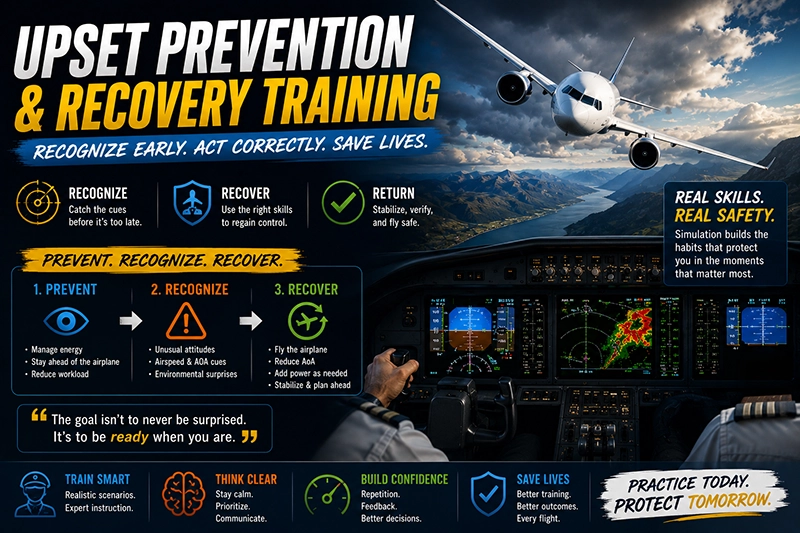
Upset prevention and recovery training is a focused, skills-based approach that teaches pilots how to recognize and recover from unintended airplane attitudes and flight conditions. For pilots, student pilots, and instructors, UPRT improves situational awareness, aerodynamic understanding, and recovery technique in circumstances where control and energy management are challenged. This article explains why UPRT matters, how to interpret the concepts in the cockpit, common training pitfalls, and actionable practices you can apply to make flying safer and more resilient.
The rest of this article is written for pilots, flight instructors, training managers, and serious aviation enthusiasts who want operationally useful guidance. You will find clear explanations of the core concepts, real-world applications, a practical scenario, common mistakes to avoid, recommended training practices, and a focused FAQ. The primary keyword "upset prevention and recovery training" appears early because this topic drives training choices, decision-making, and safety outcomes in everyday flying.
What is Upset Prevention and Recovery Training?
Upset prevention and recovery training is a discipline that pairs prevention strategies with recovery techniques. Prevention aims to reduce the likelihood that a pilot will experience an unwanted departure from controlled flight. Recovery provides the skills to return the airplane to normal flight when prevention fails. Together, they address the human, technical, and aerodynamic elements that create or resolve unusual attitudes, stalls, and incipient loss-of-control situations.
Within the training context, "upset" is a practical term that refers to any flight condition outside the normal operating parameters for which the pilot was trained and prepared. That includes steep unusual attitudes, accelerated stalls, and situations where the pilot's expectations about aircraft behavior do not match actual performance. UPRT covers recognition, avoidance, and recovery techniques across those spectrums.
Why This Matters in Real-World Aviation
Loss of control in flight is a risk category that spans aircraft types and pilot experience levels. The fundamental factors that lead to upsets are often a mix of aerodynamics, energy management, environmental conditions, and human performance. Training that isolates each factor helps pilots develop mental models they can apply when unexpected events occur.
For flight instructors and training managers, teaching UPRT means giving students more than procedural memory. It means teaching them how to recognize precursors, manage energy, interpret aircraft cues, and execute recovery techniques calmly. For operational pilots, UPRT strengthens decision-making during transitions between visual and instrument conditions, during turbulence, or when encountering unfamiliar aerodynamics near the performance envelope.
From a safety perspective, the value of UPRT is practical. It reduces the probability that a pilot will become disoriented or delayed in recognizing a developing upset. It also reduces the likelihood of inappropriate control inputs that can worsen a developing situation. Those practical benefits translate into better outcomes when real aerodynamic surprises occur.
How Pilots Should Understand This Topic
The right mental approach to upset prevention and recovery training separates three domains: aerodynamics, human factors, and training technique. Understanding each domain helps pilots react correctly when their airplane is outside the expected flight envelope.
Aerodynamics. Pilots must understand how lift, angle of attack, energy, and configuration affect airplane behavior. Angle of attack is the aerodynamic parameter most closely tied to a stall. Recognizing aerodynamic cues such as buffeting or control feel helps pilots detect an approaching stall before excessive angle of attack or loss of control occurs.
Human factors. Upsets often begin with a breakdown in situational awareness. Stress, startle, spatial disorientation, and task saturation degrade perception and decision-making. Training should include scenarios that replicate workload and startle in a controlled way so pilots can practice recovery procedures under realistic pressures.
Training technique. UPRT is most effective when it blends classroom theory with hands-on practice. Aeronautical knowledge alone does not instill the automatic motor skills and judgment needed under stress. Conversely, physical practice without conceptual understanding can teach unsafe habits. Effective programs integrate both: clear concepts, explanation of why maneuvers work, and progressive physical practice in safe environments such as simulators and appropriate aerobatic-capable training aircraft.
Core Components of Upset Prevention and Recovery Training
A comprehensive UPRT program contains several components that work together to develop competence and judgment.
- Recognition and prevention: Training to identify early signs of upset risk, such as energy mismatch, high workload, unstable approaches, or weather transitions.
- Aerodynamic education: Focused explanation of angle of attack, accelerated stalls, load factor, and how control inputs affect the aircraft in unusual attitudes.
- Recovery technique: Practiced responses that prioritize aircraft control, energy management, and safe flight path return without introducing secondary hazards.
- Human factors training: Exercises that reduce startle, manage stress, and reinforce crew resource management and decision-making.
- Scenario integration: Realistic training that places the pilot in common operational upsets, reinforcing recognition and correct responses in mission-relevant contexts.
Common Mistakes or Misunderstandings
Even well-intentioned training or flying practices can create dangerous misunderstandings about upsets. Identifying these helps instructors and pilots correct them before they become habits.
Misunderstanding angle of attack. Some pilots equate stall only with low airspeed. While speed is often related, stall is fundamentally about angle of attack. High-speed stalls happen in accelerated flight when aerodynamic loads change. Training should reinforce that a pilot must sense and manage angle of attack, not only monitor indicated airspeed.
Overreliance on a single recovery mantra. Simplified rules such as "push to recover" can be misapplied without context. Recovery must consider aircraft configuration, energy state, altitude, and structural limits. Rigidly applying a single memorized action can cause secondary problems if it does not consider the aircraft's current state.
Insufficient progression in training. Practicing advanced upsets before mastering basic recognition and control can create unsafe training exposures and poor skill transfer. Effective programs build from recognition to recovery, with increasing realism and complexity.
Ignoring human factors. Training that focuses exclusively on flight controls and ignores the effects of startle, surprise, and communication breakdowns often fails to improve real-world outcomes. Pilots benefit from drills that include communication, task prioritization, and stress inoculation.
Practical Example: A Realistic Training Scenario
Scenario: You are on a short cross-country flight in a single-engine piston airplane. The weather marginally degrades near a range of hills. While maneuvering to remain clear of terrain, you encounter a strong, localized downdraft and turbulence that causes an abrupt nose-down attitude and a rapid loss of altitude. You are low over rising terrain.
What UPRT teaches you to do. First, recognize the upset. Look for immediate attitude, energy, and control cues rather than relying solely on airspeed. Stabilize aircraft control by applying smooth, deliberate control inputs to re-establish a safe attitude. Manage energy by adding or reducing power as appropriate. Communicate intent and call for assistance if necessary. Monitor terrain and return to a safe flight path without abrupt or exaggerated control movements that could further stress the airframe or increase the angle of attack unintentionally.
Why this matters operationally. In this scenario, prevention would include conservative terrain clearance planning and recognizing weather-related wind shear or turbulence signatures in the preflight brief and en route observations. Recovery requires practiced stick and power coordination and calm judgment so that control inputs restore safe flight while minimizing risk of overcontrol or stall during recovery.
Best Practices for Pilots
Effective habits make upset prevention and recovery training durable and applicable in flight.
- Train progressively. Begin with knowledge and recognition, then use simulators or aerobatic-capable trainers for controlled hands-on recovery practice.
- Practice energy management. Work scenarios that require you to manage speed and configuration to avoid entering flight regimes where recovery becomes more difficult.
- Use scenario-based training. Incorporate common operational contexts such as low-level maneuvering, approach and landing instability, and weather transitions into practice sessions.
- Build crew coordination. When flying with others, practice clear commands, delegated tasks, and verification steps so that workloads remain manageable during surprises.
- Reinforce safe control technique. Emphasize smooth, measured inputs that reduce risk of secondary aerodynamic issues such as accelerated stalls or structural overstress.
- Maintain currency. Periodic refresher training helps preserve reflexive responses and judgment under stress.
Training Modalities and Where to Practice
UPRT is most effective when delivered through complementary training modalities, each with strength in specific areas.
Classroom and computer-based learning provide the theoretical foundation. They explain aerodynamic principles, human factors, and decision-making frameworks without exposing the aircraft to risk.
Flight simulators allow repetition of rare and hazardous upsets in a controlled environment with immediate feedback. They are particularly valuable for transporting pilots through instrument meteorological conditions, spatial disorientation cases, and high-workload scenarios.
In-aircraft practice in appropriately equipped and approved trainers provides the kinesthetic cues and control feel that simulators cannot perfectly reproduce. This modality requires careful safety briefing, appropriate aircraft selection, experienced instructors, and a conservative training progression.
When choosing training providers or syllabus elements, ensure that instructors have appropriate experience, that training aircraft are maintained and equipped for the maneuvers, and that safety margins are conservative. Because regulatory requirements and accepted practices differ by region and operator, confirm local rules and guidance before undertaking any in-flight upset practice.
How Instructors Should Structure UPRT
Flight instructors should design UPRT lessons with clear objectives, measurable outcomes, and incremental exposure to risk. Start with scenario identification and recognition exercises in the classroom, followed by briefing on safe recovery techniques. Move to simulator sessions that introduce surprise elements and higher workload situations. End with in-aircraft practice limited to maneuvers authorized by the training organization and matched to student proficiency.
Assessment should test recognition, appropriate control strategy, and decision-making under stress. Students should demonstrate not only correct control inputs but also sound judgment about when to recover, when to terminate a maneuver, and when to seek assistance or diversion.
Common Training Pitfalls and How to Avoid Them
Training pitfalls often stem from shortcuts or misapplied simplifications. Avoid these common errors.
- Overemphasis on single responses. Avoid teaching recovery as a simple reflex. Ensure pilots understand context and associated risks.
- Insufficient debriefing. Practical recovery must be followed by structured debrief that explains what happened, why, and how to improve.
- Poorly sequenced exposure. Do not introduce complex upsets before mastering foundational recognition and recovery skills.
- Neglecting personal limitations. Pilots should recognize personal physiological or psychological limitations and maintain currency within those constraints.
Measuring Training Effectiveness
Training effectiveness is best measured by observable improvements in recognition, correct control application, and decision-making under stress. Practical measures include performance during surprise scenarios in simulators, validated evaluation by qualified instructors, and consistent demonstration of safe technique in live practice where permitted.
Because there is variability in individual responses to startle and stress, effective programs emphasize repeated exposure under graduated conditions and include human factors coaching to build resilience.
Frequently Asked Questions
What differentiates prevention from recovery in UPRT?
Prevention focuses on avoiding situations that could lead to an upset through planning, energy management, and recognizing precursors. Recovery refers to the specific control and power inputs, plus judgment, required to return to normal flight once an upset occurs. Both are necessary; prevention reduces exposure while recovery mitigates consequences.
Can general flight training replace formal UPRT?
General training introduces basic stall recognition and recovery, but UPRT provides targeted exposure to a wider range of unusual attitudes, accelerated stalls, and human factors issues. Pilots who want robust upset-handling skills benefit from formal programs that integrate theory, simulator practice, and supervised in-aircraft experience.
Is in-aircraft upset training safe?
In-aircraft UPRT can be safe when conducted by qualified instructors in suitable aircraft, with conservative safety margins and a progressive syllabus. Safety depends on careful planning, aircraft capability, instructor competency, and clear emergency protocols. Simulators are a lower-risk complement for higher-risk or rare scenarios.
How often should pilots train UPRT skills?
There is no universal prescription. Pilots should pursue refresher training at regular intervals appropriate to their operations, currency, and personal proficiency. Many operators include UPRT in recurrent training cycles, and private pilots should consider periodic refresher courses to maintain reflexive skills and judgment.
Does UPRT apply to all aircraft types?
The principles of recognition, aerodynamic understanding, and control technique apply to all types. Specific recovery techniques and performance limits differ between light airplanes, turboprops, and jets. Training should be tailored to the aircraft type and the pilot's typical operations.
Practical Checklist for Integrating UPRT into Your Flying
Integrating UPRT into your routine does not require radical changes. Focus on deliberate practice and realistic scenarios.
- Include UPRT-focused goals in your training plan.
- Use simulators to practice surprise scenarios and instrument transitions.
- Schedule supervised in-aircraft practice with qualified instructors where appropriate.
- Debrief thoroughly after each session to link actions to outcomes.
- Practice crew communication and task shares for multi-crew operations.
Key Takeaways
- Practical takeaway: Upset prevention and recovery training strengthens recognition and control skills so pilots can safely manage unexpected flight attitudes.
- Safety takeaway: Combining prevention strategies with practiced recovery reduces the likelihood of inappropriate control inputs and improves outcomes in surprise situations.
- Training takeaway: Effective UPRT blends classroom theory, simulator surprises, and supervised in-aircraft practice with structured debriefing and human factors training.
Upset prevention and recovery training is not a one-size-fits-all magic bullet. It is a deliberate, layered approach to reduce risk and improve pilot performance in unusual flight conditions. Pilots and instructors who approach UPRT thoughtfully gain better recognition, steadier control technique, and more resilient decision-making when the unexpected happens. Use this article as a practical guide to program design, personal practice, and incremental improvement in handling upsets.