
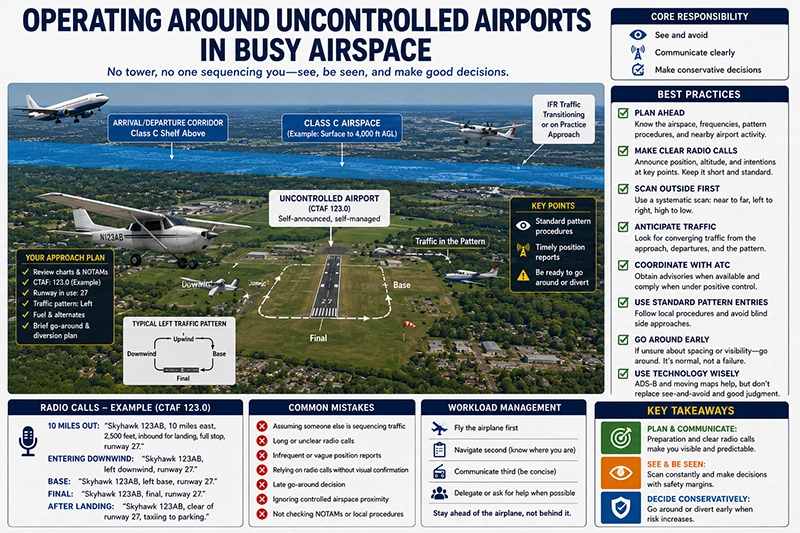
Uncontrolled airports present a distinct operational challenge when they sit inside or adjacent to busy airspace. Pilots operating at these fields must combine disciplined radio technique, precise traffic scanning, strong aeronautical decision-making, and local-area knowledge to maintain safety and efficiency. This guide explains how to operate around uncontrolled airports in busy airspace with a focus on practical flying, training value, and safety-critical decision making.
Whether you are a student pilot practicing pattern work, a private pilot flying cross-country, or an instructor supervising a complex training sortie, understanding the dynamics of uncontrolled airports is essential. The remainder of this article outlines core concepts, real-world implications, common mistakes, a realistic flight scenario, and best practices you can use on your next flight.
Main idea: Operating Uncontrolled Airports in Busy Airspace
At an uncontrolled airport, there is no tower providing sequencing or positive control. Pilots rely on self-announcing procedures, established traffic pattern conventions, and, where available, advisory radio services or flight service. When those airports are located near busy controlled airspace, the interaction between controlled traffic and self-managed traffic increases complexity. Pilots must manage their own separation, communicate clearly on the appropriate frequency, and anticipate interactions with aircraft transiting nearby controlled airspace.
Key practical elements include: accurate position reporting, using published traffic pattern altitudes and directions when available, understanding local noise abatement or runway usage preferences, and coordinating with approach or departure control when entering or leaving controlled airspace. Visual scanning and timely decisions to go around or divert are fundamental layers of safety when reliance on external sequencing is reduced.
Why this matters in real-world aviation
Uncontrolled airports frequently serve flight training, business travel, and recreational flying. In busy regions, those airports can sit under arrival or departure corridors for larger airports, near Class B or C airspace shelves, or within complex terminal areas. That proximity increases the chance of converging traffic flows: short local flights in light singles, turbine and commuter traffic climbing or descending to join controlled routes, and IFR aircraft transitioning VFR for visual approaches.
The operational consequences are straightforward. When pilots assume someone else is sequencing them or that a controller will provide traffic advisories, they may delay critical calls or reduce scan discipline. Instructors and safety officers should emphasize that uncontrolled does not mean unimportant: responsibility for seeing-and-avoiding and making timely decisions remains with the pilot-in-command.
Training implications are significant. Practicing operations at busy uncontrolled fields exposes students to radio discipline, cockpit scanning in high-workload situations, and the judgment needed to accept or decline pattern work. Instructors should stage training scenarios that progressively add complexity: multiple pattern aircraft, an inbound IFR practice approach near a controlled-airspace shelf, crosswinds, and simulated radio failures.
How pilots should understand this topic
Think of an uncontrolled airport in busy airspace as a shared workspace with variable visibility and no manager. Each aircraft entering the workspace must make visible, predictable, and timely decisions. That starts before you arrive: thorough preflight planning, reviewing current charts and NOTAMs, identifying the Common Traffic Advisory Frequency or other advisory frequencies, and deciding on a plan for landing or pattern work depending on traffic density and your level of proficiency.
In-flight, adopt a phased approach: initial arrival preparation, active traffic management while remaining clear in communications, and conservative decisions under uncertainty. Use standard traffic pattern entries, make position reports at key points (such as 10 miles out, entering downwind, base, and final), and make your radio calls concise and consistent. When there is uncertainty about other aircraft intentions, prioritize visual contact, and be prepared to execute a missed approach or go-around without hesitation.
Common mistakes or misunderstandings
Pilots frequently make similar errors at uncontrolled airports in congested regions. Recognizing these common mistakes helps prevent incidents in training and operations:
- Assuming someone else is sequencing traffic. Without a tower, no one is guaranteed to be sequencing you. Expect to manage your own spacing.
- Poor radio discipline. Long, unclear broadcasts or failure to monitor the correct frequency reduces shared situational awareness.
- Inconsistent position reporting. Vague or infrequent calls leave gaps in other pilots' mental picture of traffic.
- Inadequate visual scan. Relying on radio calls alone without clear visual acquisition increases collision risk.
- Late decision to go around or divert. Waiting for the last moment to act erodes safety margins; go-arounds should be normal, not abnormal, responses.
- Underestimating the influence of controlled airspace. Pilots sometimes fail to coordinate with approach or departure when needed, leading to unexpected interactions with controlled traffic.
Training programs should explicitly address each mistake. Simulated high-density operations and instructor-led debriefs build better habits than topic lectures alone.
Practical example: A realistic arrival scenario
Scenario: You are flying a single-engine training flight to an uncontrolled field that sits beneath a Class C shelf adjacent to a busy commercial airport. You have a student onboard working on solo pattern work. Weather is VFR with light winds. Traffic information indicates increased local training activity and periodic IFR arrivals transitioning visually.
Preflight and planning: Before departure, review sectional charts and approach plates to identify the Class C boundary, the airport traffic area, and the recommended traffic pattern. Note the Common Traffic Advisory Frequency and any preferred runways. Brief the student on pattern entry, go-around decision points, and radio calls. Confirm alternates and fuel reserves in case congestion forces a diversion.
Arrival: At 10 miles, announce position and intentions clearly: inbound to the field, altitude, and whether you plan to join the pattern or overfly. If approach control offers a frequency change, accept for advisories if they offer additional traffic information, but remember acceptance does not shift responsibility for separation unless you’re in controlled airspace under positive ATC control.
Pattern entry and sequencing: Use a standard 45-degree entry to the downwind unless local procedures recommend otherwise. Make position reports at downwind, base, and final. Maintain vigilant visual scanning for other pattern traffic and for IFR aircraft that may appear on short final. If another aircraft appears to be well-established on final and you are not sequenced, be prepared to extend downwind, or communicate your intention to avoid conflicts.
Go-around and diversion: If the pattern becomes congested or visual acquisition of traffic is uncertain, execute a go-around early. Brief the missed approach procedure with the student before landing so it becomes a muscle memory response. If fuel or weather constraints exist, use your diversion plan and coordinate with ATC or flight service as needed.
Debrief: After landing, debrief with the student focusing on radio calls, scan technique, spacing decisions, and the timing and execution of the go-around. Discuss how proximity to the Class C shelf influenced decisions and whether accepting advisory service from approach helped the situation.
Best practices for pilots
Adopt the following habits to operate safely and efficiently at uncontrolled airports in busy airspace.
- Plan early and brief thoroughly. Preflight planning should include frequencies, traffic pattern direction, nearby controlled airspace, and diversion options.
- Use standard, predictable procedures. Flying consistent entries, pattern legs, and radio calls reduces ambiguity for other pilots.
- Keep radio calls short, precise, and timely. Announce position, altitude, and intentions at standard reporting points. Use plain language and avoid nonessential chatter.
- Maintain an aggressive visual scan. Use a systematic scanning technique and cross-check between pilot and safety pilot or instructor when possible.
- Respect controlled airspace boundaries. Coordinate with approach or departure when entering or leaving controlled airspace; comply with their instructions when receiving positive control.
- Make conservative go-around decisions. Treat a go-around as a normal outcome when spacing, visibility, or traffic conflicts arise.
- Train for high workload. Practice single-pilot resource management: delegate tasks, prioritize flying the aircraft first, and manage communications and navigation second.
- Use technology judiciously. Traffic advisory tools and ADS-B In improve situational awareness but do not replace visual scanning or disciplined radio procedures.
Procedural guidance for radio communications and pattern etiquette
Effective communications at uncontrolled airports begin with understanding which frequency to use and when to make calls. Pilots should monitor and announce on the Common Traffic Advisory Frequency (CTAF) or Multicom frequency as published. Use concise phraseology to indicate position (for example, "Five miles east, inbound, midfield crosswind to runway 27") and update other pilots as you move through the pattern. When operating in the pattern, make intention calls at entry, downwind, base, and final. If you will extend downwind or make an early turn, announce that change so other pilots can adjust.
If advisory services from approach or a Flight Service Station are available, they can be helpful for traffic advisories and airspace information. However, pilots must avoid assuming that advisory service relieves them from their responsibility to see and avoid and to follow published procedures for entering controlled airspace. Always verify who is providing advisories and whether you remain responsible for your own separation.
Training approaches and instructor considerations
Flight instructors should treat operations at busy uncontrolled airports as a progressive training module. Start with basic pattern work in light-traffic windows and gradually introduce elements of complexity: overlapping traffic, nearby controlled-airspace transitions, unexpected IFR traffic, and simulated avionics failures. Focus training on decision-making, clarity of communications, and scan discipline rather than simply landing performance.
Use scenario-based training that includes preflight planning, executing approach sequences, handling go-arounds, and diverting. Include post-flight debriefs with recorded radio calls and a replay of key decisions. When supervising students, clearly define the instructor’s willingness to intervene on final and make go-around decisions early to model good judgment.
Common misunderstandings about responsibilities and right-of-way
One common misunderstanding is that uncontrolled means the pilot can be less structured; the opposite is true. Without a tower, each pilot’s actions must be predictable to others. Right-of-way principles and see-and-avoid responsibilities are central. Do not rely solely on another pilot’s radio calls; validate visually and maintain margins of safety.
Another misunderstanding is about the role of approach or departure control. When advisory services are accepted, pilots sometimes believe they are being sequenced; advisory information is helpful, but unless receiving explicit air traffic control instructions and operating under positive control, pilots must preserve responsibility for separation and for complying with the rules that apply to their current flight operations status.
Technology and tools: what helps, what can mislead
ADS-B In, traffic display systems, and moving maps add another layer of situational awareness. Use these tools to corroborate visual scans and radio reports, but avoid depending on them exclusively. Be aware of limitations: ADS-B traffic may not display aircraft without ADS-B Out, and screens can create tunnel vision during busy pattern work. Establish a scanning regimen that integrates instrument reference, outside visual scanning, and periodic instrument cross-checks.
When using flight following or a flight service advisories, ensure you maintain your own mental model of traffic and do not shift responsibility to the service provider. Technology should reduce workload, not shift accountability.
Legal and procedural context
Pilots should familiarize themselves with the published procedures and airport-specific information provided on sectional charts, airport/facility directories, and published NOTAMs. These publications describe traffic pattern direction, noise-abatement procedures, and any other operational guidance specific to the field. Local standard practices often evolve based on community concerns and airport layout, so contacting a local flight school or fixed-base operator for the most current guidance is good practice before attempting pattern work under high traffic density.
Because regulations and facility procedures change, verify any procedural or regulatory claims with current official publications before relying on them operationally. Manual review items in the article metadata identify areas that should be checked against current FAA or local guidance.
Frequently Asked Questions
How do I choose whether to accept pattern work or overfly?
Decide based on your currency and proficiency, traffic density, weather, and fuel state. If the pattern is congested and you are not confident in maintaining visual separation, choose to overfly or divert to a less busy field. Communicate your intentions clearly on CTAF so other pilots know you are not joining the pattern.
What should I say on the radio when approaching an uncontrolled airport?
Make concise, timely position reports. Typical useful calls include: initial inbound call at around 10 miles with altitude and intentions; entering the traffic pattern (for example, "entering left downwind"), downwind, base, and final calls. State runway and position relative to the field. Avoid long transmissions; keep calls short and informative.
Can I accept advisories from approach or departure control near a busy airport?
Yes, advisory services can improve your situational awareness. However, accepting advisories does not remove your responsibility for visual separation unless you are explicitly under positive control by ATC. Use advisories as supplemental information and remain prepared to take immediate visual action if a conflict appears.
How should I handle a radio failure while operating at an uncontrolled airport?
If you experience a radio failure, use standard light signals if available, and rely on pattern visual discipline. Squawk 7600 if you have a transponder and follow the lost-communications procedures appropriate to your flight rules and local environment. If needed, land at a less busy airport where you can coordinate on the ground. Always brief and practice these procedures with students before flight.
Is it safe to rely on ADS-B traffic displays in the pattern?
ADS-B In and traffic displays are valuable for situational awareness but have limitations. Do not rely on them as the sole source for traffic detection. Use them to confirm visual sightings and to inform decision-making, while maintaining robust outside scanning and radio discipline.
Common mistakes recap and how to correct them
Correcting common mistakes requires deliberate practice and structured debriefs. Replace assumptions with visible actions: make early, standard radio calls; practice go-arounds so they become routine; use a scan technique that cycles from near to far and back; and rehearse divert decisions during mission planning. Instructors should simulate high-density operations frequently and critique decision timing and communication clarity.
Key Takeaways
- Practical takeaway: Plan and brief your approach to uncontrolled airports before you get close; predictable, standardized actions reduce conflicts.
- Safety takeaway: Maintain disciplined visual scanning and make conservative go-around decisions; do not assume sequencing from others.
- Training/decision-making takeaway: Use progressive, scenario-based training to build radio discipline and split-attention skills for busy, uncontrolled fields.
Operating at uncontrolled airports in busy airspace is a common but nontrivial part of many pilots' flying experience. Success depends on preparation, consistent procedures, clear communications, technology used for cross-checking, and the willingness to divert when risk exceeds acceptable margins. Instructors, safety officers, and pilots who practice these elements systematically will be better prepared to manage the added complexity and maintain safe operations.