
Stall recovery training is fundamental to safe airmanship. Whether you are a student pilot learning basic aerodynamics, a flight instructor preparing the next generation, or an experienced pilot refreshing critical skills, understanding the aerodynamic and human factors behind stalls improves recognition, decision-making, and recovery. This article explains the science that governs stall behavior, describes effective training practices, and highlights operational implications for real-world flying.
You should continue reading if you want clear, practical guidance on how stalls form, why recovery actions work, and how to train or teach stall recognition and recovery in a way that transfers to operational flying. The goal here is to connect aerodynamics to the cockpit — not to replace specific aircraft procedures, but to give pilots the conceptual tools they need to apply aircraft-specific guidance safely and effectively.
What a Stall Really Is: The Aerodynamic Core
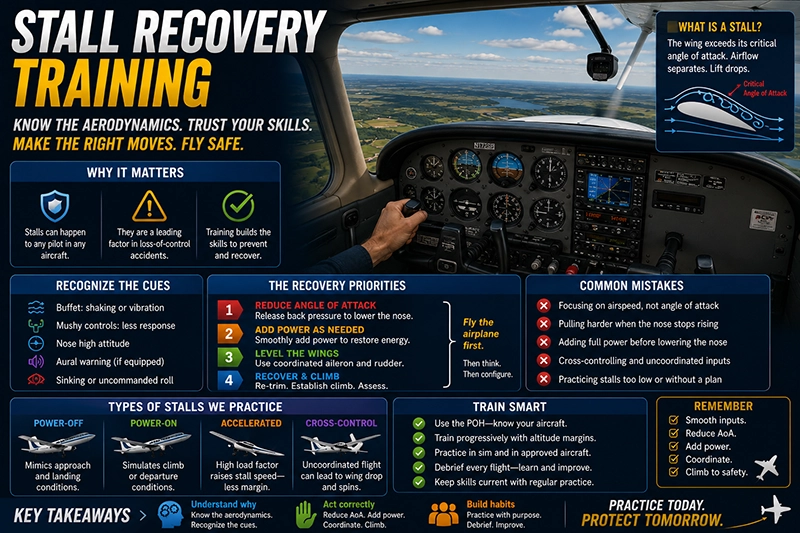
A stall is an aerodynamic condition, not a mechanical failure. It happens when the wing exceeds its critical angle of attack and airflow separates from the upper surface, reducing lift dramatically. Angle of attack is the angle between the wing chord line and the relative wind. When the wing is at or above the critical angle, the lift-producing pressure distribution changes, flow separates, and lift falls off rapidly.
Key points about stalls that matter in training and operations:
- Stalls are primarily about angle of attack, not airspeed. Airspeed is a useful proxy, but the same airspeed can be safe or unsafe depending on configuration, load factor, and gusts.
- Wing configuration affects the stall. Flaps, slats, and other high-lift devices change the critical angle and the wing’s behavior near the stall.
- Load factor changes the effective wing loading and can raise stall speed. A maneuvering or pulling aircraft challenges the wing at a higher angle for the same airspeed, making a stall more likely if not managed.
- Stall behavior varies among aircraft. The same inputs can produce different responses depending on wing planform, washout, and aerodynamic design.
Why This Matters in Real-World Aviation
Understanding stalls matters because many loss-of-control accidents start with a stall or an approach to a stall that the flight crew does not recognize or recover from in time. In everyday operations, stalls can occur during approach and landing, in turns at low speed, during go-arounds, and when pilots push the performance envelope in gusty conditions or at high density altitude.
Training that emphasizes the aerodynamic root causes of stalls helps pilots interpret what the aircraft is telling them. For example, buffet or mushy controls are symptoms of approaching separation. Effective training links those sensory cues to the physical cause and to immediate, appropriate recovery actions. That linkage supports better decision-making under stress and improves the odds that a pilot will apply the right technique promptly.
How Pilots Should Understand Stall Recovery
Recovery is conceptually simple: reduce the angle of attack below the critical value and restore smooth airflow over the wing so lift recovers. In practice, recovery involves a prioritized sequence of actions tailored to the aircraft and the situation. The common high-level priorities are to control the airplane, relieve the stall condition, and then configure and return to desired flight.
Many training syllabi teach a sequence similar to: recognize the stall, release back pressure to reduce angle of attack, add power as appropriate, level the wings, and re-trim to cruise or climb attitude. The exact order, rates of control movement, and the role of power depend on the airplane. For example, adding power before reducing angle of attack can cause a pitch-up moment in some aircraft, which makes recovery harder. That is why pilots must know the performance and handling characteristics of the specific aircraft they are flying and consult the Pilot’s Operating Handbook (POH) for recommended procedures.
Important conceptual elements for pilots:
- Recognize stalls through multiple cues: visual outside references, control feel (mushy flight controls), aerodynamic buffet, and instrument indications where applicable.
- Prioritize angle-of-attack reduction first. Restoring smooth flow is the determinant of lift recovery.
- Use power strategically. Power increases energy and can help accelerate through the stalled regime, but power also introduces pitching moments and yaw tendencies that must be managed.
- Coordinate controls to avoid inadvertent spins. Wings that are unequally loaded or intentionally held in a cross-controlled condition can depart into autorotation.
Training Types and Their Purpose
Stall training typically includes several distinct exercises, each designed to teach different recognition and recovery skills.
Power-off stalls mimic approach and landing conditions and teach the pilot to recognize stall cues during descent and landing configurations. Power-on stalls simulate climb attitudes or departure conditions where pitch and power combine to raise the angle of attack rapidly. Accelerated stalls introduce load factor changes to show how maneuvering can raise stall speed. Cross-control stalls demonstrate how uncoordinated flight promotes wing drop and spin entry.
Each exercise grows a pilot’s internal model of how angle-of-attack, configuration, power, and control inputs interact. Proper sequencing and safe parameters build that model incrementally, beginning with instructor demonstration, then guided practice, and then solo mastery under supervision.
Common Mistakes or Misunderstandings
Training gaps and misunderstandings often create the conditions for ineffective or dangerous recovery attempts. These are common problems instructors and pilots should watch for and correct.
Misplaced emphasis on airspeed. Novice pilots may focus on an airspeed number as the stall threshold. Airspeed indicators are valuable, but they are affected by pitot-static errors, flap changes, and weight. Teaching pilots to correlate stall buffet and control feel with angle of attack is more robust than relying solely on numbers.
Overcontrol and abrupt inputs. In a startled response, pilots may pull back aggressively or make large control inputs that increase angle of attack or load factor. Training must include scenarios that reduce startle and reinforce smooth, deliberate control actions.
Improper power management. Adding full power without first reducing angle of attack can exacerbate a deep stall in some aircraft. Conversely, failing to add power when appropriate prolongs the recovery and reduces the energy available to accelerate out of the stalled regime.
Cross-controlled stalls and coordination errors. A common mistake is allowing one wing to be more stalled than the other by applying opposite rudder during a bank or slip. This can lead to a wing drop and, if uncorrected, to a spin. Emphasize coordinated control inputs during recovery and practice recognizing cross-control buffet and roll tendencies.
Insufficient altitude margin. Practicing full stalls at low altitude removes the room to recover from unexpected developments. Proper training sets conservative minimum altitudes and contingency plans before demonstration and practice. The safe learning environment is as important as the exercise itself.
Practical Example: Teaching a Power-On Stall
Scenario: An instructor wants to teach a student a power-on stall that simulates a departure stall. The flight is conducted in a stable training area with sufficient altitude and a safety pilot or instructor in control for each stage.
Pre-brief: The instructor explains learning objectives clearly. They describe the cues the student should expect: pitch attitude, power setting, control feel, visual references, and the stall buffet. They define the cross-check: at the first sign of full stall buffet or abrupt wing drop, the student will reduce the angle of attack and allow the instructor to resume control if recovery is not immediate. Minimum altitude is set to a conservative value well above maneuvers that would compromise safety.
Demonstration: The instructor demonstrates a power-on stall, narrating actions: aggressive but smooth pitch to a high nose attitude with moderate power, recognition of buffet and impending stall, immediate release of back pressure to reduce angle of attack, coordinated rudder to maintain heading, and careful re-trim for climb as lift returns.
Student practice: The student repeats the maneuver under supervision, focusing on small, prompt inputs rather than dramatic movements. The instructor stresses that the priority is reducing angle of attack, not chasing airspeed. After successful recoveries, variations are introduced: different flap settings, different power settings, and an accelerated entry to teach load-factor effects.
Debrief: The instructor reviews the student’s recognition times, control smoothness, and how effectively power was used. The review focuses on linking sensory cues to the aerodynamic state and reinforcing the mental model that resisting a stall begins with angle-of-attack awareness.
Best Practices for Pilots
Use the aircraft POH. Always follow the manufacturer’s recommended procedures for recovery. POHs and type-specific guidance account for unique flight characteristics and are authoritative for a given aircraft.
Emphasize angle-of-attack awareness. Teach students to recognize pitch and buffet cues, and consider using angle-of-attack indicators where available. Instrumentation that provides direct AOA information improves situational awareness, especially in high workload conditions.
Progress gradually. Start with clean, simple demonstrations, then practice in benign conditions, increasing complexity only as the pilot demonstrates safe proficiency. Include cross-controlled and accelerated stalls only after basic stall recognition and recovery are reliable.
Prioritize safe margins. Set conservative minimum altitudes for demonstrations and practice, and ensure a safety pilot or instructor is prepared to intervene. Avoid practicing full stalls near the ground or during critical phases of flight unless the exercise is essential and the pilot is highly proficient.
Train for startle and surprise. Include scenarios where stall cues are subtle or where the pilot must transition from a high workload task to recognizing a stall. Developing cognitive flexibility and a calm, practiced motor response is as important as the physical control inputs.
Use simulators appropriately. Advanced simulators and flight training devices can replicate stall cues and spin entry without the same risk as live flight. They are valuable for procedural practice and for introducing unusual attitudes safely.
Instructor Considerations
Instructors must balance demonstration and student practice. Demonstrations show the full spectrum of stall behavior and recovery, but students need the hands-on experience to build muscle memory. Instructors should model precise control inputs and discuss why each action is taken.
Teaching moments include discussing the aerodynamic reasons for each recovery step, explaining how configuration and power affect the critical angle, and rehearsing decision rules such as when to abort a maneuver or transition to an emergency landing. Encourage students to verbalize their recognition cues during practice; verbalization strengthens situational awareness and helps instructors correct misconceptions in real time.
Common Operational Scenarios Where Stalls Occur
Approach and landing: Low-speed approach phases, especially with gusts or wind shear, can put the wing close to its critical angle if pitch and power are mismanaged.
Go-arounds: Poorly managed pitch-up during a climb-out, or delayed power application, can result in a high angle of attack and an inadvertent stall.
Maneuvering at low altitude: Steep turns or aggressive pull-ups during aerial maneuvering raise load factor and reduce the margin above stall.
Instrument conditions: Spatial disorientation, task saturation, or misinterpretation of instruments can allow the airplane to reach a high angle of attack without the pilot realizing it.
Human Factors and Cognitive Elements
Stall recognition is subject to human factors: startle, fixation, and confirmation bias. Pilots under stress may fail to recognize changing aerodynamic cues, or may focus on troubleshooting an unrelated problem while the angle of attack increases. Training should intentionally address cognitive workload, decision heuristics, and the importance of simple priority-based responses under pressure.
Examples of useful human-factors training: practicing single-task focus on the primary flying task during emergencies, simulating surprise stalls in a controlled environment so pilots learn to manage their initial reaction, and training recovery priorities until they become automatic under stress.
Common Misunderstandings That Training Should Correct
"Stalls always happen at the published stall speed." Stall speeds are conditional. The published stall speed is for a specific configuration and load factor. Maneuvering, flap settings, heavy weights, or icing change the conditions and the stall margin.
"Adding full power always helps immediately." Power can help accelerate recovery, but it can also induce a pitch-up or yaw that complicates control if angle of attack remains high. Teach pilots to sequence controls according to the aircraft’s handling characteristics.
"Only novices stall the airplane." Experienced pilots can also encounter stalls, particularly when distracted or when operating in degraded conditions. Professional training and recurrent practice maintain recognition skills.
Regulatory and Training Context
Regulatory standards and training syllabi differ by certificate level and aircraft category. Flight instructors and pilots should follow applicable training requirements and best-practice guidance from recognized authorities. The manufacturer’s POH remains the final reference for aircraft-specific recovery procedures and limitations.
When integrating stall training into a program, ensure alignment with your training organization’s syllabus and any applicable regulatory guidance. Document student performance and ensure recurrent practice for higher-risk operations.
Frequently Asked Questions
What immediately causes a stall?
A stall is caused by the wing exceeding its critical angle of attack, which disrupts smooth airflow and causes lift to fall off. This can occur during high-pitch attitudes, abrupt maneuvers, or when flying at slow airspeeds with heavy loading or in turbulent air.
Is stall recovery the same for all airplanes?
The underlying principle—reduce angle of attack to restore smooth airflow—applies broadly, but the specific control sequence, power application, and recommended attitudes vary by aircraft. Always follow the POH or approved procedures for the airplane you are flying.
Can I recover from a stall close to the ground?
Low-altitude recoveries are risky because they offer little margin for error. Recovery is possible, but training and operations should prioritize preventing stalls near the ground by managing energy, configuration, and conservative go-around decisions rather than relying on last-moment recovery.
Should students practice full stalls and spins?
Instructor-led practice of full stalls is essential for developing recognition and recovery skills. Spin training is typically more advanced and may be restricted or require specific endorsements or aircraft approval. Follow training organization policies and aircraft limitations before including spins in a syllabus.
How can angle-of-attack awareness be taught without expensive equipment?
Use consistent pitch and power references, practice recognizing buffet and control feel, and incorporate simulated AoA cues in the briefing. Flight simulators and verbalized cues help students internalize what an approaching stall feels like. If AoA indicators are available, use them as a training aid to correlate instrument readings with tactile and visual cues.
Key Takeaways
- Practical takeaway: Prioritize reducing angle of attack first, then manage power and configuration to regain safe flight.
- Safety takeaway: Always practice stalls with conservative altitude margins and a qualified instructor; do not practice full stalls near the ground.
- Training and decision-making takeaway: Teach recognition using multiple cues and develop automatic, prioritized responses that function under startle and workload.
Stall recovery training is an investment in airmanship: it reduces the risk of loss-of-control events and builds a pilot’s confidence in handling unexpected situations. Effective training combines solid aerodynamic explanation, deliberate practice across a range of conditions, and a focus on human factors so pilots can apply clear priorities when it matters most.