
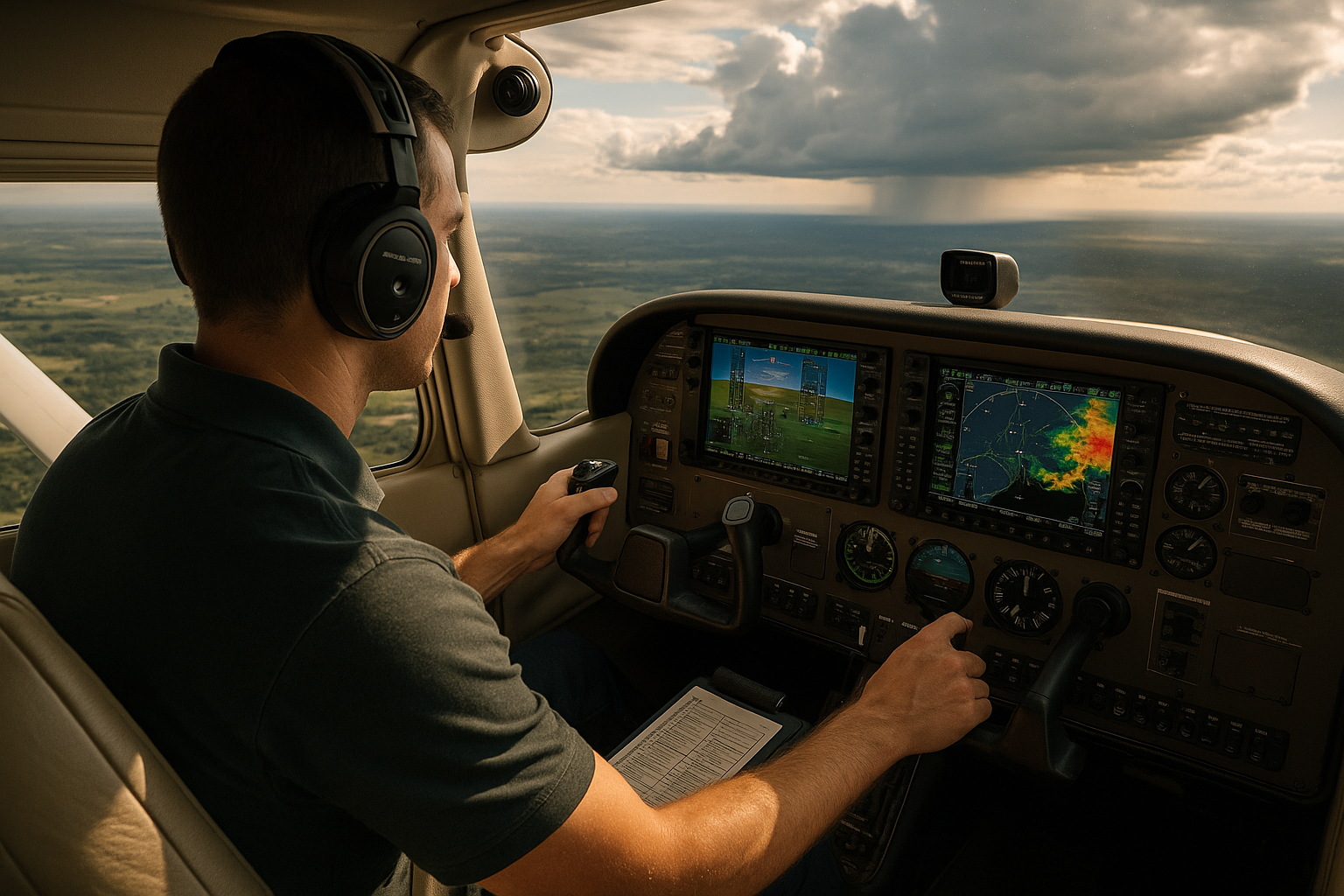
Single-pilot resource management is one of the most practical safety skills a general aviation pilot can develop. In a crewed cockpit, tasks can be divided, decisions can be challenged, and one pilot can monitor while another flies. In a single-pilot aircraft, the same responsibilities still exist, but they are concentrated in one person. The pilot must aviate, navigate, communicate, manage systems, evaluate weather, monitor fuel, interpret traffic information, brief approaches, and make timely decisions without letting workload outpace awareness.
For student pilots, private pilots, instrument pilots, flight instructors, and aircraft owners, single-pilot resource management is not an abstract classroom idea. It is the daily discipline of using every available resource before and during flight. Those resources include training, checklists, avionics, autopilot, air traffic control, weather information, passenger assistance when appropriate, personal minimums, and the pilot’s own ability to recognize when a situation is becoming too complex. The goal is not to make every flight effortless. The goal is to build a cockpit management system that helps the pilot stay ahead of the aircraft and make better decisions when conditions change.
What Single-Pilot Resource Management Means
Single-pilot resource management, often shortened to SRM, is the effective use of all available resources by a pilot operating without another required flight crewmember. It combines aeronautical decision-making, risk management, task management, situational awareness, automation management, and communication. In plain language, SRM is how a pilot manages the entire flight, not just the flight controls.
A pilot with strong stick-and-rudder skills can still become overloaded if the flight is poorly organized. A pilot with advanced avionics can still make a poor decision if the technology is used without a clear plan. SRM brings those pieces together. It asks practical questions: What are the risks before departure? What will I do if weather is worse than forecast? Which tasks can be completed on the ground instead of in the air? What information should I monitor continuously, and what can wait? When should I ask for help? When should I divert, delay, or cancel?
Good SRM is not a rigid script. It is a repeatable way of thinking. A pilot may use structured risk management models, personal minimums, flow patterns, checklists, and standard callouts, but the deeper skill is judgment. The pilot learns to identify threats early, make small corrections before problems compound, and preserve enough mental bandwidth to handle the unexpected.
Why SRM Matters in Real-World General Aviation
General aviation flying is diverse. A pilot may fly a basic trainer on a local pattern flight in the morning and a technically advanced aircraft on a cross-country in the afternoon. Some flights are conducted in clear weather at familiar airports. Others involve night operations, changing weather, busy airspace, mountainous terrain, short runways, passengers, instrument procedures, or complex avionics. The airplane may be certified, maintained, and operated within its limitations, yet the pilot can still face a high workload environment.
Single-pilot operations are especially sensitive to task saturation. Task saturation occurs when the number or complexity of required tasks exceeds the pilot’s ability to process them effectively. It may show up as missed radio calls, altitude deviations, late checklist use, fixation on a moving map, uncertainty about position, rushed approach setup, or a sense that the aircraft is getting ahead of the pilot. The danger is that a pilot may not immediately recognize overload while it is happening.
SRM matters because it creates margins. A thoughtful preflight plan reduces the number of surprises. A well-briefed route reduces navigation uncertainty. Conservative fuel planning reduces pressure. Early weather decisions reduce the temptation to continue into deteriorating conditions. Proper use of autopilot can reduce workload, while poor use of automation can increase it. Clear communication with air traffic control can simplify complex situations, but only if the pilot is willing to ask for clarification, delay vectors, or assistance.
In training, SRM helps students connect individual skills into a complete flight operation. Learning to hold altitude, track a course, and talk on the radio are important, but they are not enough by themselves. The pilot must also decide when a task should be delayed, when a checklist should be used, when conditions no longer match the plan, and when a safe outcome requires changing the plan. For flight instructors, SRM is a valuable teaching lens because it reveals how a learner thinks, prioritizes, and manages pressure.
The Core Elements of Single-Pilot Resource Management
SRM can be understood through several overlapping elements. Each element supports the others. When one weakens, the pilot’s margin may narrow.
Aeronautical Decision-Making
Aeronautical decision-making is the process of selecting a safe and practical course of action in a flying environment. It includes recognizing a problem, evaluating options, considering consequences, and acting while there is still time. In single-pilot flying, decision-making must be intentional because there may be no second pilot to question assumptions.
Good decision-making often begins before engine start. A pilot who identifies a weather alternate, sets a fuel decision point, reviews runway performance, and defines personal limits has already made the flight easier to manage. The decision is not postponed until the aircraft is close to fuel minimums, boxed in by weather, or descending toward an unstable approach.
Risk Management
Risk management is the process of identifying hazards, assessing their seriousness, and choosing ways to reduce exposure. Common training models encourage pilots to consider the pilot, aircraft, environment, and external pressures. The value of these models is not in memorizing acronyms for their own sake. The value is in forcing the pilot to look beyond the airplane and ask whether the complete operating picture is acceptable.
For example, a flight may look simple when considered only by distance. But if the pilot is fatigued, the destination is unfamiliar, the forecast includes marginal ceilings, the aircraft has recently returned from maintenance, and passengers are expecting an on-time arrival, the risk picture changes. SRM helps the pilot identify that combination early enough to adjust the plan.
Task Management
Task management is the ability to prioritize, sequence, delegate when possible, and defer nonessential tasks. The familiar aviation priority of flying the aircraft first remains central. In practice, that means maintaining aircraft control and a safe flight path before handling less urgent items.
Task management also means moving workload to lower-pressure phases of flight. Programming avionics, organizing charts, reviewing taxi routes, setting frequencies, briefing departure procedures, and discussing passenger expectations are best done on the ground whenever practical. In the air, the pilot should avoid turning routine tasks into urgent tasks through delay or disorganization.
Situational Awareness
Situational awareness is the pilot’s understanding of what is happening now, what it means, and what is likely to happen next. It includes aircraft attitude, altitude, airspeed, position, weather, terrain, traffic, fuel state, system status, airspace, and clearance requirements. A pilot can be busy and still lose situational awareness if attention becomes too narrow.
Single-pilot SRM encourages a broad scan. The pilot should periodically step back mentally and ask: Where am I? What is the airplane doing? What is the next constraint? What has changed? What is my next decision point? These questions help interrupt fixation and bring the pilot back to the big picture.
Automation Management
Modern general aviation aircraft may include GPS navigators, moving maps, flight directors, autopilots, traffic displays, weather datalink, engine monitoring, and electronic checklists. These tools can significantly support SRM when the pilot understands their operation and limitations. They can also create new workload if the pilot is uncertain about modes, button sequences, database currency, or what the system is actually commanding.
Automation management means using technology deliberately. The pilot should know when to use it, when to simplify it, and when to disconnect it. An autopilot can help manage workload in instrument conditions or on a long cross-country, but it does not relieve the pilot of monitoring aircraft performance, navigation, and system behavior. A moving map can improve position awareness, but it should not replace basic navigation discipline or clearance compliance.
Communication and Use of External Resources
A single pilot is not truly alone. Air traffic control, flight service resources, airport personnel, maintenance technicians, dispatch or flight school staff, passengers, and other pilots may all be resources. The key is to use them appropriately and early.
Asking ATC for a repeat, a vector, a frequency confirmation, a delay, or assistance is often a sign of good cockpit management, not weakness. If the workload is high, a simple request such as “unable at this time,” “stand by,” or “request vectors while I troubleshoot” can buy valuable time. On the ground, a call to maintenance or a conversation with an instructor may prevent a questionable launch. In the cabin, passengers can be briefed to help look for traffic, remain quiet during busy phases, or assist with simple noncritical tasks if the pilot has trained and briefed them appropriately.
How Pilots Should Understand SRM in Practical Terms
It is helpful to think of SRM as a continuous cycle rather than a one-time preflight item. Before the flight, the pilot gathers information, identifies threats, and creates a plan. During the flight, the pilot monitors whether reality still matches that plan. If it does not, the pilot updates the plan early. After the flight, the pilot reviews what worked, what felt rushed, and what should be improved next time.
The best single-pilot cockpit is organized before it becomes busy. Charts and devices are secured. Frequencies are ready. The taxi route is understood. The departure briefing is complete. The pilot knows where the first few tasks will occur. In cruise, the pilot uses the lower workload period to prepare for arrival, check fuel, review weather, and brief expected procedures. During descent and approach, the cockpit becomes quieter and more focused.
SRM also requires honest self-assessment. A pilot may be legal to fly and still not be well positioned for a particular operation. Fatigue, stress, illness, medication, lack of recent experience, and distraction can reduce performance. So can overconfidence. The pilot who says “I can probably make it work” should pause and ask what specific factors support that conclusion. If the answer is mostly hope, schedule pressure, or pride, SRM is already sending a warning.
Personal minimums are useful because they turn vague comfort levels into preplanned decision boundaries. A pilot might establish minimum weather conditions, crosswind components, fuel reserves, runway lengths, night limitations, or recency requirements that are more conservative than regulatory or aircraft limits. These are not universal numbers. They should reflect the pilot’s training, proficiency, aircraft, environment, and instructor guidance. As proficiency improves, personal minimums can be reviewed thoughtfully, not stretched impulsively during a demanding flight.
Preflight SRM: Building the Flight Before Takeoff
Many single-pilot problems begin before departure. The cockpit may become overloaded in flight because the pilot launched with unresolved questions. A strong SRM process treats preflight planning as the first major safety barrier.
Weather planning should go beyond checking whether conditions are above minimums. The pilot should understand trends, ceilings, visibility, winds, convective potential, freezing concerns when relevant, turbulence, alternate options, and the difference between forecast and observed conditions. For a VFR pilot, marginal visibility or lowering ceilings may require an earlier diversion than expected. For an IFR pilot, low ceilings, strong winds, icing potential, or convective activity can greatly increase workload and reduce options.
Aircraft planning includes performance, fuel, weight and balance, equipment status, maintenance discrepancies, and required documents or inspections appropriate to the operation. The pilot should avoid treating the airplane as a generic aircraft. A heavily loaded airplane on a hot day at a short field is not the same operational problem as a lightly loaded airplane on a cool morning at a long runway. If performance calculations, aircraft limitations, or equipment requirements are uncertain, the pilot should resolve them before flight.
Route planning should include terrain, airspace, communication coverage, navigation alternatives, suitable airports, and points where decisions will be made. A good route is not only a magenta line. It is a sequence of manageable segments with options. If the weather deteriorates at the halfway point, where will the pilot go? If the destination runway closes, what is the alternate plan? If the GPS fails, what navigation method remains? These questions do not need to create fear. They create readiness.
Passenger management is also part of SRM. Passengers may unintentionally add pressure through schedules, questions, discomfort, or expectations. A pilot can reduce that pressure by briefing the flight honestly. A good passenger briefing explains seat belts, doors, emergency procedures, sterile cockpit expectations during taxi, takeoff, approach, and landing, and the possibility of delay or diversion. When passengers understand that changing the plan is normal aviation decision-making, they are less likely to become an external pressure source.
In-Flight SRM: Staying Ahead of the Aircraft
Once airborne, SRM becomes active monitoring and timely adjustment. The pilot compares planned performance to actual performance. Are groundspeeds as expected? Is fuel burn reasonable? Is weather improving, stable, or deteriorating? Is the workload acceptable? Is the aircraft behaving normally? Are radio communications and navigation proceeding smoothly?
One of the most useful habits is to create decision gates. A decision gate is a point in time, distance, fuel state, weather condition, or aircraft status that triggers a reassessment. For example, a pilot might decide before departure that if ceilings are below a certain comfort level by a specific checkpoint, the flight will divert. An instrument pilot might decide that if not stabilized by a predetermined altitude on approach, a go-around will be flown. A pilot crossing remote terrain might set fuel and weather checkpoints at specific airports. These gates reduce the temptation to negotiate with the situation after pressure builds.
Another important in-flight habit is workload shedding. When saturated, the pilot should simplify. That may mean leveling off, slowing down if appropriate, asking ATC for delay vectors, engaging a properly understood autopilot, discontinuing a nonessential task, or going around. A pilot who is behind the aircraft often needs time more than information. Creating that time is a core SRM skill.
Radio communication should support the flight, not dominate it. If a clearance or instruction is unclear, ask. If a frequency is busy and the task is not urgent, wait. If a pilot cannot comply safely, the correct response is to communicate that inability. Professional communication is concise, timely, and honest. It helps other participants in the system understand what the aircraft can safely do.
Common Mistakes and Misunderstandings
A common misunderstanding is that SRM is mainly for pilots flying complex aircraft with glass panels. In reality, single-pilot resource management applies just as much in a two-seat trainer with basic instruments. A pilot flying a simple aircraft still manages weather, fuel, navigation, traffic, communications, distractions, and personal readiness. Advanced avionics change the tools, not the need for judgment.
Another mistake is treating checklists as a substitute for thinking. Checklists are essential cockpit tools, but they work best when used within a disciplined flow and an accurate understanding of the aircraft. A pilot can complete a checklist mechanically and still miss the larger issue, such as deteriorating weather, an unstable approach, or increasing fatigue. Checklists help verify configuration and critical actions. SRM helps the pilot decide what the flight needs next.
Overreliance on automation is a frequent training concern. A pilot may become highly comfortable programming a navigator while becoming less comfortable hand-flying, estimating position, or recognizing mode confusion. The opposite error also occurs. Some pilots underuse automation because they distrust it or never trained deeply enough to operate it confidently. Balanced SRM means maintaining manual flying competence while using automation as an aid when it improves safety and workload management.
Press-on thinking is another serious risk. A pilot may continue because the destination is close, passengers are waiting, a rental reservation is ending, or the schedule seems important. External pressure can quietly reshape decision-making. The pilot may begin accepting conditions that would have seemed unacceptable during calm preflight planning. Strong SRM recognizes that pressure and brings the decision back to safety, options, and margins.
A subtle mistake is failing to brief oneself. Crew briefings are common in multi-pilot operations, but single pilots also benefit from spoken or silent self-briefings. A departure briefing, approach briefing, missed approach review, terrain review, or taxi briefing organizes the pilot’s thinking before workload increases. The act of briefing helps reveal missing information. If a pilot cannot explain the next phase clearly, more preparation may be needed.
Finally, pilots sometimes confuse legal minimums with good operating decisions. Regulations, aircraft limitations, and published procedures establish important boundaries, but they do not answer every judgment question. A flight can be legally permissible and still be unwise for a particular pilot, aircraft, weather condition, or operational context. SRM fills that gap by encouraging conservative, situation-specific judgment.
Practical Example: A Single-Pilot Cross-Country That Changes
Consider a private pilot flying a normally aspirated single-engine airplane on a daytime cross-country to an unfamiliar airport. The forecast calls for VFR conditions, but a weak frontal boundary is expected to bring lower ceilings later in the afternoon. The pilot is current, the aircraft is familiar, and the passengers are friends attending an evening event. On paper, the flight looks reasonable.
Before departure, the pilot applies SRM. The route is reviewed for terrain, airspace, and suitable diversion airports. Fuel planning includes more than the minimum required reserve, and the pilot selects a midpoint airport as a weather decision gate. The pilot briefs passengers that the trip may divert or return if weather does not match expectations. Frequencies and taxi diagrams are prepared. The destination pattern entry, runway options, and nearby alternates are reviewed before engine start.
During cruise, the pilot notices that visibility ahead is lower than expected and the ceiling appears to be gradually decreasing. The aircraft is still in VFR conditions, but the trend does not match the optimistic part of the forecast. Instead of continuing toward the destination and hoping the conditions improve, the pilot checks updated weather information, compares the current position to the preselected decision gate, and contacts ATC for assistance with current conditions along the route. The passengers are told calmly that the pilot is evaluating weather and may change the plan.
As the aircraft approaches the midpoint, the pilot decides that continuing would leave fewer options. The pilot diverts to the selected airport, lands uneventfully, and reassesses on the ground. The event is missed, but the flight remains controlled, deliberate, and safe. Nothing dramatic happened because SRM worked early. The pilot did not wait for a crisis to become obvious. The decision gate, passenger briefing, fuel margin, alternate planning, and willingness to use outside resources all combined to preserve safety.
This example is intentionally ordinary. Most good SRM does not look heroic. It looks like preparation, early recognition, and calm adjustment. The best outcome is often the flight that never becomes an emergency because the pilot made a conservative decision while options were still available.
Best Practices for General Aviation Pilots
Effective SRM develops through repetition. It is not enough to understand the concept during ground training. Pilots should practice it on routine flights so it becomes natural when workload rises.
One best practice is to conduct a short risk review before every flight, even local flights. The review does not need to be lengthy, but it should be honest. Consider pilot condition, aircraft status, weather, route, airport environment, and external pressures. Ask what is different today. A familiar airport with unusual winds, a familiar airplane after maintenance, or a familiar route at night may not be as routine as it first appears.
Another best practice is to brief each major phase of flight. Before takeoff, know the departure path, initial altitude, emergency options, and first navigation task. Before descent, review weather, runway, traffic pattern or instrument procedure, terrain, frequencies, and go-around expectations. Before taxi at an unfamiliar airport, review the taxi route and hotspots if available. Briefings should be short enough to use consistently but specific enough to be useful.
Pilots should also develop automation discipline. Learn the avionics on the ground, not during a busy arrival. Practice common tasks such as direct-to navigation, flight plan changes, approach loading, autopilot mode selection, altitude preselect use, and reversion to basic navigation. Know how to simplify. If the automation becomes confusing, maintain aircraft control, use a known safe mode or disconnect when appropriate, and return to basic flying.
Personal minimums should be written, reviewed, and updated with training. They are especially valuable for weather, crosswind, night operations, instrument approaches, fuel, and unfamiliar airports. A pilot should avoid changing personal minimums in flight to satisfy a schedule. If they are adjusted, it should be done after training, reflection, and ideally instructor input.
Use checklists intentionally. A flow can help configure the aircraft efficiently, but the checklist should verify critical items. In abnormal situations, resist the urge to rush. Maintain control, confirm the problem, use the appropriate checklist, and consider whether landing at the nearest suitable airport is the safest option. A single pilot should avoid troubleshooting so deeply that aircraft control or situational awareness suffers.
Finally, debrief every flight. Ask what created the most workload, what could have been prepared earlier, what information was missing, and whether any decision was influenced by pressure. A short self-debrief turns routine flying into continuing education. For instructors, this is also an opportunity to ask scenario-based questions and help learners verbalize their decision process.
How Flight Instructors Can Teach SRM
Flight instructors play a central role in making SRM practical rather than theoretical. Students often learn what instructors emphasize. If the lesson focuses only on maneuvers, the learner may view risk management as a paperwork exercise. If the instructor weaves SRM into every flight, the learner begins to see decision-making as part of airmanship.
Instructors can teach SRM by asking good questions. Instead of simply telling the student what to do, ask: What is your plan if the ceiling lowers? What would make you divert? Which task is most important right now? What is the autopilot doing? What is your next frequency? Are we ahead of the airplane or catching up? These questions help the learner build a mental model.
Scenario-based training is especially useful. A lesson might include a simulated passenger pressure scenario, a reroute, a runway change, an unexpected hold, a radio distraction, or a weather decision. The point is not to overwhelm the student. The point is to teach prioritization, communication, and conservative decision-making in a controlled training environment.
Instructors should also model humility. If an instructor openly delays a flight for weather, asks maintenance about a discrepancy, briefs a go-around, or admits that a plan should be changed, the student sees professional behavior in action. SRM is learned partly through observation. The instructor’s cockpit habits become the student’s template.
SRM for Technically Advanced Aircraft
Technically advanced aircraft can improve information access and reduce workload, but only when pilots are trained and disciplined. Large displays, integrated avionics, and autopilot systems can support navigation, traffic awareness, weather awareness, and aircraft control. They can also tempt pilots to spend too much time looking inside the cockpit.
A good SRM approach in these aircraft includes clear mode awareness. The pilot should know which lateral and vertical modes are active, what the system will do next, and how to intervene. If the aircraft does not respond as expected, the pilot should not continue pressing buttons while the flight path deteriorates. The priority remains aircraft control and a safe path.
Database and system status also matter. A pilot should verify that required navigation data and equipment status are appropriate for the intended operation. If a system is inoperative, the pilot should understand the operational consequence before departure. A bright display does not guarantee that the information is current, complete, or suitable for the task at hand.
Technically advanced aircraft also demand disciplined attention management. Weather overlays, traffic symbols, engine pages, terrain views, and flight plan pages are useful, but they can create fixation. The pilot should maintain an outside scan when operating visually and a disciplined instrument scan when operating by reference to instruments. Technology should widen awareness, not narrow it.
SRM for Basic Training Aircraft
Basic training aircraft are excellent SRM classrooms because they reveal the fundamentals. Without extensive automation, the student must learn to plan ahead, organize cockpit materials, manage radio work, navigate, and maintain aircraft control. These skills remain valuable when the pilot later transitions to more advanced aircraft.
In a training aircraft, SRM may be as simple as setting up the cockpit before taxi, verbalizing the takeoff briefing, identifying emergency landing areas after departure, planning pattern spacing, and recognizing when a maneuver setup is becoming rushed. A student who learns to say “let’s go around,” “I need a moment,” or “I am not comfortable with this weather” is learning the language of safe single-pilot operations.
Instructors should avoid rescuing every situation too early. Appropriate supervision is essential, but students need opportunities to recognize increasing workload and choose corrective action. A well-designed lesson allows the learner to experience manageable task saturation, then debrief how to prevent it. This builds confidence without normalizing unsafe margins.
Frequently Asked Questions
Is single-pilot resource management only for instrument pilots?
No. Instrument flying often increases the need for disciplined SRM because workload can be high, but VFR pilots need it as well. Weather judgment, fuel planning, traffic awareness, passenger management, navigation, and diversion decisions are part of VFR flying. A local VFR flight can still become demanding if winds, traffic, airspace, or aircraft issues change the plan.
How is SRM different from basic aeronautical decision-making?
Aeronautical decision-making is a major part of SRM, but SRM is broader. It includes decision-making plus task management, automation use, situational awareness, communication, workload management, and the use of all available resources. ADM helps the pilot choose wisely. SRM helps the pilot manage the whole operating environment so wise choices are easier to make.
Can passengers be considered a resource?
Sometimes, but only within appropriate limits. Passengers can help by remaining quiet during busy phases, looking for traffic when briefed, reading a simple item such as a checklist title if trained to do so, or helping locate an airport visually. They should not be given safety-critical duties that require pilot training. The most important passenger resource is often reducing distraction and pressure through a clear preflight briefing.
What should a pilot do when workload becomes too high?
The first priority is to maintain aircraft control and a safe flight path. Then simplify. Level off if appropriate, slow the pace when safe, ask ATC for help or delay vectors, use automation if it is understood and appropriate, postpone nonessential tasks, or go around. Workload management is not about doing everything faster. It is about doing the most important things first and creating time to think.
Does using an autopilot mean the pilot is practicing good SRM?
Not automatically. Autopilot can be an excellent resource, but only if the pilot understands its modes, monitors its performance, and remains ready to take over. Good SRM may include using the autopilot to reduce workload, but it also includes knowing when to simplify, disconnect, or hand-fly.
How can a pilot improve SRM between formal training events?
Use every flight as practice. Conduct a short risk review, brief each phase, set decision gates, monitor workload, and debrief afterward. Chair-flying, avionics practice on the ground, scenario discussions with instructors, and reviewing personal minimums are also useful ways to strengthen SRM without waiting for a checkride or recurrent training event.
Key Takeaways
- Single-pilot resource management is the practical discipline of using planning, cockpit organization, automation, communication, and judgment to stay ahead of the aircraft.
- The safest SRM decisions are usually made early, before weather, fuel, workload, or external pressure reduces the pilot’s options.
- Strong training should treat SRM as a normal part of every flight, not as a separate classroom topic reserved for complex scenarios.