
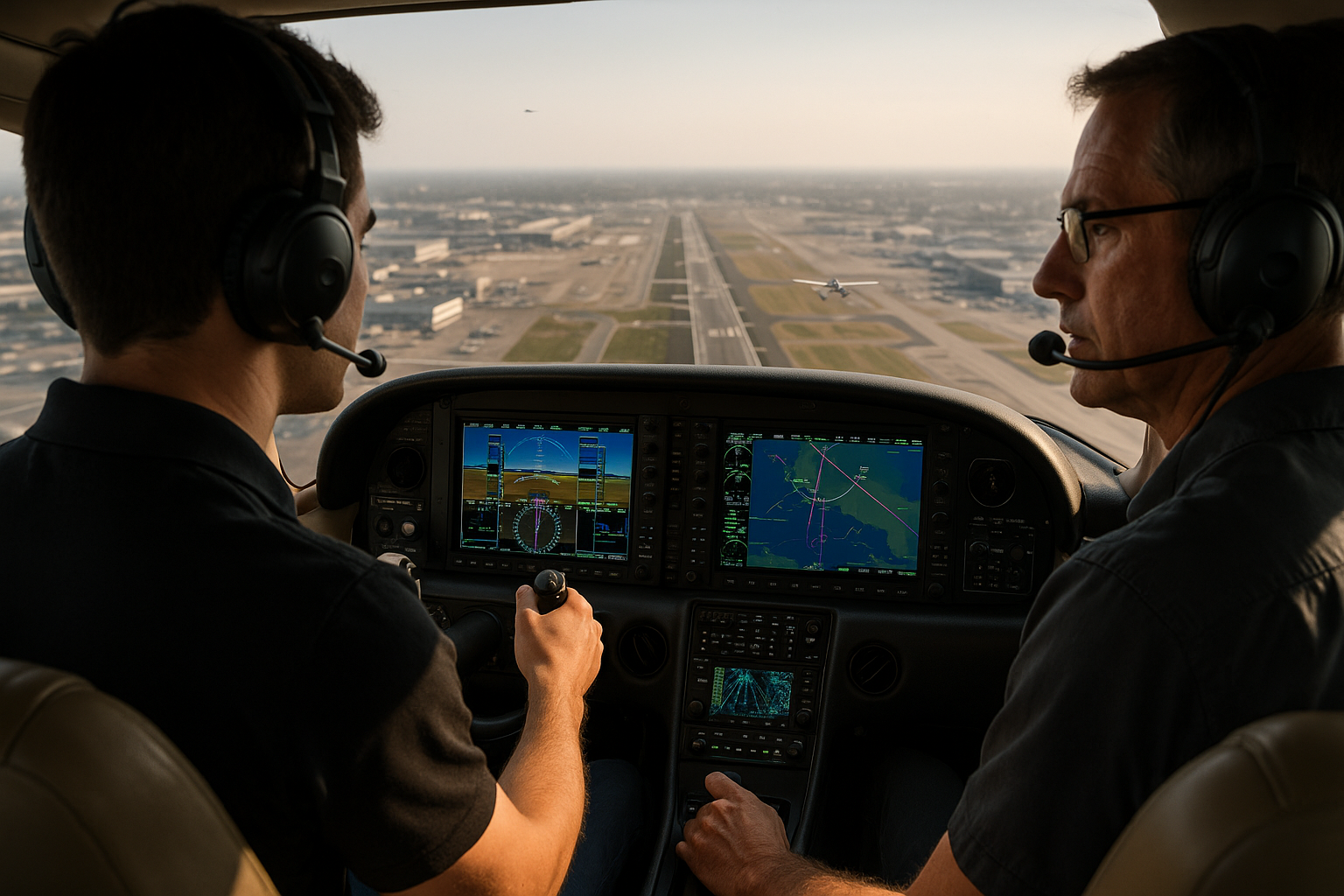
Scenario-based training is a practical approach that teaches pilots how to apply skills, judgment, and procedures in realistic operational contexts. For operations in busy airspace, scenario-based training helps pilots prioritize tasks, manage communications, and make effective decisions under traffic, weather, and air traffic control complexity. Whether you are a student pilot preparing to enter controlled airspace, a certificated pilot brushing up on procedural flying, or an instructor building lesson plans, mastering scenario-based training in busy airspace delivers tangible improvements in safety and airmanship.
This article explains how to design and fly scenarios that mimic the tempo and demands of congested airspace. You will find practical guidance on framing learning objectives, coaching decision-making, integrating ATC communications, managing cockpit workload, and assessing performance. The goal is not to provide rote checklists but to help pilots internalize patterns of thought and behavior that translate to safer, more competent flying when the radio traffic and traffic picture are dense.
What scenario-based training in busy airspace really means
Scenario-based training centers instruction around realistic flights instead of isolated maneuvers. In busy airspace, realistic means traffic calls, overlapping clearances, altitude/heading changes, frequency congestion, and the need to scan for conflicting traffic visually and on traffic systems. Training events are built to require pilots to integrate multiple skills simultaneously: flying precise headings and altitudes, communicating succinctly with ATC, maintaining visual lookout, configuring the aircraft for expected phases of flight, and making timely decisions when situations change.
At its core, scenario-based training teaches pattern recognition and decision frameworks. Instead of only practicing individual tasks, pilots learn to sequence tasks, prioritize threats, and adapt strategies when the environment evolves. For example, a student pilot might practice entering class delta or class bravo airspace with simulated inbound traffic, ATC frequency congestion, and a diversion request. The scenario forces the student to manage approach briefings, checklists, and clearances while maintaining good scanning and stable flight control.
Why this matters in real-world aviation
Busy airspace raises operational demands that increase the need for sound task management and judgment. Pilots operating near major airports or along congested corridors face compressed decision windows, frequent communication exchanges, and high expectations from air traffic control. Without practiced strategies for handling this complexity, even technically proficient pilots can become overloaded, miss clearances, or freeze when conflicting priorities arise.
Scenario-based training improves real-world aviation outcomes by exposing pilots to the interactions that cause most operational errors: interrupted tasks, degraded situational awareness, ambiguous instructions, or simultaneous failures of systems or support. Practicing these interactions in a controlled instructional setting builds resilience. It teaches pilots how to re-establish priorities, regain situational awareness, and keep the aircraft safe while addressing secondary tasks.
How pilots should understand scenario-based training in busy airspace
Pilots benefit from a conceptual model that breaks busy-airspace operations into manageable elements: perception, comprehension, projection, and action. Perception is what you notice on the radios, instruments, and outside the airplane. Comprehension is how you interpret those cues relative to traffic, clearances, and your flight plan. Projection is your ability to foresee the immediate future from those cues, and action is how you allocate time and resources to maintain safety.
A scenario-driven lesson uses these elements deliberately. The instructor designs cues that test the pilot's perception: more than one frequency calling, a pop-up request for a frequency change, or an unexpected altitude restriction. The student must interpret those cues in context, anticipate likely developments, and act in a prioritized way—fly the airplane first, then manage communications, then brief the next phase. The instructor's role is to create graduated complexity, monitor responses, and debrief to surface decision points and cognitive strategies.
Common mistakes and misunderstandings
Pilots and instructors often fall into patterns that reduce the value of scenario-based training when teaching busy-airspace skills.
One common mistake is treating scenarios as checklists. If a scenario simply becomes an exercise of complying line-by-line with a script, it misses the point of developing adaptive judgment. Another frequent error is over-scripting ATC interactions to the point that students do not learn to handle imperfect communications, such as partial readbacks, frequency congestion, or nonstandard phraseology. Real-world busy airspace includes noise, missed calls, and nonstandard inputs; scenarios must reflect that messiness.
Instructors also sometimes expect perfect performance from the first attempt rather than using early errors as diagnostic opportunities. Early mistakes reveal gaps in technique, knowledge, or decision strategy; they are a rich source of learning if the debrief focuses on underlying thought processes rather than only on procedural correction.
Finally, students may misunderstand the training objective as simply learning to get a clearance or maintain an altitude. The real objective is to manage multiple tasks without losing control of the aircraft. If the training emphasizes only task completion, pilots can develop brittle behaviors that fail under added pressure.
Practical example: an arrival into controlled airspace with an unexpected pop-up
Imagine a single-pilot, high-performance piston aircraft arriving at a busy terminal airport. The student is flying the filed arrival, established on the downwind. The instructor introduces complexity: another aircraft on the same frequency reports a missed approach and is receiving vectors back to the airport. At the same time, tower asks the student to expedite and accept a shorter approach spacing, and the weather is marginal VFR with a low cloud base.
The student must first stabilize the aircraft: trim, power, configuration. While maintaining flight path, the student listens to ATC and assesses the traffic call. They need to decide whether to accept the expedited approach spacing, request a longer spacing, or execute a go-around if workload or visual acquisition of traffic is inadequate. The optimal response often balances workload, visual acquisition, and the risk of an unstable approach.
After the flight, the instructor debriefs focusing on the student’s perception of traffic, the mental model used to predict separation, and the tipping point that triggered a go-around or a request for more spacing. The debrief highlights alternatives the student considered and why one was chosen. This post-flight analysis builds the cognitive models that transfer to future real-world encounters.
Designing effective busy-airspace scenarios
Good scenarios are realistic, measurable, and focused on specific learning objectives. Start with the objective: what decision, communication skill, or workload management behavior do you want the pilot to demonstrate? Design the flight to create the conditions that will require that behavior. Use graded complexity so that the pilot can practice the task at lower intensity before introducing time pressure or multi-source distractions.
Include realistic ATC exchanges: partial transmissions, varying phraseology, and frequency congestion. Don't forget the human elements: fatigue, surprise, and interruptions. Simulate or role-play nontechnical skills such as assertive communication, asking for clarification, and managing external pressures like an impatient operator or a passenger pushing to land on schedule.
Finally, ensure scenarios end with a debrief. The debrief should explore decision rationale, threat assessment, and alternative strategies. Encourage pilots to verbalize their thought process during the scenario so instructors can identify where misunderstandings originate.
Training progression and assessment
Progression in busy-airspace scenario training should move from low to high complexity and from trainer-supported to independent decision-making. Early lessons focus on basic radio procedures, position reporting, and entry/exit flows for particular classes of airspace. Intermediate lessons introduce traffic and ATC coordination, including handling reroutes or altitude constraints. Advanced lessons layer in distractions such as system failures, deteriorating weather, or simultaneous tasks requiring prioritization.
Assessment should measure both technical execution and cognitive skills. Technical measures include accurate headings, altitudes, and compliance with clearances. Cognitive measures assess effective communication, anticipation of traffic conflicts, recovery from task interruptions, and the quality of the pilot’s scan. Use scenario-based checkrides or proficiency flights to evaluate whether the pilot has internalized adaptable strategies rather than memorized responses.
Common safety risks and how scenarios mitigate them
Busy airspace accidents often trace back to loss of situational awareness, nonstandard communications, target fixation, and inappropriate workload management. Scenario-based training mitigates these risks by forcing pilots to practice task prioritization and recovery strategies under controlled stress. For example, a scenario that simulates missed transmissions teaches pilots to use positional reporting, use radar-derived traffic information when available, and communicate assertively when unclear about a clearance.
Another risk is complacency induced by repeated uneventful flights in busy airspace. Varied scenarios that introduce surprise elements—such as an unexpected traffic call or a sudden runway closure—prevent complacency by keeping pilots’ decision processes active rather than automatic.
Best practices for pilots and instructors
Design scenarios that reflect the airspace and traffic patterns pilots will actually encounter. For student pilots, begin with common procedures such as entering controlled airspace, basic radio work, and position reports. For more experienced pilots, include complex interactions such as simultaneous frequency changes, nonstandard ATC requests, or diversion decision-making.
- Focus on one or two learning objectives per scenario to avoid dilution of training effect.
- Encourage out-loud decision-making. Hearing a pilot verbalize choices gives the instructor insight into cognitive processes.
- Use graded difficulty. Start with clear, scripted interactions, then gradually introduce ambiguity or distractions.
- Practice assertive, concise radio phraseology and readback techniques. Include role-play with nonstandard or partial transmissions.
- Debrief thoroughly. Discuss alternatives, missed cues, and strategies to recognize overload before it becomes unsafe.
Integrating avionics and traffic tools into scenarios
Traffic awareness tools are invaluable in busy airspace, but they are not substitutes for visual scan and good judgment. Scenarios should teach pilots how to integrate traffic advisory systems, ADS-B traffic displays, TCAS advisories when available, and primary/secondary radar information into decision-making. Practice identifying when a traffic target requires immediate maneuvering versus when continued monitoring is reasonable.
Train to cross-check avionics information with visual observation and ATC calls. Avionics may have latency, display clutter, or ambiguous target labels. Scenario practice should include degraded or ambiguous traffic displays so that pilots learn to resolve conflicting inputs through prioritized scan and verification.
How instructors should coach judgment
Coaching judgment is different from teaching maneuvers. It requires instructors to challenge a student’s assumptions, ask probing questions, and provide feedback on thought processes rather than only on outcomes. Use Socratic questioning during debriefs to get students to explain why they made specific choices and to consider alternatives.
When a student makes an error, explore the contributing factors: Was the error due to lack of knowledge, poor scanning, distraction, or incorrect prioritization? Tailor remedial training to the underlying cause. For example, if poor scanning is the issue, design exercises that force frequent visual checks and workload management. If communication is the gap, create targeted radio-telephony scenarios with ambiguous or busy transmissions.
Frequently Asked Questions
What is the primary goal of scenario-based training in busy airspace?
The primary goal is to develop transferable decision-making skills and task management strategies so pilots can maintain aircraft control, manage communications, and handle traffic complexity without losing situational awareness. Scenarios teach pilots how to integrate technical skills and judgment under realistic pressures.
How often should pilots practice busy-airspace scenarios?
Frequency depends on experience level and operation tempo. Student pilots should practice regularly during dual instruction as they progress into controlled airspace. Experienced pilots should incorporate scenario practice into recurrent training or proficiency flights, especially before operating in unfamiliar or high-traffic environments. Regular practice helps maintain adaptability and reduces the risk of error when traffic or ATC demands increase.
Can scenario-based training be done in simulators or only in the airplane?
Both are valuable. Flight simulators and virtual training devices let instructors create complex, repeatable scenarios with controlled variability and reduced risk. In-aircraft scenarios add the sensory and performance elements of real flight. Use simulators for high-complexity practice and the airplane for polishing real-world execution and sensory cues like sight picture and noise.
How do I measure success in scenario-based training?
Success should be measured by the quality of decision-making, not just procedural compliance. Evaluate whether pilots maintain aircraft control, communicate effectively, anticipate developing problems, and recover from interruptions. Use debriefs to assess whether pilots can explain their decisions and list alternatives they considered.
What common pitfalls should instructors avoid when teaching these scenarios?
Instructors should avoid over-scripting, excessive correction without explanation, and treating scenarios as pass/fail checklists. Instead, focus on scaffolding learning, encouraging reflection, and creating varied conditions that require adaptive thinking. Also avoid introducing hazards that exceed the pilot’s incremental abilities without proper support.
Key Takeaways
- Practical takeaway: Use realistic, graded scenarios to train task prioritization and ATC coordination in busy airspace.
- Safety takeaway: Train for interrupted tasks and ambiguous communications to reduce loss of situational awareness during high workload periods.
- Training takeaway: Instructors should coach decision processes, not only procedures, and always debrief to surface cognitive strategies.
Scenario-based training in busy airspace is about making cognitive skills as habitual and reliable as stick-and-rudder technique. The difference between a safe, confident flight and an overwhelmed pilot often comes down to practiced patterns of thought and prioritized actions. Design scenarios that simulate the messy complexity of real operations, keep objectives focused, and spend more time debriefing than lecturing. Over time, pilots who train this way will handle busy airspace with greater situational awareness, clearer communications, and better judgment.