
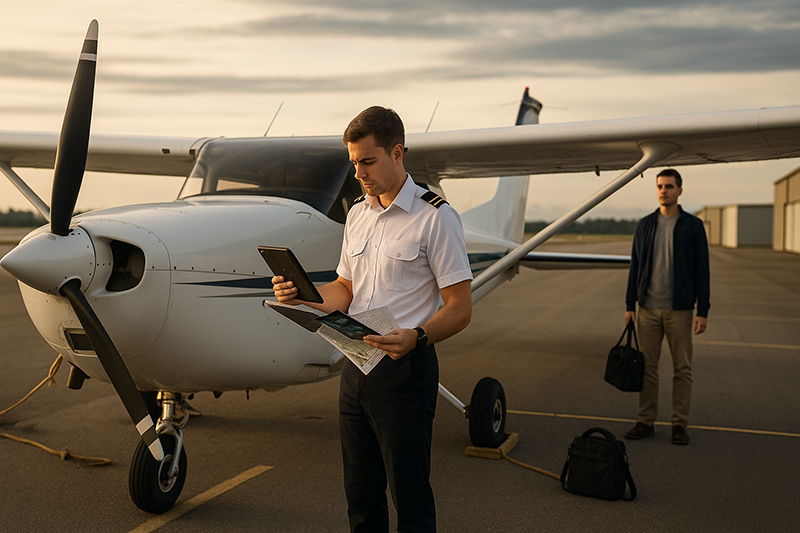
Real-world flying is where a pilot’s training begins to meet the full complexity of aviation decision-making. Training flights are designed around lessons, maneuvers, and measurable proficiency. Real flights are designed around missions: getting to another airport, managing passengers, navigating weather, coordinating with air traffic control, handling schedule pressure, and making practical decisions as pilot in command. That transition can be exciting, but it also deserves deliberate preparation.
For student pilots approaching a checkride, newly certificated pilots planning their first independent cross-country flights, and flight instructors helping clients move beyond the training environment, the shift from training flights to real-world flying is one of the most important phases in pilot development. The fundamentals do not change. Aircraft control, navigation, communication, weather awareness, systems knowledge, and risk management remain the foundation. What changes is the context. The pilot must now apply those skills without the structure of a lesson plan or the quiet safety net of an instructor sitting in the next seat.
The Real Transition: From Lesson Objectives to Mission Management
In flight training, each lesson usually has a defined objective. One flight may focus on steep turns, another on crosswind landings, another on navigation, and another on emergency procedures. The instructor selects the training area, manages the instructional pace, and often helps identify when a scenario is becoming too complex for the student’s current level of experience. Even on solo flights, the operation is often bounded by school policies, local practice areas, endorsement limitations, and familiar routes.
Real-world flying is different because the flight itself becomes the objective. A pilot may be taking a family member to lunch, repositioning an aircraft, attending a business meeting, visiting a new airport, or building experience toward future ratings. The tasks learned in training are still present, but they are no longer isolated. Weather analysis, fuel planning, aircraft performance, airport selection, passenger expectations, and time management all interact at the same time.
This is why the transition should not be viewed as a single event that happens after a checkride. It is a gradual expansion of operating experience. A pilot who has been trained well has the building blocks. The next step is learning how to assemble those blocks under changing conditions while maintaining wide safety margins.
Why This Matters in Real-World Aviation
The training environment can unintentionally create habits that work well during lessons but need refinement for independent operations. A student may become accustomed to flying at the same time of day, departing from the same runway, using the same practice area, and returning to the same traffic pattern. Familiarity is useful during training because it allows concentration on specific skills. However, too much familiarity can mask how much operational judgment is required when the airport, weather, passengers, and mission change.
Real-world aviation rewards pilots who think ahead. A short daytime flight in good visibility may still require careful planning if the destination airport has unusual runway geometry, complex airspace nearby, limited services, rising terrain, or a forecast that suggests conditions may deteriorate before the return leg. A flight that appears simple on a map can become demanding when the pilot adds passenger briefings, fuel decisions, communication workload, and changing winds.
The transition also matters because the pilot in command role becomes more visible. During training, the instructor may allow the student to make decisions but is still monitoring the overall safety of the flight. After certification, that responsibility belongs to the pilot. The aircraft does not know whether the flight is a lesson or a personal trip. Weather, mechanical issues, airspace complexity, and human factors affect both in the same way.
What Changes After Training Flights
After training, the most important changes are not usually technical. Most pilots already know how to preflight an aircraft, use a checklist, communicate on the radio, read weather products, and navigate. The bigger challenge is integrating those skills into a complete operating picture. Real-world flying asks the pilot to make choices when the answer is not written on a maneuver card.
Weather Becomes a Go, Delay, Divert, or Cancel Decision
During training, weather decisions are often filtered through the instructor, dispatcher, chief instructor, or school policy. In personal flying, the pilot must decide not only whether the weather is legal for the intended operation, but whether it is appropriate for the pilot’s experience, aircraft, route, terrain, time of day, and alternatives.
That distinction is important. Legal minimums are not the same as personal minimums. A flight may be legally possible while still being a poor choice for a pilot with limited experience in gusty winds, low ceilings, marginal visibility, night conditions, mountainous terrain, or busy airspace. Mature pilot judgment involves recognizing when conditions exceed current comfort or proficiency, even if the aircraft and regulations technically allow the flight.
Passenger Management Becomes Part of the Flight
Training flights usually involve two aviation-minded people: the student and instructor. Real-world flights may include passengers who do not understand aviation weather, delays, turbulence, fuel stops, or why a pilot might cancel a trip that looks fine from the ground. Passenger expectations can create subtle pressure. A pilot may feel reluctant to disappoint family, friends, coworkers, or clients.
Good passenger management starts before the flight. Explain that aviation decisions are weather-dependent, that departure times may change, and that a cancellation or diversion is a normal safety decision rather than a failure. A clear passenger briefing also reduces cockpit distractions. Passengers should understand seat belts, sterile cockpit expectations during taxi, takeoff, approach, and landing, how to avoid interfering with controls, and what to do if they feel uncomfortable or unwell.
Unfamiliar Airports Require More Preparation
A training airport becomes familiar quickly. Pilots learn local taxi routes, pattern entries, radio habits, landmarks, noise-sensitive areas, and typical traffic flows. At an unfamiliar airport, those cues may be absent. Runway slope, lighting, terrain, traffic pattern direction, hotspots, complex taxiways, and nearby airspace can all increase workload.
Before flying to a new airport, pilots should study current airport information, runway lengths and surfaces, traffic pattern details, airport diagrams when available, communications procedures, terrain and obstacle environment, fuel availability, and any operational notes that may affect arrival or departure. None of that replaces looking outside and flying the airplane, but it reduces surprises when workload is highest.
Maintenance Awareness Becomes More Personal
Training aircraft are often managed by a flight school or maintenance department. A renter or owner-pilot still has responsibility to ensure the aircraft is airworthy for the intended flight. That means paying attention to aircraft documents, inspections, discrepancies, placards, inoperative equipment, fuel and oil requirements, and the practical meaning of anything found during preflight.
A real-world pilot should never treat a squawk as background noise. If something does not look right, sound right, smell right, or behave normally, the pilot should pause and resolve the issue before flight. The pressure to complete a trip can make minor concerns feel inconvenient, but mechanical uncertainty rarely improves after takeoff.
How Pilots Should Understand This Topic
The best way to understand the move into real-world flying is to think in terms of expanding operating envelopes. A pilot’s certificate may authorize certain operations, but experience should grow step by step. A newly certificated pilot might begin with short daytime flights to familiar airports in favorable weather, then gradually add new destinations, longer routes, more complex airspace, different seasonal conditions, passengers, night operations if appropriately trained and current, and additional aircraft types with proper transition training.
This approach respects both confidence and caution. Confidence is necessary because pilots must make decisions and act. Caution is necessary because aviation gives little benefit to overestimating one’s readiness. The goal is not to avoid challenge. The goal is to choose challenges that are appropriate, planned, and supported by good margins.
One useful mindset is to ask, “What is new on this flight?” A flight may include a new airport, new airspace, new passenger, new weather pattern, new aircraft, new time of day, new terrain, or new operational goal. Any one of those may be manageable. Several at once can create an unnecessary workload spike. Pilots build experience more effectively when they limit the number of new variables introduced on a single flight.
Another useful mindset is to separate capability from proficiency. A pilot may have demonstrated a maneuver or operation during training, but that does not guarantee sharp proficiency months later under different conditions. Skills such as crosswind landing technique, short-field operations, instrument scan, emergency procedures, and radio communication in complex airspace benefit from regular practice. Real-world flying should include intentional proficiency maintenance, not just transportation.
Building Your First Real-World Flight Plan
A good real-world flight plan starts earlier than many training flights. Instead of arriving at the airport and deciding whether to go, the pilot begins with a mission review. What is the purpose of the flight? Who is going? What is the latest acceptable arrival time? Is there pressure to return the same day? What are the backup plans if weather, aircraft availability, or passenger comfort changes?
From there, the pilot builds a route that makes sense for the aircraft and conditions. Direct routing may not always be the best routing. A slightly longer route that keeps the flight closer to better landing options, avoids complex weather, reduces terrain exposure, or simplifies airspace may be the wiser choice. Fuel planning should include more than a mathematical minimum. It should consider winds, potential reroutes, delays, fuel availability at the destination, and the pilot’s comfort with reserve margins.
Destination planning should include more than runway length. Pilots should consider runway orientation relative to forecast winds, traffic pattern procedures, airport elevation, lighting, services, arrival time, and the departure plan for the next leg. A destination that is suitable at noon in calm winds may be less attractive near sunset with shifting winds and limited services.
The return flight deserves equal attention. Many personal flights become riskier on the way home because the pilot is tired, passengers are ready to return, daylight is fading, or weather is changing. A sound plan treats the return leg as a separate flight, not a guaranteed continuation of the outbound trip.
Common Mistakes or Misunderstandings
One common misunderstanding is believing that passing a checkride means a pilot is fully prepared for every operation allowed by the certificate. A practical test is an important milestone, but it is not the end of learning. It confirms that the pilot met the applicable standards on that day. Real-world proficiency grows through thoughtful experience, recurrent training, and honest self-assessment.
Another mistake is planning to the edge of comfort. Pilots sometimes accept a flight because every individual factor appears manageable: winds are a little stronger than usual, the destination is unfamiliar, the airspace is busier, the passengers are new, and the schedule is tight. The problem is not one factor. The problem is the combination. Risk often accumulates quietly.
A third mistake is treating technology as a substitute for preparation. Moving maps, electronic flight bags, datalink weather, traffic displays, and autopilots can improve situational awareness when used correctly. They can also create overconfidence or distraction. A pilot still needs to understand the route, airspace, weather picture, fuel plan, aircraft performance, and available alternatives. Technology should support pilot judgment, not replace it.
Some pilots also underestimate the effect of passengers on workload. A passenger who asks questions during taxi, becomes anxious in turbulence, drops an item near the rudder pedals, or feels airsick can distract the pilot at a critical time. This is not a reason to avoid carrying passengers. It is a reason to brief them well and maintain cockpit discipline.
Finally, pilots may hesitate to divert or cancel because they interpret it as poor performance. In professional aviation culture, changing the plan for safety is a normal and respected decision. A pilot who cancels early, delays departure, lands short of the destination, or turns around before conditions deteriorate is exercising command authority, not admitting defeat.
Practical Example: A First Independent Weekend Trip
Consider a newly certificated private pilot planning a weekend flight to an airport about 120 nautical miles away. The route is within the pilot’s experience, but the destination is unfamiliar. Two friends are coming along. The weather forecast shows good visibility in the morning, increasing surface winds in the afternoon, and scattered cloud layers along part of the route. The aircraft is a familiar trainer that the pilot has flown many times.
A training-flight mindset might focus mainly on navigation, radio calls, and landing at the destination. A real-world flying mindset looks broader. The pilot reviews the weather trend, not just the current conditions. The pilot checks whether the destination runway aligns favorably with the expected wind and identifies alternates along the route. The pilot confirms fuel availability, calculates weight and balance with passengers and baggage, reviews aircraft performance for the departure and destination airports, and considers whether the afternoon return could become more demanding than the morning outbound leg.
The pilot also manages expectations before anyone arrives at the airport. The passengers are told that the trip depends on weather and that a delay or change of destination is possible. During the preflight briefing, the pilot explains seat belts, door operation, avoiding the controls, use of headsets, and the need for a quiet cockpit during busy phases.
On the day of the flight, the outbound leg is smooth. Near the destination, the pilot notices that winds are stronger than forecast and traffic is using a runway that requires an unfamiliar pattern entry. Instead of rushing, the pilot slows the pace mentally, listens to traffic, confirms the airport layout, and enters the pattern with extra attention to spacing and wind correction. After landing, the pilot rechecks the return forecast rather than assuming the original plan is still valid.
By midafternoon, winds have increased at the home airport, and the crosswind component is near the pilot’s personal comfort limit. The pilot chooses to delay the return until conditions improve, with a backup plan to leave the aircraft overnight if necessary. That decision may be inconvenient, but it reflects good command judgment. The flight becomes a successful real-world learning experience because the pilot managed the mission, not just the airplane.
Best Practices for Pilots Transitioning to Real-World Flying
The most effective pilots make their transition intentional. They do not simply fly farther and hope experience fills the gaps. They choose flights that build judgment as well as logbook time. Early post-training flights should reinforce good habits: thorough preflight planning, disciplined checklist use, conservative weather decisions, strong communication, and honest post-flight review.
Personal minimums are especially valuable. These are self-imposed limits for weather, wind, visibility, ceilings, fuel reserves, runway length comfort, night operations, and other factors that affect safety. Personal minimums should be more conservative than legal minimums, especially for pilots with limited experience. They should also evolve carefully as proficiency grows. Raising personal minimums should be based on training and demonstrated competence, not impatience.
Recurrent training is another best practice. A flight review, aircraft checkout, instrument proficiency session, crosswind practice, or scenario-based lesson with an instructor can reveal habits that routine flying may hide. Instructors can also help pilots design realistic transition flights, such as operations into busier airports, mountain or coastal weather environments, night cross-country planning, or more advanced avionics use.
It also helps to conduct a personal debrief after each meaningful flight. What went well? What was more difficult than expected? Did the weather match the forecast? Was the fuel plan appropriate? Were communications smooth? Did passenger needs create distraction? Did any decision feel rushed? A short, honest review turns ordinary flights into structured experience.
Several habits are particularly useful during the transition:
- Limit new variables on early flights by changing one major factor at a time.
- Set conservative personal minimums and write them down before the flight.
- Brief passengers in plain language and normalize delays, diversions, and cancellations.
- Plan the return leg as carefully as the outbound leg.
- Use technology as a support tool while maintaining basic navigation and weather understanding.
- Ask an instructor or experienced mentor to review challenging trips before departure.
The Instructor’s Role in Preparing Pilots for Real Operations
Flight instructors play a key role in helping students cross the bridge from training to independent flying. The best preparation is not limited to maneuvers. It includes scenario-based decision-making, realistic cross-country planning, passenger considerations, abnormal situations, weather judgment, and exposure to different airports and airspace when appropriate.
Instructors can help by asking students to explain the “why” behind decisions. Why is this route better than another? Why is this fuel stop appropriate? Why is this weather acceptable or not acceptable? Why would a delay be wise? These questions develop judgment rather than rote answers.
For pilots who have recently earned a certificate, an instructor can serve as a valuable transition coach. A post-checkride flight to a new airport, a dual cross-country in busier airspace, or a weather planning session can build confidence without leaving the pilot to learn everything alone. This type of training is not remedial. It is professional development.
Managing External Pressure
External pressure is one of the most persistent challenges in real-world flying. It may come from passengers, business obligations, hotel reservations, aircraft scheduling, daylight, social expectations, or the pilot’s own desire to complete the trip. The danger is that pressure can make a pilot reinterpret facts in a more favorable way. A marginal forecast becomes “probably fine.” A maintenance concern becomes “likely nothing.” A fatigue concern becomes “I can push through.”
The best defense is to make key decisions before pressure peaks. Establish cancellation criteria before passengers arrive. Identify alternates before takeoff. Decide in advance what weather or wind conditions would trigger a delay. Tell passengers early that the plan is flexible. When the pilot has already defined the boundaries, it becomes easier to make a safe decision later.
Professional pilots use structured decision-making because it reduces the chance of improvising under pressure. General aviation pilots can use the same principle without making the process complicated. Pause, gather the facts, compare the situation to the plan, consider alternatives, and choose the option that preserves safety margins.
Keeping Training Skills Alive After Certification
Some skills fade when pilots use the airplane mainly for transportation. Steep turns, slow flight awareness, ground reference maneuvers, emergency procedures, short-field technique, crosswind correction, and manual navigation may not appear on every real-world trip. Yet these skills contribute to aircraft control and confidence when conditions become less routine.
Pilots should intentionally schedule proficiency flights. These do not need to be long or complicated. A local flight with a few takeoffs and landings, practice diversions, simulated system abnormalities with an instructor, or navigation without relying solely on automation can sharpen skills. The purpose is not to recreate primary training. The purpose is to keep the pilot’s hands, eyes, and judgment connected.
Instrument-rated pilots face a similar issue. Filing an instrument flight plan and using automation can be routine, but maintaining instrument scan, approach briefing discipline, missed approach readiness, and weather judgment requires practice. Visual pilots also benefit from understanding the limits of visual flight in changing weather and avoiding any situation where continued visual reference becomes doubtful.
Frequently Asked Questions
How soon after training should a pilot start real-world flying?
A pilot can begin appropriate real-world flying as soon as qualified and current, but the first flights should be conservative. Choose familiar aircraft, favorable weather, simple routes, and manageable destinations. Expand gradually as experience and proficiency grow.
What is the biggest difference between a training flight and a real-world flight?
The biggest difference is mission management. In training, the lesson objective is usually controlled and supervised. In real-world flying, the pilot must integrate weather, aircraft readiness, passengers, fuel, airspace, schedule pressure, and alternatives into one safe decision-making process.
Should newly certificated pilots carry passengers right away?
Carrying passengers can be appropriate when the pilot is qualified, current, comfortable, and operating within conservative limits. Early passenger flights should be simple, well-briefed, and free of unnecessary pressure. Pilots should avoid combining first passenger flights with unfamiliar airports, marginal weather, or demanding conditions.
How can pilots set personal minimums?
Personal minimums should reflect experience, proficiency, aircraft capability, terrain, airspace, and recent practice. A pilot can start conservatively, discuss the numbers with an instructor or mentor, and adjust them gradually after additional training and demonstrated competence.
Is using advanced avionics enough to make real-world flying safer?
Advanced avionics can improve situational awareness, but they do not replace planning, aircraft control, weather judgment, or decision-making. Pilots should understand the equipment, know its limitations, and remain capable of flying safely if a display, database, or automation feature is unavailable.
When should a pilot ask an instructor for help after certification?
A pilot should involve an instructor whenever a planned flight introduces unfamiliar complexity or when proficiency feels uncertain. Examples include new aircraft, busy airspace, night operations, challenging weather patterns, advanced avionics, or a destination that demands skills not recently practiced.
Key Takeaways
- Real-world flying requires pilots to combine training skills with mission planning, passenger management, weather judgment, and flexible decision-making.
- Safety margins should be wider during the transition from training, especially when a flight includes unfamiliar airports, stronger winds, passengers, or schedule pressure.
- Continued instruction, personal minimums, and honest post-flight debriefs help pilots turn early real-world flights into structured aviation experience.