
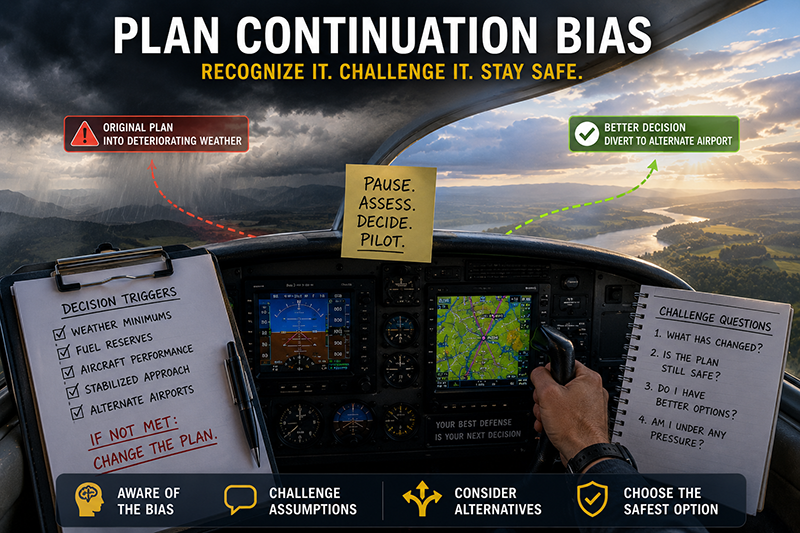
Plan continuation bias is a common human-factor trap that encourages pilots to keep executing an original plan even when changing conditions make that plan unsafe. Recognizing plan continuation bias early helps pilots, instructors, and flight crews avoid poor decisions that can lead to incidents or accidents. This article explains how the bias works, why it matters in flight operations, and what pilots can do to reduce its impact in real time.
Understanding this bias is practical, not academic. A well-trained pilot who recognizes plan continuation bias can stop a chain of decisions that otherwise grows progressively worse. You will get clear explanations of the cognitive mechanics behind the bias, examples from real-world operations, common misunderstandings, and practical techniques to use in training and on the flight deck.
What plan continuation bias is and how it happens
Plan continuation bias is a cognitive tendency to stick with a previously chosen plan despite new information suggesting the plan is no longer the best option. In aviation, that might mean pressing on toward a destination after weather deteriorates, continuing an approach when stabilization criteria are not met, or following an original maintenance plan despite evidence of unresolved system anomalies.
The bias grows from several normal mental tendencies: commitment to initial decisions, desire to avoid admitting error, time pressure, perceived costs of changing course, and limited attention. These tendencies interact with flight deck demands to create a readiness to interpret ambiguous data in ways that support the original plan.
Why this matters in real-world aviation
Pilots make many decisions under pressure, with incomplete information, and while managing complex tasks. Plan continuation bias can convert a small problem into a major hazard because a pilot who is already committed to a course of action may discount or delay acting on new information. That delay can reduce available options and degrade safety margins in weather avoidance, approach stabilization, fuel management, and emergency handling.
In training and line operations, plan continuation bias affects single-pilot crews and multi-crew environments differently. In single-pilot operations the pilot’s own commitment and mental workload are central. In multi-crew operations, authority gradients, communication patterns, and crew coordination determine whether someone challenges the continuing plan. Both environments require explicit strategies to catch the bias early.
How pilots should understand plan continuation bias
Seeing the bias for what it is helps pilots treat it like any other hazard: a predictable human tendency that can be countered with specific techniques. The useful way to think about plan continuation bias is as an error-amplifying factor rather than a discrete mistake. It rarely appears alone. Instead, it magnifies the effect of other small errors, such as a misread chart, a weather forecast that changed, or an incomplete checklist.
Key features to recognize during flight are the appearance of selective attention, rationalization of conflicting cues, and reduced consideration of alternatives. For example, a pilot may explain increasing crosswind components as temporary or manageable while discounting runway braking reports. That rationalization preserves the plan and postpones a go-around, diversion, or other corrective action.
Common mistakes and misunderstandings
Several myths make it harder to identify and mitigate plan continuation bias.
Myth: Confidence equals correct judgment. High-ability pilots are not immune. Confidence can increase commitment to a plan and make pilots less receptive to new information.
Myth: A single rule or checklist will eliminate the bias. Checklists help, but the bias operates in the mind and through group dynamics. Tools that improve awareness and encourage dissent are necessary complements to procedural controls.
Myth: Only unusual or extreme events trigger it. The bias commonly occurs around routine decisions: weather deviations, go/no-go fuel judgments, approach decisions, or timing for diversion. Because it looks like normal judgment, it is often overlooked.
Training gaps also contribute. Scenario-based training that replicates the pressures and incomplete information of real flights helps pilots practice interrupting commitment tendencies. Without this practice, clear cues may be missed during actual operations.
Practical example: weather diversion on a cross-country flight
Imagine a single-engine pilot who filed to fly to an airport with marginal ceilings. After takeoff, an updated weather briefing shows the destination cloud ceiling and visibility have degraded below personal minimums. The pilot believes they can still land because the approach looks straightforward from previous experience and they want to avoid the inconvenience of diverting.
As the flight progresses, the pilot interprets intermittent reports of lowering ceilings as temporary, delays calling ATC for vectors, and continues descent even while becoming increasingly uncomfortable. By the time the pilot recognizes the conditions are below acceptable minima, options for a safe diversion have narrowed: nearby alternate airports are farther, fuel reserves are lower, and visibility is reduced en route. The pilot’s initial commitment to the original plan created delays that reduced safety margins.
This scenario shows how plan continuation bias often manifests: a small initial commitment (an intention to land at the planned airport) becomes reinforced by selective interpretation and a reluctance to accept the inconvenience of changing plans.
How crew dynamics influence the bias
In multi-crew operations, plan continuation bias can be amplified by authority gradients and poor communication. A more junior crewmember who detects a deteriorating situation may hesitate to challenge a senior pilot’s insistence on continuing because of fear of reproach or concern about upsetting the flow of the flight.
Conversely, constructive cockpit resource management encourages challenge-and-recommend behaviors. A culture where brief, direct challenges are expected and where the pilot flying can be questioned without penalty reduces the chance that a single person’s plan will go unchallenged when conditions change.
Practical techniques to recognize and counter the bias
There are practical cognitive and procedural habits that reduce the likelihood plan continuation bias will cause harm. Use these regularly, not only when things feel risky.
- Trigger points: Define decision points before flight and during phases of flight where a specific condition will prompt reassessment. For example, if weather is within margins, set a firm turn-back or diversion point based on distance or fuel remaining.
- Pre-brief alternatives: During preflight and approach briefings, list acceptable alternates and the conditions that will cause you to use them. Making alternatives explicit reduces the cognitive cost of switching plans.
- Use deliberate pause: Pause briefly when new, conflicting information appears. Even a 10-second deliberate assessment can interrupt the instinct to press on.
- Practice dissenting voice: In multi-crew settings, encourage flat, factual challenges. Use phrases like "I have a concern" or "Would you consider diverting to..." to make dissent acceptable and specific.
- Simulate the pressure: Train in scenarios that include time pressure, system distractions, and ambiguous cues so the habit of reassessment becomes automatic rather than theoretical.
Tools and training to reduce plan continuation bias
Organizations and individual pilots can adopt several training and procedural tools to reduce bias-driven errors. Scenario-based simulation that reproduces real operational pressures is one of the most effective methods. These scenarios should include ambiguous cues and require decisions that trade convenience against safety margins.
Briefing techniques also help. A structured briefing that explicitly mentions abort, go-around, or diversion criteria reduces the cognitive friction of changing plans. In airline and corporate operations, written decision aids and standard operating procedure triggers create clear, objective thresholds for alternative planning.
For single-pilot operations, developing a personal standard operating practice that includes fuel-based diversion points, minimum visual conditions to continue an approach, and conservative personal minimums provides a replicable framework that is less susceptible to situational pressure.
Common errors when trying to counter the bias
When pilots attempt to address plan continuation bias, certain mistakes reduce effectiveness. Avoid these pitfalls:
- Relying only on rote checklists: Checklists are valuable but may not prompt the cognitive shift needed to abandon a plan. Combine checklists with explicit decision rules and verbal confirmation.
- Overloading briefings with contingencies: A preflight that lists every possible contingency becomes impractical. Focus on the most likely or most dangerous scenarios and state the decision thresholds clearly.
- Vague alternatives: Saying "we might divert" is less effective than identifying a named alternate and fuel or distance limits that will trigger diversion.
- Punitive cultures: If crews fear blame for suggesting changes, the culture will suppress useful challenges. Leaders should reward accurate early detection and safe decisions, even when the original plan appears inconvenienced.
Practical example: unstabilized approach and the decision to go around
Consider a stabilized approach policy that requires specific parameters by 1,000 feet above the runway. If the approach is not stabilized by the specified altitude, a go-around is mandatory. Plan continuation bias often appears when pilots rationalize the unstabilized condition as recoverable, citing factors like "we’re close" or "we can fix it in time."
To counter this, treat the stabilization rule as a committed trigger. If the approach is unstabilized at the trigger altitude, execute the go-around without delay. Making the rule procedural reduces the mental burden of choosing to abandon the plan and prevents rationalization from extending the approach beyond safe limits.
Integrating human factors into routine decision-making
Plan continuation bias is one of many human-factor risks. Integrating human-factors thinking into routine operations normalizes the recognition of cognitive traps. Use simple habit-forming techniques: verbal callouts during briefings, regular post-flight reflection on decision points, and peer debriefs that focus on choice points, not only outcomes.
Instructors can build recognition of the bias into training syllabi by setting up scenarios where continuing the original plan is tempting and consequences increase over time. Asking students to pause and list reasons for and against continuing before executing a critical maneuver builds the mental muscle needed in real operations.
When technology can help and when it cannot
Tools such as flight planning apps, weather radar, and onboard automation provide data that can counter plan continuation bias, but they are not silver bullets. Technology can pull attention toward new facts, but pilots still interpret that data. If a pilot is committed to a plan, they may underweight or misinterpret technological warnings.
Design technology use so that it supports decision points rather than replaces judgment. For example, use automated alerts to highlight deteriorating weather or fuel trends, but explicitly tie those alerts to pre-established actions. Train on interpreting and acting on the alerts within the context of your operational decision rules.
Regulatory and training context
Regulations and advisory guidance recognize human factors as a contributor to aviation risk. Training syllabi and operator standard operating procedures frequently include decision rules, stabilized approach criteria, and crew resource management techniques designed to counter human-factor vulnerabilities like plan continuation bias. Incorporate these elements into everyday practice rather than treating them as check-the-box exercises.
Best practices for pilots
Below are practical, repeatable actions that reduce the risk of plan continuation bias and improve decision-making under pressure.
- Identify and state key decision triggers before flight, including fuel thresholds and weather minima.
- Pre-brief alternates and the conditions that will trigger diversion or go-arounds.
- Use short, structured verbal challenges in crew environments; encourage junior crewmembers to speak up.
- Practice scenario-based training that includes ambiguous cues and time pressure.
- Apply a deliberate pause when new conflicting information appears, and verbalize the reassessment.
- Treat stabilization and other safety-critical criteria as mandatory triggers rather than subjective judgments.
Frequently Asked Questions
How can I tell plan continuation bias from reasonable perseverance?
Perseverance is appropriate when new data support the original plan or when the plan still meets safety margins. Plan continuation bias is present when pilots discount or ignore new evidence that reduces those margins. The practical test is whether objective criteria or pre-set triggers indicate reassessment or abandonment of the plan.
Are experienced pilots less likely to suffer from it?
Experience can reduce some errors but does not eliminate cognitive biases. Experienced pilots may be skilled at justifying continuing a plan and thus can also fall prey to the bias. The protective factor is disciplined use of decision rules and a culture that encourages challenge and reassessment.
What role does fatigue play in plan continuation bias?
Fatigue narrows attention and reduces cognitive flexibility, making it harder to notice discrepant information. When fatigued, pilots are more likely to default to the original plan rather than invest the effort needed to evaluate alternatives.
How can instructors teach students to avoid this bias?
Use scenario-based training that simulates pressure and ambiguous cues. Require students to identify decision triggers and alternates during briefings. During debriefs, focus on the decision points and reinforce when changing plans was the safer option.
Can technology solve plan continuation bias?
Technology can assist by providing clearer information and explicit alerts, but it cannot replace judgment. The most effective approach is to combine technological aids with pre-established decision rules and training that practices acting on those alerts.
Key Takeaways
- Practical takeaway: Define decision triggers and alternates before flight to reduce the cognitive cost of changing plans.
- Safety takeaway: Treat stabilization and other safety-critical criteria as mandatory triggers to prevent rationalization under pressure.
- Training takeaway: Use scenario-based training and structured briefings to build the habit of reassessment and encourage constructive crew challenges.