
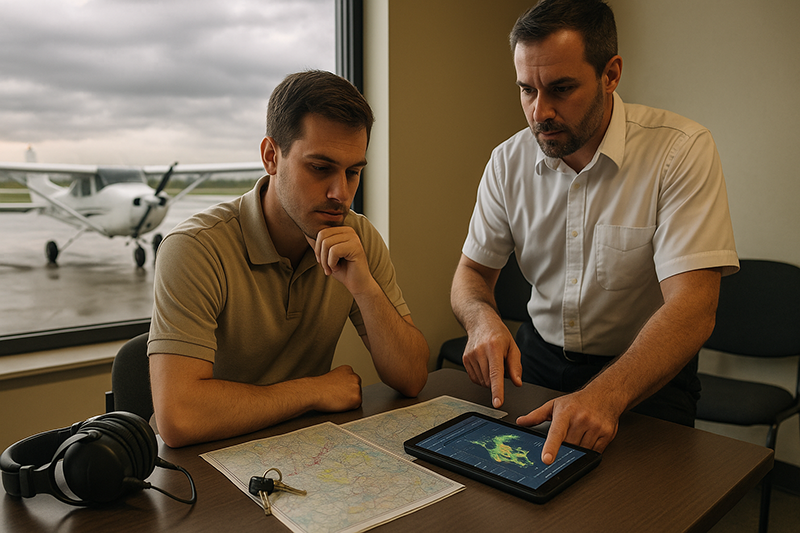
The PAVE checklist is one of the most practical tools a pilot can use to make better go/no-go and in-flight decisions. It gives structure to a question every pilot faces repeatedly: is this flight still a good idea under today’s conditions, in this aircraft, with this pilot, and with these pressures? PAVE stands for Pilot, Aircraft, enVironment, and External pressures. Those four categories help pilots organize risk before a flight and reassess it when conditions change.
In real-world aviation, decisions are rarely made with perfect information. Weather changes, passengers have expectations, maintenance questions appear at inconvenient times, and pilots sometimes feel pressure to complete a flight because the plan looked reasonable earlier. The value of the PAVE checklist is not that it produces a mechanical answer. Its value is that it slows the decision down, exposes risk factors that are easy to rationalize, and helps pilots choose safer alternatives before options narrow.
For student pilots, PAVE provides a simple framework for aeronautical decision-making. For certificated pilots, flight instructors, and aviation professionals, it is a reminder that experience does not remove risk. It only gives the pilot a better opportunity to recognize risk early and manage it deliberately.
What the PAVE Checklist Really Does
The PAVE checklist is a preflight and in-flight risk management model. It divides the flight into four broad areas: the pilot, the aircraft, the environment, and external pressures. Each area asks the pilot to look beyond the obvious and consider whether several small concerns are beginning to add up.
The pilot category includes fitness, proficiency, fatigue, illness, medication, stress, recent experience, and comfort with the planned operation. The aircraft category includes airworthiness, performance, equipment, fuel planning, loading, and whether the aircraft is appropriate for the mission. The environment category includes weather, terrain, airspace, airports, lighting, traffic, runway conditions, and operational complexity. External pressures include schedule demands, passengers, business expectations, personal pride, financial considerations, and the subtle desire to avoid disappointing someone.
Used well, PAVE is not a box-checking exercise. A pilot can technically answer every question and still make a poor decision if the process is rushed or treated as a formality. The checklist is most useful when the pilot treats it as a conversation with the facts. What is different today? What has changed since the plan was made? What would make this flight easier, safer, or less time-sensitive? What would I advise another pilot to do in the same situation?
The most important feature of PAVE is that it encourages a whole-flight view. A flight might look acceptable if the pilot studies only the departure weather. It might look acceptable if the aircraft has enough fuel. It might look acceptable if the pilot is legally current. But when the pilot combines marginal weather, a late departure, unfamiliar terrain, a tired crew member, and pressure to arrive before dark, the overall picture may look very different.
Why This Matters in Real-World Aviation
Real-world flight decisions are affected by more than regulations and performance charts. Regulations establish minimum standards and operating boundaries, but safe decisions often require a margin beyond minimum compliance. PAVE helps pilots think about that margin in a disciplined way.
A pilot may be legally able to depart, the aircraft may be airworthy, and the weather may be above applicable minimums. That does not automatically mean the flight is wise for that pilot, in that aircraft, on that route, at that time. A newly certificated private pilot flying a lightly equipped aircraft over unfamiliar terrain at night faces a different risk picture than a highly experienced instrument pilot flying a well-equipped aircraft on a familiar route. PAVE gives both pilots a way to evaluate the flight without pretending that all legal flights carry the same practical risk.
The checklist also matters because risks interact. A moderate crosswind may be manageable for a proficient pilot at a wide, familiar runway. The same crosswind may become a significant concern when combined with gusts, a short runway, fatigue, passengers, and a pilot who has not practiced crosswind landings recently. A forecast for scattered showers may be manageable in daylight over flat terrain with several alternates nearby. It may be far more demanding at night in mountainous areas or in airspace with limited diversion options.
Flight instructors can use PAVE to help students move from knowledge-based answers to judgment-based decisions. It is one thing for a student to recite weather minimums or aircraft inspection requirements. It is another for that student to explain why a flight should be delayed because the combination of low experience, gusty wind, high workload, and schedule pressure leaves too little margin. That is the kind of decision-making skill that carries into solo flying, cross-country operations, instrument training, and later professional aviation environments.
How Pilots Should Understand Each PAVE Element
PAVE is easy to remember, but each letter deserves more than a quick glance. The goal is not to find a reason to cancel every flight. The goal is to understand the risk accurately and then manage it with appropriate choices. Sometimes the right answer is to go. Sometimes it is to delay, change the route, add fuel, take an instructor, choose a different aircraft, brief passengers differently, or set a specific turnaround point.
Pilot: The Human Factor in the Flight
The pilot is often the most variable part of the system. Aircraft performance can be calculated, weather can be briefed, and airport data can be reviewed, but pilot fitness and judgment require honest self-assessment. A pilot who is tired, distracted, ill, dehydrated, emotionally stressed, or out of practice may not perform at the level expected on a normal day.
Pilot risk is not limited to physical condition. Proficiency matters. A pilot may be current for a particular operation but not truly comfortable with it. Recent experience in crosswinds, instrument procedures, night landings, short-field operations, busy airspace, or complex avionics can make a meaningful difference in workload and decision quality. If a planned flight depends on a skill that has not been practiced recently, that belongs in the PAVE discussion.
Good pilots do not treat personal limitations as weakness. They treat them as operational facts. A personal minimum is not an admission of fear. It is a planned safety boundary that helps the pilot make clear decisions before the pressure of the moment increases.
Aircraft: Capability, Condition, and Suitability
The aircraft category asks whether the aircraft is ready and suitable for the flight. Airworthiness is the starting point, not the finish line. A pilot should also consider performance, equipment, fuel reserves, loading, avionics familiarity, and whether the aircraft’s capabilities match the planned conditions.
For example, a training aircraft that is excellent for local day VFR practice may not be the best choice for a long cross-country with strong headwinds, high terrain, night arrival, or limited weather options. An aircraft with advanced avionics can reduce workload when the pilot is proficient, but it can increase workload when the pilot is unfamiliar with its menus, automation modes, or failure indications. More equipment is not automatically more safety unless the pilot knows how to use it correctly.
Aircraft performance planning is especially important when temperature, elevation, runway length, weight, obstacles, or surface condition affect takeoff and landing margins. PAVE does not replace the aircraft flight manual or pilot’s operating handbook. It reminds the pilot to use those resources and then ask whether the resulting margin is appropriate for the day’s conditions and the pilot’s proficiency.
Environment: Weather, Airspace, Terrain, and Airports
The environment is often where risk becomes dynamic. Weather may be forecast, but it is not controlled by the pilot. Visibility, ceilings, winds, convective activity, turbulence, icing potential, density altitude, and frontal movement can all alter the risk of a flight. The environment also includes terrain, water crossings, airspace complexity, airport layout, runway lighting, traffic, and available alternates.
A key mistake is evaluating the environment only at the departure airport. A complete decision considers the entire route, the destination, alternates, fuel stops, and the time of day. A flight that begins in good weather may encounter lower ceilings, stronger winds, or reduced visibility later. A route that is easy in daylight can become much more demanding at night, particularly where terrain, sparse lighting, or limited emergency landing options are factors.
Environmental risk is not only about severe weather. Many difficult decisions happen in marginal but legal conditions. The pilot may be tempted to continue because each individual condition seems acceptable. PAVE helps reveal when the total environment is becoming less forgiving.
External Pressures: The Quiet Risk Multiplier
External pressures are sometimes the hardest part of PAVE because they are emotional rather than technical. A pilot may feel pressure to attend a meeting, keep a reservation, return an aircraft on time, impress passengers, complete a trip after planning it for weeks, or avoid the inconvenience of canceling. These pressures can distort judgment and make risk seem more acceptable than it really is.
External pressure is dangerous because it often appears reasonable. Passengers may not be demanding anything unsafe. A business appointment may be important. A weather delay may be expensive. The risk arises when the pilot begins to treat completion of the trip as the primary objective instead of safe management of the flight.
One of the best ways to manage external pressure is to brief alternatives before the flight. Tell passengers that delays and diversions are normal aviation decisions, not failures. Build flexibility into the schedule. Avoid making firm promises about arrival time when weather, aircraft availability, or daylight may affect the outcome. The pilot who has already normalized a delay is more likely to choose it when conditions warrant.
Using PAVE Before Takeoff
The best time to use PAVE is before the pilot is committed. Before engine start, the pilot has the most options: delay, cancel, change aircraft, adjust fuel, choose a different route, wait for weather to improve, bring an instructor or safety pilot, reduce passenger or baggage load, or plan an intermediate stop. Once airborne, options may still exist, but they can become more expensive, more complex, or more time-sensitive.
A practical preflight PAVE review begins with an honest summary of the day. Is this a routine flight, a training flight, a proficiency-building flight, or a mission with meaningful consequences if delayed? Is the pilot rested and current? Is the aircraft operating normally and equipped for the expected conditions? Is the weather stable, improving, deteriorating, or uncertain? Are there external pressures that might make it harder to turn back?
The pilot should then look for clusters of risk. A single concern may be manageable. Multiple concerns in different categories deserve more attention. For example, a pilot who is slightly fatigued may still be comfortable making a short local flight in excellent weather. The same fatigue becomes more serious when combined with night operations, marginal weather, unfamiliar avionics, and passengers expecting to arrive on time.
Instructors can make this process more useful by asking students to state not only whether they would go, but what would change their decision. That question teaches pilots to think in thresholds. If the crosswind increases by five knots, does the plan change? If the ceiling lowers, what is the new decision point? If the destination weather drops below the pilot’s comfort level, where is the diversion? If the flight departs one hour late, does night arrival become a factor?
Using PAVE During the Flight
PAVE is often introduced as a preflight tool, but it is equally valuable in the air. Conditions change, and pilots should be willing to update the risk assessment as new information appears. A good in-flight PAVE review may take less than a minute, but it can prevent continuation bias from taking over.
Continuation bias is the tendency to keep going with the original plan even when new information suggests the plan should change. A pilot who has already invested time, fuel, money, and emotional energy into a flight may unconsciously search for reasons to continue. PAVE provides a simple interruption. It asks the pilot to re-evaluate the pilot, aircraft, environment, and external pressures now, not as they existed at departure.
In flight, the pilot category might include fatigue, workload, task saturation, or confusion with avionics. The aircraft category might include abnormal indications, fuel state, equipment issues, or performance concerns. The environment might include lowering visibility, stronger winds, unexpected turbulence, changing ceilings, or an airport that looks more challenging than expected. External pressures might include a passenger’s meeting, a closing FBO, approaching darkness, or the pilot’s reluctance to admit the plan is no longer ideal.
A disciplined pilot is willing to make conservative changes early. Turning around, diverting, slowing down, climbing or descending within safe and appropriate limits, asking ATC for assistance when available, holding outside busy airspace, or landing short of the destination can all be sound decisions. The earlier the pilot acts, the more options usually remain.
Common Mistakes and Misunderstandings
One common mistake is treating PAVE as a memory item to satisfy a training requirement rather than as a decision-making method. A student might recite the four letters perfectly but still fail to connect them to the day’s actual risks. The real test is whether PAVE changes behavior when conditions are not ideal.
Another mistake is focusing only on the most dramatic hazard. Pilots often recognize thunderstorms, strong winds, or an obvious mechanical problem. The more subtle risk is a combination of ordinary issues: a late start, a tired pilot, a passenger who must arrive on time, a destination with unfamiliar procedures, and weather that is legal but not comfortable. PAVE is designed to catch those combinations.
A third misunderstanding is believing that legal equals safe. Compliance with applicable rules is essential, but decision-making does not end at the minimum standard. A pilot can operate legally and still have too little margin for personal proficiency, aircraft performance, or changing conditions. PAVE helps bridge the gap between minimum legality and practical safety.
Pilots also sometimes underestimate external pressure. They may say there is no pressure because no one is explicitly demanding the flight. In practice, pressure can come from within the pilot. Wanting to prove capability, avoid embarrassment, save money, or complete a trip as planned can influence decisions just as strongly as a passenger’s request.
Finally, some pilots use PAVE too late. If the first serious risk review happens after the aircraft is loaded, passengers are seated, and the engine is running, the pilot has already increased the psychological cost of canceling. A better habit is to start the PAVE review during planning, revisit it before departure, and update it during the flight.
Practical Example: A Cross-Country That Looks Legal but Feels Tight
Consider a private pilot planning a late afternoon VFR cross-country in a familiar single-engine training aircraft. The route is about two hours, with passengers on board for a weekend trip. The departure weather is good, but the destination forecast suggests lowering ceilings near evening. Surface winds are forecast to be gusty at the destination, with a crosswind component near the pilot’s personal comfort limit. The pilot had a long workday, has not flown at night recently, and the passengers have hotel reservations waiting.
A superficial review might conclude that the flight is possible. The aircraft is available, the pilot is certificated and current, and the weather may remain VFR. But a PAVE review creates a more complete picture.
Under Pilot, fatigue and limited recent night experience stand out. Under Aircraft, the training aircraft may be perfectly airworthy, but it offers limited speed and limited weather flexibility compared with more capable aircraft. Under enVironment, the destination weather is trending in the wrong direction, winds may be challenging, and a delayed arrival could push the flight into night conditions. Under External pressures, passengers, reservations, and the desire to complete the weekend trip all create pressure to continue.
The safest decision may not be an automatic cancellation. The pilot has several options. Depart earlier if possible, delay until better conditions are expected, choose a daytime arrival window with a firm diversion plan, reduce pressure by telling passengers that the trip may stop short, select a route with better alternates, bring a more experienced instructor or pilot if appropriate, or drive instead. The key is that PAVE shifts the pilot’s thinking from “Can I legally go?” to “What is the safest way to manage this mission, and where are my boundaries?”
Now imagine the pilot departs and, halfway to the destination, learns that ceilings are lower than expected and winds have increased. This is the moment when an in-flight PAVE review matters. The pilot is more tired, the aircraft’s fuel state is no longer full, the environment has deteriorated, and external pressure may be stronger because the destination is closer. A diversion made early to a suitable airport with better conditions may be a confident, professional decision. Continuing just because the original plan was made earlier may reduce safety margin unnecessarily.
Best Practices for Pilots
The most effective pilots make PAVE part of their normal operating rhythm. They do not reserve it only for checkrides or unusually difficult flights. When used consistently, the checklist becomes a practical habit that supports clear thinking under pressure.
Start by writing down personal minimums for weather, wind, fuel, night operations, terrain, and other factors relevant to the type of flying you do. Personal minimums should be realistic, experience-based, and adjustable as proficiency changes. They should become more conservative when several risk factors appear together.
Use PAVE early in planning. If a flight depends on perfect timing, perfect weather, or perfect aircraft performance, the plan may be too fragile. Build alternatives before you need them. Identify suitable airports along the route, consider fuel options, and brief passengers that a safe diversion is always an acceptable outcome.
Make risk visible. Some pilots use a formal flight risk assessment tool, while others use a written briefing or verbal review. The exact format matters less than the quality of the thinking. If the risk factors cannot be clearly explained, the pilot may not understand them well enough to manage them.
- Review PAVE during planning, before departure, and whenever conditions change in flight.
- Look for combinations of small risks rather than waiting for one obvious hazard.
- Separate legal minimums from personal safety margins and proficiency limits.
- Brief passengers that delays, diversions, and cancellations are normal safety decisions.
- Decide in advance what conditions will trigger a turnback, diversion, or delay.
Flight instructors should model this process openly. Instead of simply announcing a go/no-go decision, explain the reasoning. Students learn judgment by hearing how experienced pilots weigh uncertainty, workload, proficiency, and pressure. The goal is not to make students afraid of flying. The goal is to teach them to recognize when a safe flight requires a different plan.
Connecting PAVE to Personal Minimums
PAVE and personal minimums work best together. PAVE identifies the risk categories. Personal minimums define specific boundaries that help the pilot make timely decisions. Without personal minimums, a pilot may recognize a risk but still negotiate with it too long. Without PAVE, personal minimums may be applied too narrowly without considering the broader context.
For example, a pilot might have a personal minimum for maximum crosswind, but that number should not be treated in isolation. A crosswind below the stated limit may still be too demanding if the runway is short, the surface is contaminated, the pilot is fatigued, or the arrival is at night. Conversely, a pilot may gradually expand a personal minimum after receiving instruction and demonstrating proficiency in appropriate conditions.
The important principle is flexibility with discipline. Personal minimums should not be changed impulsively at the airport to make a flight work. They should be reviewed thoughtfully after training, experience, and honest evaluation. PAVE helps determine whether today’s flight deserves normal limits or more conservative ones.
How Instructors Can Teach PAVE Without Making It Mechanical
Students often learn checklists as fixed procedures, but decision-making checklists require discussion. Instructors can make PAVE more meaningful by tying it to actual training flights. Before a lesson, ask the student to identify one risk factor in each category and one mitigation for each risk. After the flight, ask which risks changed and whether the original plan remained appropriate.
Scenario-based training is especially valuable. Present a student with a realistic flight that includes several manageable risks, then add a change: a delayed departure, a passenger running late, a lower ceiling, a runway closure, or a maintenance discrepancy that requires review. The student must decide whether to continue, modify, or cancel the plan. This develops judgment more effectively than memorizing definitions.
Instructors should also be careful not to reward only completed flights. If a student makes a sound decision to delay or discontinue a lesson because the risk picture changed, that decision should be treated as successful aeronautical decision-making. The training culture should reinforce that conservative decisions are part of professional flying, not signs of poor confidence.
Frequently Asked Questions
Is the PAVE checklist required for every flight?
PAVE is best understood as a widely used risk management tool rather than a separate operating requirement by itself. Pilots are responsible for safe decision-making and compliance with applicable regulations, and PAVE provides a practical structure for evaluating risk before and during flight.
What does PAVE stand for in aviation?
PAVE stands for Pilot, Aircraft, enVironment, and External pressures. These four categories help pilots evaluate personal readiness, aircraft suitability, operating conditions, and pressures that may influence judgment.
How is PAVE different from a normal aircraft checklist?
An aircraft checklist confirms configuration, procedures, and required actions for operating the aircraft. PAVE is a decision-making framework. It helps the pilot decide whether the flight should be conducted as planned, modified, delayed, or canceled.
Can PAVE be used after takeoff?
Yes. PAVE is valuable in flight whenever conditions change. Pilots can reassess fatigue, aircraft status, weather, fuel, workload, and external pressure, then decide whether to continue, divert, return, or take another safer action.
How should student pilots use PAVE during training?
Student pilots should use PAVE before each lesson and cross-country flight, then discuss the results with an instructor. The objective is to build judgment, recognize risk combinations, and learn how to set safe personal limits.
What is the biggest risk PAVE helps reveal?
PAVE is especially useful for identifying combined risks and external pressures. Many unsafe decisions are not caused by one obvious hazard, but by several ordinary factors that reduce the pilot’s margin at the same time.
Key Takeaways
- The PAVE checklist helps pilots organize real-world flight risk into Pilot, Aircraft, enVironment, and External pressures.
- Its greatest value is identifying combinations of small risks before they reduce options or create unnecessary pressure.
- PAVE supports better training, stronger personal minimums, and more disciplined go/no-go and in-flight decisions.