Newton’s Laws of Motion are the foundation for understanding how aircraft move, respond to controls, and interact with the atmosphere. Newton’s Laws of Motion appear in every phase of flight, from the takeoff roll to cruise, and they explain why an aircraft resists changes in motion, how forces produce acceleration, and how action and reaction pairs create lift and thrust. For pilots, instructors, and technicians, a clear grasp of these principles improves decision making, airmanship, and safety.
This article explains each law in plain aviation terms, connects the ideas to everyday flying and training, and offers practical examples and operational takeaways. You will come away with a better mental model for aircraft behavior, so you can anticipate responses to control inputs, turbulence, power changes, weight shifts, and abnormal situations.
Clear Main Section
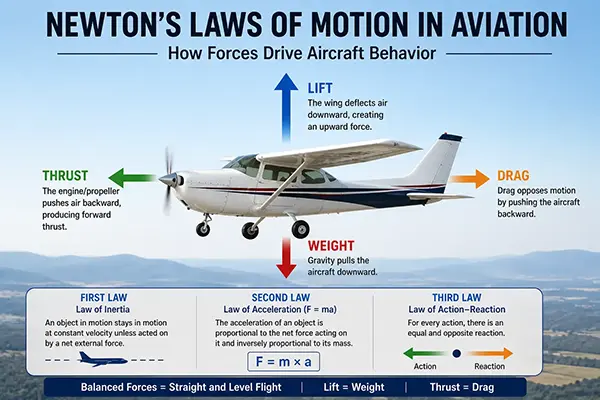
Newton’s three laws describe how forces affect motion. In aviation these translate directly to the familiar forces of lift, weight, thrust, and drag as well as to concepts like inertia, acceleration, and reaction forces. Below are the laws with aviation-focused explanations.
First Law: The Law of Inertia
The first law states that an object at rest stays at rest and an object in motion remains in motion at constant velocity unless acted on by a net external force. For aircraft this means an airplane in steady, level flight will continue straight and level if the forces are balanced. Inertia also explains why abrupt control inputs or sudden changes in attitude can feel like the airplane is resisting those changes.
Practical implications include recognizing the aircraft’s tendency to maintain airspeed and heading when power and trim are constant, and understanding why heavy aircraft require more force to change speed or direction. Inertia affects how quickly an aircraft will respond to control inputs and how it reacts to gusts and turbulence.
Second Law: The Law of Acceleration (F = ma)
The second law links net force, mass, and acceleration: the acceleration produced is proportional to the net force and inversely proportional to the mass. In flight operations this describes how changes in thrust, drag, lift, or weight produce acceleration or deceleration. For a given net force, a lighter aircraft accelerates more than a heavier one.
When you add power on takeoff, the excess thrust accelerates the airplane along the runway. During a climb, available excess thrust must overcome both drag and the component of weight opposing the climb. Mass in this context includes fuel, payload, and the airplane itself; mass management therefore affects climb rate, acceleration, and controllability.
Third Law: Action and Reaction
The third law says every action has an equal and opposite reaction. Propellers push air backward and receive a forward reaction as thrust. Wings deflect air downward; the downward acceleration of the air produces an upward reaction force we call lift. Jet engines accelerate exhaust gases rearward, producing forward thrust as a reaction.
This law explains several operational effects: propeller slipstream striking the fuselage or tail surfaces, asymmetric thrust when an engine fails, and the forces transmitted to airframes during hard landings where the runway pushes back against the wheels.
Why This Matters in Real-World Aviation
Understanding these laws helps pilots predict aircraft responses and manage energy. When you plan a go-around, execute a short-field takeoff, perform a crosswind landing, or respond to an engine failure, Newton’s laws provide the framework that explains what the airplane will do and why.
Flight training becomes more efficient when instructors explain maneuvers in terms of forces and mass rather than only procedural steps. For example, teaching a student that climbing with excess pitch and insufficient power will quickly lead to a decaying airspeed because gravity and insufficient thrust produce a net force that reduces speed clarifies the link between control inputs and energy state.
How Pilots Should Understand This Topic
Pilots should translate Newton’s abstract laws into operational concepts: energy management, control coordination, load factors, inertia, and the effects of mass and balance. Key practical interpretations include:
- Energy Management: Think in terms of kinetic and potential energy. Speed and altitude are interchangeable forms of energy that determine available maneuvering capability.
- Mass Matters: Heavier aircraft accelerate and decelerate more slowly and require more control force to change motion. Weight and balance affect how forces produce acceleration and moment arms.
- Predict Responses: Apply the laws mentally before making large control or power changes. Anticipate how the aircraft will accelerate or rotate when you add or remove thrust.
Use the aircraft’s trim to relieve control forces and maintain predictable responses. Proper trimming reduces the need for continuous control inputs that fight inertia and helps the airplane settle into a balanced state where forces are neutralized.
Common Mistakes or Misunderstandings
Pilots sometimes misapply Newton’s laws in ways that increase risk. Common issues include:
- Overcontrolling: Large, abrupt inputs try to overcome inertia abruptly and can induce oscillations or overstress the airframe.
- Ignoring Mass Effects: Treating a loaded aircraft the same as an empty one when planning climb performance or energy management leads to inadequate margins.
- Misreading Action-Reaction: Underestimating the consequences of propeller slipstream or jet blast on control surfaces and tailplane loading, which can affect pitch and yaw during power changes.
- Improper Trim Use: Relying solely on constant control pressure instead of trim increases pilot workload and may mask the true control forces required as speed or configuration changes.
Recognizing these mistakes in training and operations reduces surprises and improves safety margins.
Practical Example
Scenario: Single-engine piston aircraft on a short-field departure with obstacles at the end of the runway. The pilot must accelerate to rotation speed and climb clear of trees. Apply Newton’s Laws in sequence:
- First law: The airplane resists changes in motion. The pilot must apply sustained thrust to overcome inertia and maintain acceleration down the runway.
- Second law: Increased mass from full fuel and payload reduces acceleration for a given engine power. To achieve the necessary climb acceleration, the pilot must ensure adequate power and use flaps and climb profile recommended by performance planning.
- Third law: The propeller accelerates air rearward. Ensuring correct propeller pitch and full throttle produces the reaction force that propels the airplane forward and enables rotation and climb.
Operational takeaway: Preflight performance planning must account for mass and density altitude. During the takeoff, smooth, timely power and pitch control combined with proper configuration minimize time on the runway and maximize climb gradient.
Best Practices for Pilots
Apply Newton’s laws to build safer habits and better airmanship:
- Plan energy: Before takeoff and before maneuvers, consider where energy is stored as speed or altitude and how you will trade between them.
- Use smooth control inputs: Reduce the likelihood of overcontrol and dynamic instabilities by applying gradual, deliberate stick or yoke movements.
- Manage weight and balance: Understand how loading changes acceleration, climb performance, and controllability.
- Train for abnormal configurations: Practice power changes, engine failures, and sudden attitude changes in a simulator or with an instructor to see how inertia and reaction forces manifest.
- Trim proactively: Use trim to minimize continuous control force and maintain a steady state where forces are balanced.
Frequently Asked Questions
How does Newton’s first law explain turbulence response?
Turbulence introduces brief external forces that upset a previously balanced state. Because of inertia, the aircraft’s structure and occupants resist rapid changes in motion. Small, well-trimmed aircraft will accelerate and pitch briefly in response to a gust; maintaining smooth corrective inputs and allowing the airplane to damp naturally is usually better than aggressive control movements.
How does weight affect acceleration during climb?
Weight contributes to the mass term in F = ma. For a given excess thrust, a heavier airplane will show less upward acceleration than a lighter one. Practically this reduces climb rate and requires more runway or power to achieve the same performance, so pilots must include weight in performance calculations.
Why does adding power sometimes pitch the nose up in propeller-driven airplanes?
Adding power increases the propeller slipstream and torque effects. The slipstream can change the pressure distribution over the tail and elevator, and torque can induce a rolling or pitching tendency. These are action-reaction consequences: the engine action on the propeller and air produces reaction forces on the airframe that change attitude. Proper rudder and elevator coordination and trim adjustments compensate for these effects.
Can Newton’s laws explain a go-around procedure?
Yes. A go-around requires adding thrust to produce net forward acceleration, increasing pitch to a climb attitude, and reconfiguring flaps. Pilots must manage energy to prevent airspeed decay. Newton’s laws explain why delays in adding power or abrupt pitch changes can lead to an unfavorable energy state and potential loss of altitude.
Key Takeaways
- Practical takeaway: Think in terms of forces and energy for every maneuver—speed and altitude are interchangeable tools you manage with power and attitude.
- Safety takeaway: Smooth, timely inputs and proper trim prevent overcontrol and reduce the risk of unintended accelerations or structural loading.
- Training and decision-making takeaway: Incorporate demonstrations of inertia, F = ma, and action-reaction into lessons and briefings so students grasp why maneuvers behave as they do.