
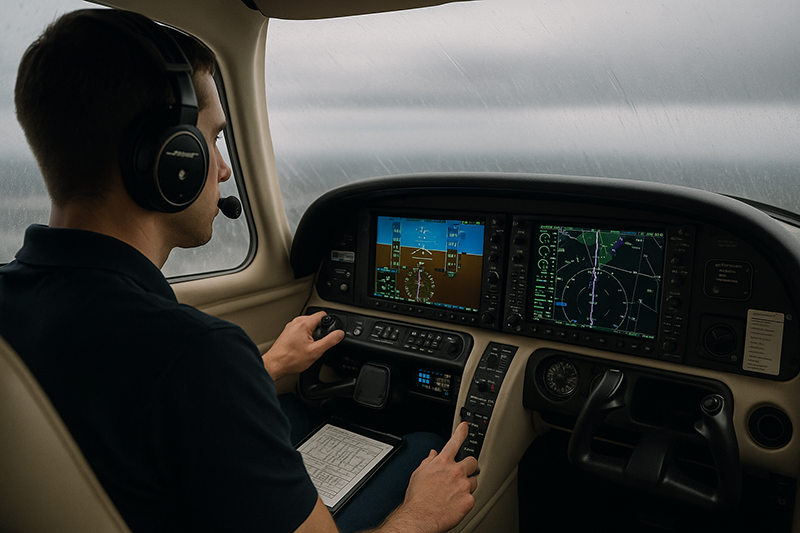
Managing workload during busy IFR flights is one of the most important skills a pilot can develop after learning the basic mechanics of instrument flying. In instrument meteorological conditions, high-density airspace, or a fast-moving arrival sequence, the airplane does not wait while the pilot catches up. Altitudes, headings, frequencies, approach briefings, weather decisions, checklist flow, aircraft configuration, and traffic awareness can all compete for attention at the same time.
The good news is that IFR workload is manageable when pilots understand where it comes from and build disciplined habits before the flight becomes saturated. The goal is not to become faster at doing everything. The goal is to make better decisions about what must be done now, what can be delayed, what can be prepared in advance, and what can be simplified. This article explains how pilots, student pilots, flight instructors, and aviation professionals can think about workload management in practical terms, with emphasis on safety, training, cockpit discipline, and real-world IFR decision-making.
What Workload Means in IFR Flying
Workload is the total demand placed on a pilot’s attention, time, memory, hand-flying skill, communication ability, and decision-making capacity. In VFR flying, workload often rises during takeoff, landing, weather changes, traffic conflicts, or abnormal situations. In IFR flying, workload can rise sharply because the pilot must control the aircraft precisely while also interpreting clearances, tracking navigation, managing avionics, monitoring weather, and staying ahead of the next segment of the flight.
A busy IFR flight is not necessarily unsafe. Many IFR operations are busy by nature, especially in terminal areas, training environments, and mixed airspace with jets, turboprops, helicopters, and piston aircraft. The safety issue appears when workload exceeds the pilot’s ability to process information accurately. At that point, errors become more likely: missed altitude assignments, incorrect frequencies, late configuration changes, rushed approach briefings, poor checklist discipline, or an unnoticed deviation from course or glidepath.
Workload also has a timing component. A task that is easy in cruise can become difficult on vectors to final. Loading an approach into the navigator, briefing minimums, tuning frequencies, reviewing missed approach instructions, and changing weather strategy are all manageable tasks when done early. The same tasks can become stressful if delayed until the aircraft is descending, turning, communicating with approach control, and approaching the final approach course.
Effective IFR workload management begins with a simple principle: do not let routine tasks become emergencies of timing. The more a pilot can prepare, sequence, and simplify, the more mental capacity remains available for the unexpected.
Why This Matters in Real-World Aviation
Instrument flying places a premium on disciplined attention. A pilot operating in cloud, at night over sparse visual references, or in marginal weather has fewer external cues to correct a developing mistake. The flight instruments, navigation displays, ATC instructions, and published procedures become the pilot’s primary references. If workload crowds out instrument scan, aircraft control can degrade quickly.
Busy IFR operations also tend to occur near airports, during arrivals, departures, holds, amendments, and approach transitions. These phases of flight already involve reduced time and increased consequences. A late descent, an unstable approach, an incorrect approach mode, or a misunderstood clearance can force the pilot into rapid corrective action. In some cases, the safest decision is to slow down, request delaying vectors, ask for clarification, or execute a missed approach rather than trying to salvage a poorly organized situation.
For student pilots and instrument students, workload management is often the hidden skill behind apparent proficiency. A student may be able to fly headings and altitudes well in isolation but struggle when radio calls, chart interpretation, avionics programming, and simulated weather decisions are added. That is normal. Instrument training is partly about building capacity, but it is also about learning how to reduce unnecessary demand on that capacity.
For instructors, workload management deserves direct teaching rather than casual mention. Students need to learn not only which button to press or which altitude to capture, but when to do it, when not to do it, and how to protect aircraft control while tasks accumulate. Scenario-based training is especially useful because it reveals how pilots prioritize under pressure.
For experienced pilots, workload management is still relevant because advanced avionics, capable autopilots, datalink weather, electronic flight bags, and complex airspace can create the illusion that the flight is easier than it really is. Technology can reduce workload when used properly, but it can also add workload if the pilot is troubleshooting, reprogramming, or staring inside at the wrong moment.
The Core Principle: Aviate, Navigate, Communicate
The familiar priority of aviate, navigate, communicate remains one of the best workload management tools in IFR flying. It is not a slogan to recite during training. It is a decision filter for moments when the cockpit gets saturated.
Aviate means maintain aircraft control, energy management, attitude, airspeed, altitude, and configuration appropriate to the phase of flight. In IFR conditions, this includes protecting the instrument scan and verifying what the aircraft is actually doing, not what the pilot expected it to do. If a pilot becomes task saturated while programming an approach and the airplane begins drifting through an assigned altitude, the workload problem has already affected the highest priority.
Navigate means know where the aircraft is, where it is going, what clearance or procedure is being flown, and what must happen next. Navigation is not limited to the magenta line. It includes situational awareness, terrain and obstacle awareness, minimum altitudes, route changes, holding instructions, approach transitions, and missed approach planning. A pilot who is perfectly holding altitude but unsure of the cleared route or approach segment is still behind the airplane.
Communicate means transmit and receive information clearly, but communication should support the flight rather than consume it. If a pilot misses a radio call while stabilizing the aircraft, the answer is not to panic. Maintain control, then ask ATC to repeat. If a clearance is unclear, ask for clarification. If an instruction creates unsafe compression of tasks, say unable or request an alternative. Clear, calm communication is a workload tool.
The order matters most when the workload is highest. In low workload cruise, a pilot may be able to manage all three priorities at once. During a late runway change in actual IMC, with a frequency change and descent clearance, the pilot must consciously return to the priority structure. Fly the airplane first, verify navigation second, then communicate as needed.
How Pilots Should Understand Task Saturation
Task saturation occurs when the number, complexity, or urgency of tasks exceeds the pilot’s available capacity. It is not a character flaw and it is not limited to new pilots. Even experienced pilots can become saturated when a flight presents multiple simultaneous demands, especially in unfamiliar aircraft, unfamiliar airspace, challenging weather, or with a passenger or crew distraction.
Common signs of task saturation include fixation on one instrument or display, reduced radio comprehension, delayed checklist use, repeated small altitude or heading deviations, confusion about the clearance, rushing through briefings, or feeling annoyed by normal ATC communication. Another sign is a shrinking time horizon. The pilot stops thinking about the next fix, next altitude, or missed approach and focuses only on the current task.
One of the most useful ways to manage saturation is to reduce the number of active decisions. This can be done by briefing earlier, setting up avionics in phases, using standard callouts or flows, loading but verifying procedures before they are needed, and establishing personal gates for configuration and approach stability. In a single-pilot cockpit, these habits serve as a substitute for a second crewmember’s monitoring function.
Task saturation is also affected by aircraft speed. A high-performance aircraft covers distance quickly, but even a slower training airplane can feel fast when the pilot is behind. The solution is not simply to fly slower in all circumstances. The practical solution is to use speed management, early planning, and ATC coordination to create enough time for safe operation. When appropriate, asking for a vector, a slower speed, or a delay can be far safer than accepting every instruction while overloaded.
Planning Ahead Before the Flight Gets Busy
Good IFR workload management begins before engine start. Preflight planning is not just about determining whether the flight is legal or possible. It is about identifying where the pilot is likely to be busy and preparing for those moments in advance.
A useful IFR briefing looks at departure procedures, route structure, expected altitudes, terrain, weather trends, alternates, arrival procedures, approach options, NOTAMs, runway conditions where applicable, and fuel strategy. The pilot should also consider workload triggers. Will the departure require a quick frequency change and climb restriction? Is the destination in complex airspace? Are multiple approaches likely? Is weather moving through the area? Is there a high chance of a runway change? Is the pilot unfamiliar with the avionics database or autopilot mode structure?
The point is not to memorize every possible outcome. The point is to reduce surprise. A pilot who has already reviewed the likely arrival and approach choices will respond more calmly when ATC assigns one of them. A pilot who has reviewed the missed approach and alternate plan will be less tempted to continue an unstable or poorly understood approach just because the cockpit is busy.
Before takeoff, pilots should organize the cockpit so that essential information is available without searching. Charts should be accessible, frequencies should be anticipated where practical, the flight plan should be checked for reasonableness, and the avionics should be configured for the departure. In aircraft equipped with autopilot, the pilot should review the intended mode usage and be ready to hand-fly if automation does not behave as expected.
Preparation also includes personal readiness. Fatigue, dehydration, time pressure, and passenger expectations can all reduce the margin for managing workload. A pilot who begins the flight rushed is more likely to remain behind the airplane. A short pause before departure to review the clearance, departure plan, initial altitude, first fix, and contingency plan can pay dividends later.
Managing Workload During Departure
IFR departures can become busy very quickly. The pilot may need to maintain precise aircraft control, comply with an assigned heading or published procedure, contact departure control, level at an initial altitude, and manage climb performance while still close to the ground. In actual IMC, the transition from visual cues to instruments can add demand, especially for pilots with limited recent instrument experience.
The departure phase rewards simplicity. Before takeoff, the pilot should understand the clearance, initial route, initial altitude, expected first frequency, and any published or assigned departure instructions. If something is unclear, the time to resolve it is before entering the runway, not after rotation.
After takeoff, pilots should resist the urge to do nonessential cockpit work too early. The first priority is a stable climb, proper pitch and power, airspeed control, and compliance with the initial clearance. If an avionics change can wait until the aircraft is established in climb and clear of immediate terrain concerns, it should wait. If the aircraft has a capable autopilot and the pilot is trained and current in its use, automation may help reduce workload after safe engagement. However, automation should never be treated as a substitute for monitoring.
Departure workload is also a good example of why briefings should be short but meaningful. A departure briefing that merely repeats every item on a chart may not improve performance. A better briefing highlights what matters: the runway, initial heading or track, altitude constraints, first fix, emergency return options, terrain or obstacle considerations, and the first expected radio task. The briefing should help the pilot act, not just prove that the chart was read.
Enroute Workload: Staying Ahead During the Quiet Part
The enroute phase can feel quiet, which is exactly why it is valuable. In IFR flying, cruise is the time to get ahead. When pilots waste the low-workload portion of the flight, they often pay for it during descent and approach.
During cruise, pilots should periodically confirm position, route, altitude, fuel state, weather, destination conditions, alternate considerations, and equipment status. This does not require constant activity. It requires deliberate monitoring at appropriate intervals. The pilot should also begin planning the descent and arrival early enough to avoid last-minute compression.
Approach preparation is one of the most important enroute workload reducers. Before the terminal environment becomes busy, the pilot can review the likely approach, verify chart currency through the normal flight planning system, identify initial approach fixes, review minimums, understand the missed approach procedure, consider terrain, and plan aircraft configuration. If multiple approaches are likely, the pilot can compare them and identify what would drive the selection.
For pilots using electronic flight bags, enroute is also the right time to manage screen setup. The needed chart, airport diagram, weather products, and approach plate should be easy to reach. A tablet with a low battery, overheated screen, or disorganized chart sequence can become a workload problem at exactly the wrong time. Paper backups or alternate electronic access may be appropriate depending on the operation and pilot preference.
The quiet part of the flight should also include a mental rehearsal of abnormal possibilities. What if the destination weather drops? What if ATC assigns a different approach? What if the autopilot disconnects in IMC? What if the pilot is asked to hold? Thinking through these possibilities early reduces the startle effect later.
Approach Workload and the Need for Stability
The approach phase is where many IFR workload issues become visible. The aircraft is descending, airspeed and configuration are changing, navigation sensitivity may increase, ATC may issue final vectors or approach clearances, and the pilot is preparing for either landing or missed approach. If the pilot reaches this phase unprepared, there may not be enough time to catch up comfortably.
A stabilized approach concept is useful in IFR operations because it gives the pilot a practical decision point. While specific criteria vary by aircraft, operator, and training environment, the general idea is that the aircraft should be on the correct path, at an appropriate speed, properly configured, and under control by a defined point before landing. If the approach is not stable, continuing may increase risk. In instrument conditions, a missed approach is not a failure. It is a normal procedure and often the best workload management decision.
Approach briefings should be completed early enough to leave time for flying. A practical briefing covers the approach name, runway, navigation source, course, altitude constraints, minimums or decision altitude as applicable, missed approach procedure, airport environment, lighting expectations, and any special considerations the pilot has identified. The briefing should also include how automation will be used and what the pilot will do if automation does not capture the expected mode.
Mode awareness is a major part of modern IFR workload management. Many aircraft have autopilots and navigators that can reduce workload substantially, but only when the pilot understands what mode is active, what mode is armed, and what the aircraft will do next. A pilot who assumes the autopilot captured a course or glidepath without verifying it may be surprised at a critical time. The best practice is to use automation deliberately, confirm mode changes, and keep the raw flying skills sharp enough to take over smoothly.
Communication as a Workload Management Tool
ATC communication can either reduce workload or increase it, depending on how it is handled. Clear readbacks, concise requests, and early questions help keep the flight organized. Hesitation, unclear readbacks, or accepting instructions that the pilot does not understand can create downstream problems.
One of the most underused workload tools is asking for help early. Pilots can request a repeat, ask for clarification, request vectors, ask for a delay, or advise ATC when they need more time. In a busy environment, controllers may be sequencing many aircraft, but they cannot know the pilot’s cockpit workload unless the pilot communicates. A simple, professional request can prevent a rushed or unstable situation.
Communication discipline also means knowing when not to talk. During a high-workload moment, such as intercepting final in actual IMC or correcting an altitude deviation, the pilot should fly the aircraft first. A delayed response is usually less serious than a loss of aircraft control. Once the aircraft is stable, the pilot can respond or ask ATC to repeat the call.
In two-pilot operations or instructional flights, cockpit communication matters just as much. Roles should be clear. One pilot flies while the other manages radios, charts, or checklists as appropriate to the operation. In training, instructors should be careful not to overload the student with teaching points during already saturated phases. Debriefing after the event is often more effective than adding more verbal input while the student is struggling to maintain control and situational awareness.
Common Mistakes and Misunderstandings
A common misunderstanding is that good pilots simply handle more tasks faster. In reality, safe IFR pilots are often good at avoiding unnecessary task compression. They prepare early, simplify when appropriate, and recognize when the situation requires a reset.
Another mistake is allowing avionics programming to replace basic aircraft control. Advanced navigators and flight displays are valuable, but heads-down time during critical phases can be hazardous. If a clearance amendment requires significant reprogramming, the pilot may need to use heading mode, request a vector, or delay the programming until workload allows. The airplane should not be left to wander while the pilot searches through menus.
Pilots also sometimes brief too late or too broadly. A briefing delivered while intercepting the final approach course is not really a workload reducer. A briefing that includes every chart detail but fails to identify the practical threats may not help either. The most effective briefing is timely, focused, and tied to decisions the pilot will actually make.
Another risk is continuing an approach because the pilot feels committed. IFR flying requires the ability to abandon a plan that is no longer working. If the approach is unstable, the avionics are not configured correctly, the pilot is unsure of the clearance, or the aircraft is not where it should be, a missed approach or request for vectors may be the safest choice. Pride and schedule pressure are poor reasons to continue.
Finally, some pilots misunderstand automation as a workload eliminator. Automation is better understood as a workload manager. It can hold altitude, track navigation, manage vertical modes, or reduce hand-flying demand, but it also requires setup, verification, and monitoring. When automation behaves unexpectedly, the pilot must be ready to disconnect or change modes and fly the aircraft.
Practical Example: A Busy IFR Arrival
Consider a single-pilot IFR flight in a well-equipped piston aircraft approaching a busy metropolitan airport. The aircraft is in smooth IMC at 7,000 feet. The pilot expected an RNAV approach to Runway 18 and reviewed it during cruise. Twenty miles from the airport, approach control advises that the runway has changed and assigns vectors for the ILS to Runway 27. The controller also issues a descent, a frequency change is likely soon, and the pilot has not yet loaded the new approach.
This is a classic workload compression moment. The unsafe response would be to immediately go heads-down, rush through the navigator, half-listen to ATC, and allow altitude or heading control to degrade. A better response begins with priorities. The pilot maintains aircraft control, starts the assigned descent, confirms the heading, and reads back the clearance accurately. If using automation, the pilot verifies the correct lateral and vertical modes. Then, when the aircraft is stable, the pilot loads the ILS approach and verifies the correct runway, frequency, course, and final approach fix sequence.
If the pilot needs more time, a professional request is appropriate: request a vector to allow setup, ask for a repeat of the clearance, or advise that more time is needed before accepting an approach clearance. Once the approach is loaded, the pilot reviews the key items: localizer frequency and course, glideslope intercept altitude, decision altitude or minimums as applicable to the operation, missed approach instructions, and expected runway environment. The pilot sets up the chart and confirms that the aircraft is not being rushed into final before ready.
If everything is configured, the aircraft is stable, and the pilot understands the clearance, the approach can continue. If not, the pilot has options. A missed approach, delaying vector, or request for resequencing is not an embarrassment. It is sound aeronautical decision-making. The pilot who recognizes task saturation early has more options than the pilot who waits until the aircraft is already unstable.
Best Practices for Managing Workload During Busy IFR Flights
Workload management is built from habits. These habits should be practiced in training, reinforced during recurrent review, and adapted to the aircraft and operating environment. The following practices are especially useful for single-pilot IFR operations, but the principles apply broadly.
- Prepare before the busy phase. Review expected departures, arrivals, approaches, alternates, and weather before the aircraft is close to the terminal area.
- Use a consistent cockpit flow. A repeatable flow reduces the chance of missing radios, navigation setup, altimeters, fuel checks, or approach preparation.
- Brief what matters. Focus on the items that affect aircraft control, navigation, decision-making, missed approach planning, and runway alignment.
- Manage automation deliberately. Know which modes are active and armed. Verify that the aircraft is doing what you intend.
- Ask early when you need time. A request for vectors, clarification, or a delay is better than rushing into an unstable situation.
- Protect the instrument scan. Do not let chart work, avionics programming, or communication consume attention needed for aircraft control.
- Make the missed approach normal. Treat it as a planned option, not a last-second rescue maneuver.
One additional best practice is to conduct a short personal debrief after busy IFR flights. Ask what created the highest workload, what was prepared well, what was delayed too long, and what could be simplified next time. This turns experience into training value. Pilots who debrief honestly often improve faster than pilots who simply log the flight and move on.
Training Workload Management in the Aircraft and Simulator
Instrument training should include more than perfect approaches in predictable conditions. A pilot who only practices one approach at a time, with long setup periods and no realistic distractions, may be surprised by real IFR. Training should gradually introduce workload in a controlled way: amended clearances, holds, partial panel scenarios where appropriate, unexpected approach changes, weather decision points, and realistic ATC-style timing.
Simulators and aviation training devices can be excellent tools for this purpose because they allow repetition and scenario variety without the same cost or weather limitations as aircraft training. The value comes from designing scenarios that require prioritization, not from overwhelming the pilot for its own sake. The instructor should help the pilot recognize saturation cues and apply strategies to regain control of the situation.
In the aircraft, instructors can build workload management by asking students to verbalize priorities. For example, before an approach, the student can state what must be done now, what has already been completed, what can wait, and what would trigger a missed approach. This builds mental organization and helps the instructor identify gaps in understanding.
Training should also include the appropriate use of automation. Pilots should practice with automation engaged, with automation degraded, and with automation disconnected. The goal is not to avoid technology. The goal is to remain the pilot in command of the flight path regardless of the technology state.
Single-Pilot IFR: Building Your Own Support System
Single-pilot IFR deserves special attention because there is no other crewmember to catch errors, tune radios, brief procedures, or challenge a questionable decision. The single pilot must create structure through preparation, standardization, and conservative decision-making.
A personal IFR system might include standard times for approach setup, a preferred cockpit layout, consistent phraseology for self-briefing, written or electronic notes for clearances, and personal minimums that account for workload as well as weather. For example, a pilot may be legally able to attempt an approach to published minimums, but still decide that fatigue, unfamiliar avionics, night conditions, or gusty winds make a more conservative plan appropriate.
Passengers can also affect workload. A passenger question during an approach briefing, a loose item in the cockpit, or anxiety about weather can distract the pilot. A short passenger briefing before departure can help. Explain when conversation should be limited, how passengers can help by staying quiet during busy phases, and what to expect if the aircraft goes missed or diverts.
Single-pilot IFR also benefits from knowing personal limits. The right decision may be to delay, cancel, file to a less complex airport, take a safety pilot for practice, or fly with an instructor to regain proficiency. Workload management is not only an in-flight skill. It is a planning and judgment skill.
Frequently Asked Questions
What is the best way to reduce workload during an IFR approach?
The best way is to prepare early. Review and brief the approach before the terminal environment becomes busy, configure avionics deliberately, understand the missed approach, and establish a stable aircraft before final. If the approach becomes rushed or unclear, request more time or go missed.
How does automation affect IFR workload?
Automation can reduce physical flying workload and help with navigation and altitude control, but it adds a monitoring requirement. Pilots must understand active and armed modes, verify aircraft response, and remain ready to hand-fly or change modes if needed.
When should a pilot ask ATC for help during a busy IFR flight?
A pilot should ask as soon as workload begins to interfere with safe aircraft control, navigation, or comprehension of instructions. Requests for clarification, delaying vectors, a slower speed when appropriate, or more time are normal tools for maintaining safety.
Why do pilots get behind the airplane in IFR?
Pilots often get behind when tasks are delayed until a high-workload phase, when weather or routing changes create surprise, when avionics programming takes attention away from flying, or when the pilot tries to continue rather than pause, simplify, or ask for help.
Is going missed a sign of poor IFR performance?
No. A missed approach is a normal IFR procedure and a valid safety decision. If the aircraft is unstable, the runway environment is not available when required, the pilot is unsure of the setup, or workload is excessive, going missed may be the most professional choice.
Final Thoughts
Managing workload during busy IFR flights is not about eliminating pressure from instrument flying. IFR operations will always involve moments of high demand. The professional skill is recognizing those moments early, protecting aircraft control, staying organized, using available resources, and making decisions before the margin becomes thin.
Pilots who manage workload well tend to look calm because they have already done much of the work before the busy moment arrives. They brief early, use automation with discipline, communicate clearly, and are willing to slow the situation down. They also accept that a missed approach, amended plan, or request for delay is sometimes the safest and most efficient outcome.
For students, instructors, and experienced pilots alike, workload management should be treated as a core IFR proficiency. The airplane, avionics, airspace, and weather may differ from flight to flight, but the underlying discipline remains the same: fly the airplane, know where you are going, communicate clearly, and never let unnecessary task compression take control of the cockpit.
Key Takeaways
- Prepare for high-workload IFR phases early by reviewing clearances, procedures, weather, avionics setup, and missed approach plans before time pressure builds.
- When workload rises, protect the fundamentals first: aircraft control, navigation awareness, and clear communication in that order.
- Use ATC, automation, training scenarios, personal minimums, and missed approach decisions as practical tools for reducing risk during busy IFR operations.