
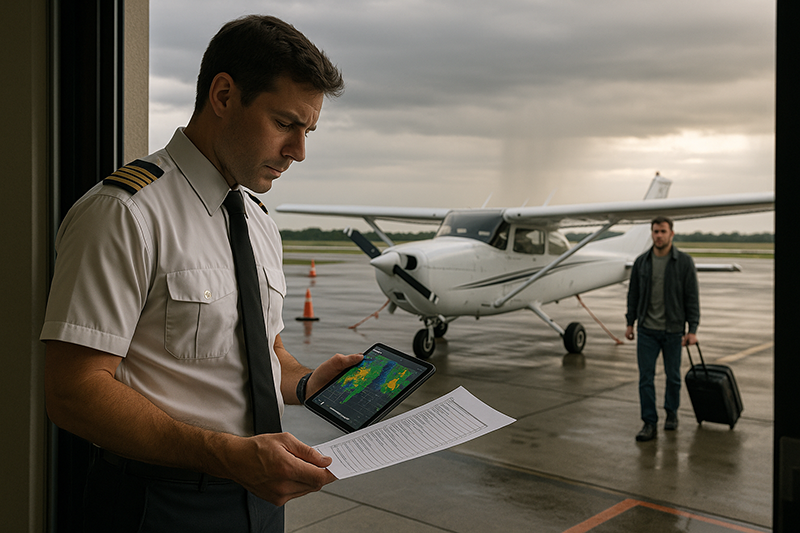
Managing external pressures is one of the most important pilot in command skills because it addresses the part of aviation decision-making that often feels least technical and most human. Weather, aircraft performance, fuel planning, airspace, and procedures can be evaluated with training and data. Pressure from passengers, schedules, money, pride, business expectations, or a long-awaited trip can be harder to measure, yet it can strongly influence how a pilot interprets every other factor.
External pressure does not automatically mean a pilot is careless or unsafe. It is a normal part of real-world flying. The safety issue begins when the desire to complete a flight starts competing with the discipline to delay, divert, cancel, or change the plan. A pilot in command must recognize that pressure early, name it honestly, and manage it before it narrows judgment. This article explains how pilots, student pilots, flight instructors, and aviation professionals can identify external pressures, integrate them into risk management, and make better go, no-go, continue, divert, and land decisions.
What External Pressure Means for the Pilot in Command
External pressure is any influence outside the aircraft’s basic flight requirements that encourages a pilot to accept more risk than would otherwise be reasonable. It may come from another person, such as a passenger expecting to arrive on time, a customer waiting at the destination, or a family member who does not understand aviation weather. It may come from circumstances, such as a hotel reservation, a business meeting, aircraft rental schedule, maintenance appointment, or the need to return before dark. It can also come from inside the pilot, especially when the pilot wants to prove competence, avoid embarrassment, protect a reputation, or justify the cost of a trip.
The key point is not whether the pressure is obvious. The key point is whether it changes the pilot’s decision standard. A pilot who would normally wait for better weather may begin looking for reasons to depart. A pilot who would normally land with a larger fuel reserve may start rationalizing a shorter margin. A student who would normally discontinue a lesson in gusty crosswinds may feel reluctant to disappoint an instructor, parent, or examiner. These are not aircraft handling problems at first. They are judgment problems that can eventually create aircraft handling problems.
As pilot in command, the pilot is responsible for the safety of the flight and has the authority to make operational decisions necessary for that safety. In practical terms, this means the PIC must be willing to say “not today,” “not this route,” “not under these conditions,” or “we are landing short of the destination.” Managing external pressure is not separate from airmanship. It is a central part of airmanship because it protects the pilot’s ability to make decisions based on the airplane, the environment, the mission, and the people on board.
Why This Matters in Real-World Aviation
Training often presents risk management as a structured process, but actual flights rarely feel like a classroom exercise. The weather briefing may be marginal but improving. The aircraft may be airworthy but missing a piece of equipment that would make the flight more comfortable. The destination may be open, but the forecast suggests a possible change later in the day. A passenger may be calm at first, then become impatient when the pilot decides to wait. The decision is not always between safe and unsafe. It is often between a conservative option and a tempting option that seems workable if everything goes as hoped.
External pressure matters because it pushes pilots toward hope-based flying. Hope-based flying sounds like this: “It should be fine,” “We only need a small gap,” “The forecast is probably overdoing it,” “We can always turn around,” or “I have done this before.” Sometimes those statements may be true. The risk is that pressure makes them feel true before they have been tested against the facts. A disciplined PIC separates desire from data. The pilot asks what conditions are actually present, what conditions are forecast, what alternatives are available, and what decision points will trigger a change in plan.
This is especially important in general aviation because pilots may operate with fewer organizational barriers than airline or military crews. A single-pilot flight may not have a dispatcher, formal release process, second pilot, or operations control center. That does not make the flight unsafe by itself, but it does place more weight on the individual pilot’s personal minimums, preflight planning, and willingness to disappoint others. Even in professional operations with procedures and management support, external pressure can still appear through customer expectations, operational tempo, crew fatigue, or the desire to complete a mission.
Flight instructors have a special role in this area. Students learn not only from what instructors say, but also from what instructors tolerate. If an instructor routinely launches into marginal training conditions because the schedule is full, the student may learn that schedule pressure outranks judgment. If an instructor calmly cancels, delays, or modifies a lesson and explains why, the student learns that conservative decision-making is normal professional behavior.
How Pilots Should Understand External Pressures
External pressures are best understood as a risk multiplier. They may not change the weather, the runway length, the fuel on board, or the aircraft’s equipment, but they can change how the pilot evaluates all of those items. A pilot under pressure may focus on information that supports departure and discount information that supports delay. This is why pressure is so dangerous: it does not need to be loud to be effective.
One practical way to understand external pressure is to view it through the complete flight environment. The aircraft may be mechanically sound, but if the pilot is tired and the destination weather is deteriorating, pressure to continue can become significant. The weather may be legal for the operation, but if the pilot is not current, not proficient, or unfamiliar with the route, the margin may be too thin. A passenger may say, “I trust you,” which can be supportive, but it can also unintentionally increase the pilot’s reluctance to cancel. The pressure is not always aggressive. Sometimes it is polite, subtle, and emotionally powerful.
Pilots often use familiar risk management models such as PAVE, IMSAFE, the 5P model, and DECIDE to organize aeronautical decision-making. These tools are useful because they help move the pilot from a vague feeling to a specific assessment. In PAVE, external pressures are considered along with the pilot, aircraft, environment, and external factors. In IMSAFE, the pilot evaluates personal readiness, including illness, medication, stress, alcohol, fatigue, and emotion. The 5P model encourages repeated review of the plan, plane, pilot, passengers, and programming. DECIDE supports a logical sequence for detecting a problem, estimating the need to act, choosing an outcome, identifying actions, doing them, and evaluating the result.
These tools should not be treated as paperwork exercises. Their value comes from honest use. A pilot who simply checks boxes can still be captured by pressure. A pilot who pauses and says, “The main reason I want to continue is that everyone is waiting for me,” has identified something operationally important. Once pressure is named, it becomes easier to manage. The pilot can call ahead, change the destination, arrange ground transportation, brief passengers, or set a hard return time before the situation becomes urgent.
The PIC Mindset: Authority, Responsibility, and Boundaries
The pilot in command mindset is not about being stubborn or dramatic. It is about accepting that safety decisions belong to the person responsible for the flight. A good PIC listens to passengers, instructors, dispatchers, maintenance personnel, air traffic control, and other pilots. A good PIC also understands that helpful input does not remove the need for independent judgment.
Strong PIC decision-making starts with boundaries. Boundaries are pre-decided limits that protect the pilot from negotiating with pressure in real time. Examples include personal weather minimums, fuel planning standards beyond the bare legal requirement, maximum crosswind comfort levels, daylight limitations for unfamiliar airports, and rules about launching when tired or emotionally distracted. These boundaries should be based on training, proficiency, aircraft capability, terrain, weather, and operational context.
Personal minimums are not a sign of weakness. They are a sign that the pilot understands the difference between qualification and proficiency. A pilot may be legally qualified to conduct a flight but still decide that the combination of conditions is not wise that day. That decision may be based on recent experience, workload, passenger considerations, or the complexity of the route. The best pilots are not trying to use every inch of legal or aircraft capability on every flight. They are trying to preserve margins.
Boundaries also help with communication. It is easier to tell passengers, “My personal minimums require a higher ceiling for this route, so we are delaying,” than to debate whether the weather is “really that bad.” It is easier to tell a customer, “We need a fuel stop because the winds are stronger than planned,” than to continue while hoping the fuel situation remains comfortable. Clear boundaries turn a subjective argument into a professional decision.
Common Mistakes and Misunderstandings
One common mistake is believing that external pressure only comes from other people. Passengers, employers, clients, and family members can all create pressure, but some of the strongest pressure comes from the pilot. A pilot may want to complete a first long cross-country, show confidence in front of passengers, avoid losing a rental deposit, or keep a perfect record of never canceling. Internal pride can become an external pressure when it is tied to how the pilot believes others will judge the outcome.
Another mistake is assuming that pressure is harmless if the flight remains legal. Legality is an essential baseline, but it is not the same as an adequate safety margin for every pilot, aircraft, route, and condition. A legal flight can still be unwise if the pilot is fatigued, the weather is near personal minimums, the alternates are poor, the terrain is demanding, or the passengers require more attention than usual. PIC judgment lives in the space between the minimum allowed and the margin that is appropriate.
A third misunderstanding is the belief that “we can always turn around” solves the problem. Turning around is a valid option only if it remains realistic. Weather may close behind the aircraft, terrain may limit options, fuel may become a constraint, or the pilot may become task saturated. If the turnaround plan is not specific, timely, and briefed before departure, it can become a comforting phrase rather than a usable escape plan.
Pilots also sometimes confuse confidence with commitment. Confidence is the ability to operate the aircraft and make decisions within known limits. Commitment is the emotional attachment to completing the original plan. The more committed a pilot becomes, the harder it can be to see alternatives. A professional mindset keeps the mission flexible. The destination is never more important than maintaining safe options.
Another frequent risk is passenger management. Pilots may avoid explaining uncertainty because they do not want to sound unsure. In reality, clear communication builds trust. Passengers do not need every technical detail, but they do need to understand that aviation decisions change with weather, fuel, daylight, aircraft status, and pilot condition. A passenger who has been briefed before the flight is less likely to be surprised by a delay or diversion.
Practical Example: A Marginal VFR Cross-Country
Consider a private pilot planning a weekend VFR cross-country in a normally aspirated single-engine airplane. The airplane is available, the passengers are excited, and the destination airport is near an event that starts in the afternoon. The forecast shows lowering ceilings along part of the route, with better conditions expected later. Surface winds are manageable, but stronger headwinds at cruise altitude will increase the flight time. The pilot is current and familiar with the aircraft, but has not flown a long cross-country in several weeks.
On paper, the flight may appear possible. The pilot could depart early, remain clear of clouds, and monitor conditions. The passengers are already at the airport, and one of them mentions that hotel check-in is nonrefundable. The pilot feels a familiar tension: the safe answer may be to wait, but the socially convenient answer is to go now.
A pressure-aware PIC does not begin by asking, “Can I make this work?” That question can invite the pilot to search for justification. A better question is, “What conditions would make this plan unacceptable, and are any of those conditions likely?” The pilot reviews the route, identifies airports along the way, checks fuel and winds, considers terrain and airspace, and looks at the trend rather than only the current observation. The pilot also evaluates personal readiness: recent experience, fatigue, comfort with marginal weather, and ability to manage passenger questions in flight.
The pilot then establishes specific decision points. For example, if ceilings along the route are below the pilot’s personal VFR minimums, departure waits. If groundspeed is lower than planned, the flight includes a fuel stop rather than continuing to the original destination. If the weather does not improve by a certain time, the trip changes to ground transportation or is postponed. These are not signs of indecision. They are signs that the pilot is managing the flight before the aircraft is airborne.
When the pilot briefs the passengers, the tone matters. A calm explanation such as, “The weather is not where I want it for this route yet. We are going to wait and reassess at 1100. If it does not improve, we will not fly this leg today,” removes ambiguity. The passengers may be disappointed, but disappointment is manageable on the ground. It is far harder to manage pressure, weather, fuel, and passenger anxiety at the same time in flight.
Best Practices for Managing External Pressures
The most effective technique is to plan the cancellation, delay, and diversion before they are needed. Many pilots plan the successful flight in detail but leave the unsuccessful version vague. A better approach is to treat alternatives as part of the primary plan. Before departure, decide where you will stop for fuel if headwinds increase, what airports are suitable if weather lowers, what time you must depart to preserve daylight, and what conditions will cause you to cancel.
Use personal minimums as living decision tools. Personal minimums should not be copied blindly from another pilot. They should reflect certificate level, recent experience, aircraft familiarity, avionics knowledge, weather skill, terrain, airspace complexity, passenger workload, and the purpose of the flight. They should become more conservative when multiple risk factors appear together. A pilot who is comfortable with a certain crosswind on a local solo flight may choose a lower limit at night, with passengers, at an unfamiliar airport, or after a long duty day.
Brief passengers early and professionally. Before the day of flight, explain that aviation plans depend on weather, aircraft status, pilot condition, and safe margins. Avoid promising arrival times that sound guaranteed. Use language such as, “Our plan is to depart at 0900 if conditions are suitable,” rather than, “We will be there by lunch.” This reduces the emotional cost of changing the plan later.
Build time into the schedule. Time pressure is one of the easiest pressures to underestimate. If the only acceptable outcome requires perfect weather, no maintenance delay, no fuel stop, no airspace reroute, and no passenger delay, the plan is fragile. A resilient plan includes slack. That may mean leaving earlier, planning an overnight option, allowing for a fuel stop, or making the flight optional rather than mandatory.
Make conservative decisions while options are abundant. The best time to divert is before the situation becomes urgent. The best time to delay is before passengers are seated and the engine is running. The best time to cancel is before fatigue, darkness, weather, or fuel reduces the number of safe choices. Pressure becomes harder to resist as the flight progresses because the pilot has already invested time, money, and emotion.
A short set of practical habits can make external pressure easier to manage:
- State the main pressure out loud during preflight planning, even if flying alone.
- Set decision points before departure, including weather, fuel, daylight, and pilot condition triggers.
- Use personal minimums that adjust for proficiency, aircraft, passengers, and environment.
- Brief passengers that delays, diversions, and cancellations are normal safety decisions.
- Call another qualified pilot, instructor, or dispatcher when you sense yourself rationalizing.
The purpose of these habits is not to eliminate judgment. It is to protect judgment from being reshaped by pressure. Pilots should still think, adapt, and use experience. The difference is that decisions are anchored in safety margins rather than in the emotional pull of the original plan.
How Instructors Can Teach External Pressure Management
Flight instructors should make external pressure visible during training. Students often learn weather minimums, fuel planning, and aircraft performance in isolation, then encounter pressure later without a structured way to respond. Scenario-based training can close that gap. Instead of asking only whether a flight is legal, the instructor can ask what the student would do if passengers were waiting, if the airplane had to be returned by a certain time, or if the destination event could not be rescheduled.
Instructors should also model professional cancellations. A canceled lesson can be a powerful teaching event if the instructor explains the decision. For example, a lesson may be postponed because the crosswind is beyond the student’s current training objective, because convective weather is developing near the practice area, or because the student appears fatigued. The lesson is not lost. It becomes a lesson in command judgment.
Debriefing is equally important. After a flight, instructors can ask, “What pressure did you feel today?” and “Did that pressure affect any decision?” These questions normalize the subject. They teach students that good pilots are not pressure-free. Good pilots are pressure-aware.
Managing Pressure in Professional and Crew Environments
External pressure does not disappear in professional aviation. It may become more organized, more subtle, or more procedural. A crew may feel pressure from passenger expectations, schedule recovery, aircraft positioning, customer service goals, or operational momentum. Professional crews often have more support than a single general aviation pilot, but they also operate in systems where many people care about completion.
In crew environments, managing pressure requires communication discipline. If one pilot senses that the crew is becoming too committed to the plan, that concern should be stated clearly and early. Standard operating procedures, briefings, callouts, fuel policies, weather requirements, and company guidance are designed to support safe operations, but they still depend on people being willing to speak up. A healthy cockpit culture treats a conservative question as a safety contribution, not an inconvenience.
For single-pilot professionals, the challenge can be even more personal. The pilot may be the only aviation expert in the immediate conversation. Clients may not understand why a flight that looked possible in the morning is not acceptable in the afternoon. The pilot’s professionalism is measured not by completing every flight, but by making decisions that preserve safety and comply with applicable rules, procedures, and sound operating practice.
Frequently Asked Questions
What are external pressures in aviation?
External pressures are influences that encourage a pilot to complete or continue a flight despite increasing risk. They may include passenger expectations, schedules, business commitments, financial concerns, rental availability, personal pride, or the desire to avoid disappointing others.
How can a pilot recognize external pressure before it affects judgment?
A pilot can recognize pressure by asking what outcome they are emotionally attached to and whether that attachment is changing the decision standard. If the pilot is searching for reasons to continue rather than objectively evaluating conditions, pressure may already be influencing judgment.
Are external pressures only a concern for student pilots?
No. Student pilots may be especially vulnerable because they are still building experience, but certificated pilots, instructors, commercial pilots, and professional crews can also experience external pressure. Experience helps only when it is paired with discipline and honest self-assessment.
Do personal minimums replace regulations or aircraft limitations?
No. Regulations and aircraft limitations establish boundaries that must be respected. Personal minimums are additional safety margins a pilot sets based on proficiency, conditions, aircraft, route, passengers, and operational complexity.
What should a pilot tell passengers when canceling or delaying a flight?
The pilot should be clear, calm, and brief. A useful explanation is that the current conditions do not meet the pilot’s safety standards for that flight, and the plan will be delayed, changed, or canceled. Passengers do not need a debate. They need confidence that the pilot is making a professional safety decision.
What is the best way to reduce get-there-itis?
The best way is to plan alternatives before the flight begins. Build extra time into the schedule, brief passengers about possible changes, set decision points, identify diversion airports, and treat delay or cancellation as normal outcomes rather than failures.
Key Takeaways
- Managing external pressures starts by naming the pressure and separating the desire to complete the flight from the facts that determine whether the flight should continue.
- External pressure is a risk multiplier because it can reduce safety margins by changing how a pilot interprets weather, fuel, aircraft status, personal readiness, and passenger needs.
- A disciplined pilot in command uses personal minimums, passenger briefings, decision points, and conservative alternatives to protect judgment before pressure becomes urgent.