
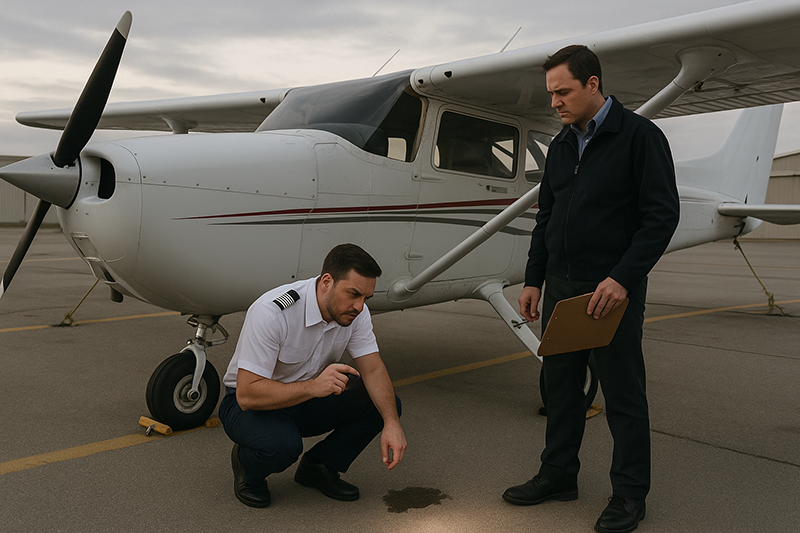
Maintenance discrepancies should influence go/no-go decisions long before a pilot reaches the runway. A discrepancy is not just an inconvenient squawk in the logbook or a note from the last flight. It is operational information that may affect legality, aircraft performance, system reliability, pilot workload, and the margin available if something else goes wrong.
For pilots, student pilots, flight instructors, and aviation professionals, the practical question is rarely, “Is the airplane perfect?” Aircraft are machines, and machines require inspection, maintenance, and judgment. The more important question is, “Can this aircraft be operated safely and legally for this specific flight, under these conditions, by this crew, with this mission?” That question requires more than a quick glance at the maintenance write-ups. It requires a disciplined decision process that combines regulations, aircraft documents, maintenance input, operational risk management, and conservative pilot judgment.
This article explains how maintenance discrepancies should shape a pilot’s go/no-go decision without turning the process into a rote checklist. The goal is to help pilots recognize when a discrepancy is minor, when it requires maintenance action, when it changes the mission, and when it should stop the flight entirely.
What Counts as a Maintenance Discrepancy?
A maintenance discrepancy is any known condition suggesting that an aircraft component, system, instrument, structure, engine indication, avionics item, or required document may not be in its expected airworthy condition. In everyday aviation language, pilots often call these “squawks.” Some are obvious, such as a flat tire, inoperative landing light, abnormal engine indication, fluid leak, cracked windshield, failed radio, or circuit breaker that will not stay in. Others are subtle, such as a slightly rough magneto check, intermittent alternator warning, unreliable fuel quantity indication, sluggish flap movement, autopilot disconnect issue, or a recurring odor that cannot be explained.
Not every discrepancy has the same significance. A missing decorative interior trim piece is not evaluated the same way as a brake problem. A failed cockpit light may carry different implications for a day VFR local flight than for an instrument flight at night. A minor item may become major when combined with weather, terrain, traffic density, pilot experience, or mission pressure.
The most important point is that pilots should not mentally downgrade a discrepancy simply because the aircraft flew recently, another pilot accepted it, or the issue seems familiar. A known discrepancy deserves deliberate attention every time the aircraft is dispatched or flown.
The Core Go/No-Go Question: Legal, Airworthy, and Suitable
Maintenance-related go/no-go decisions should be viewed through three overlapping lenses: legal, airworthy, and suitable. A flight should not proceed unless all three are reasonably satisfied.
“Legal” means the aircraft meets applicable regulatory requirements for the operation being conducted. That may involve required equipment, inspections, airworthiness limitations, placards, operating limitations, approved deferral procedures where applicable, and aircraft records. For pilots, the exact legal path depends on aircraft type, operation, equipment, and whether the aircraft is operated under a minimum equipment list, a kind of operation equipment list, or other approved or applicable procedures. Because the details matter, pilots should avoid guessing at regulatory compliance when a discrepancy involves required equipment or aircraft airworthiness.
“Airworthy” is broader than simply having a valid airworthiness certificate on board. In practical pilot terms, the aircraft must conform to its approved configuration and be in a condition for safe operation. A discrepancy can affect either part of that concept. A missing required placard, an inoperative required instrument, an unapproved modification, or a system condition that compromises safe operation can make the aircraft unacceptable for flight until properly addressed.
“Suitable” asks whether the airplane is appropriate for the planned mission even if it can legally be flown. For example, an aircraft may be permissible for a short day VFR maintenance reposition flight but unsuitable for a night cross-country with marginal weather. Suitability is where pilot judgment becomes central. It considers weather, terrain, airspace, fuel strategy, runway length, pilot proficiency, passenger needs, and alternatives.
Why This Matters in Real-World Aviation
Maintenance discrepancies matter because they reduce certainty. Aviation safety depends on layers of protection: reliable equipment, good weather planning, disciplined procedures, proficient piloting, available alternates, and sound decision-making. A discrepancy may remove one layer or weaken several at once.
Consider a landing light that is inoperative. In daylight, at a non-towered airport, for a short local training flight, it may not create the same operational concern as it would for a night arrival at a busy airport. But the decision should not stop at “the bulb is out.” The pilot should ask whether the light is required for the operation, whether it indicates a larger electrical problem, whether the aircraft records properly reflect the condition, and whether the flight environment makes the discrepancy significant.
Another example is an intermittent radio. A pilot might be tempted to accept it if the radio worked during engine start. But intermittent avionics problems often increase workload at the worst possible time. If the flight involves controlled airspace, instrument procedures, busy traffic patterns, or student training, the operational effect may be unacceptable. The issue is not merely whether the radio is working at the moment. The issue is whether the pilot can reasonably rely on it for the planned flight.
Discrepancies also matter because they can interact with human factors. Pilots face schedule pressure, passenger expectations, aircraft availability constraints, training deadlines, weather windows, and the natural desire to complete a mission. These pressures can quietly shift a pilot’s standards from “safe and legal” to “probably fine.” A structured approach helps resist that drift.
How Pilots Should Understand Maintenance Discrepancies
A good pilot does not need to become a mechanic, but every pilot should understand enough about aircraft systems and maintenance decision-making to ask the right questions. The pilot’s responsibility is not to diagnose every internal mechanical failure. The pilot’s responsibility is to identify abnormal conditions, understand operational consequences, consult appropriate references and qualified maintenance personnel, and decide whether the flight should proceed.
The starting point is documentation. A discrepancy that is merely discussed verbally but not properly recorded can create confusion. A discrepancy that is written down, evaluated, corrected, deferred, placarded where appropriate, and tracked through the proper process is far easier to manage. Pilots should be careful with informal habits such as “it has always done that” or “maintenance knows about it.” Those statements may or may not mean the issue has been evaluated in a way that supports the next flight.
Pilots should also distinguish between an observed symptom and an approved maintenance disposition. “The alternator light flickered during taxi” is a symptom. “The aircraft is approved for this flight with the item deferred in accordance with the applicable procedure” is a maintenance or operational disposition, depending on the aircraft and operation. A symptom is not a release to fly. It is a reason to investigate further.
For training aircraft, rental fleets, and club airplanes, pilots must be especially alert to continuity. Multiple pilots may fly the same aircraft in one day. A discrepancy reported after the previous flight may not be fully understood by the next pilot. The next pilot should not assume the aircraft is acceptable simply because the dispatch sheet is available or the keys are on the counter. Review the aircraft status, maintenance records available to pilots, open squawks, placards, and any dispatch limitations established by the operator.
The Difference Between Deferrable and No-Go Items
Some discrepancies may be deferrable under the right circumstances. Others are immediate no-go items. The challenge is knowing which is which and not treating that decision casually.
A deferrable item is an inoperative or discrepant item that can be addressed later only if the aircraft remains legal and safe for the intended operation and the proper procedure is followed. Depending on the aircraft and operation, that procedure may involve a minimum equipment list, aircraft equipment lists, maintenance record entries, placarding, deactivation, removal, operational limitations, or other approved methods. Pilots should not invent their own deferral process.
A no-go item is a discrepancy that prevents the aircraft from being operated safely or legally for the intended flight. Examples may include a failed required instrument for the planned operation, abnormal engine indications, fuel system concerns, brake problems, flight control abnormalities, structural damage, unresolved fluid leaks, or any condition that the pilot cannot confidently evaluate. The exact classification depends on the aircraft, operation, and circumstances, but the principle is simple: if the discrepancy affects required equipment, essential systems, controllability, powerplant reliability, fuel management, braking, navigation, communication, or emergency capability, the decision deserves a high level of caution.
One of the most dangerous pilot habits is treating deferral as a convenience rather than a controlled maintenance process. Deferring an item should mean the risk has been evaluated, the aircraft status is clear, the legal path is understood, and the operational limitations are respected. It should not mean “we can live without it” or “we will fix it after the trip.”
Regulatory Thinking Without Guesswork
Maintenance discrepancies often create regulatory questions, and pilots should be careful not to answer those questions from memory alone. Required equipment rules vary by operation, aircraft certification basis, installed equipment, day or night operations, VFR or IFR, and other factors. Some aircraft have approved minimum equipment lists. Many general aviation aircraft do not. Some equipment may be required by regulation, by the aircraft’s type design, by the operating limitations, by an equipment list, by a placard, or by the intended operation.
In practical terms, a pilot should ask four regulatory-minded questions when a discrepancy appears:
- Is the item required for this type of operation?
- Is the item required by the aircraft’s approved equipment, limitations, or placards?
- Has the discrepancy been handled through an appropriate maintenance or deferral process?
- Does the aircraft remain in a condition for safe operation for this specific flight?
If the pilot cannot answer those questions confidently, the correct next step is not to rationalize. It is to consult the aircraft documents, the operator’s procedures, an instructor or chief pilot when appropriate, and qualified maintenance personnel. A phone call to maintenance is not a sign of weak airmanship. It is often exactly what professional decision-making looks like.
Operational Risk: The Same Discrepancy Can Mean Different Decisions
A maintenance discrepancy should never be evaluated in isolation. The same squawk may lead to different go/no-go decisions depending on the operation. This does not mean standards are flexible in a careless way. It means risk is contextual.
For example, an inoperative second communication radio in an aircraft with two radios may have limited impact for a local day VFR flight in uncongested airspace if the remaining radio is reliable and the aircraft is otherwise legal. The same discrepancy may have greater significance for an IFR training flight in busy terminal airspace, where backup communication capability can reduce workload and provide resilience.
A questionable pitot heat system may not affect a warm-weather day VFR flight that avoids visible moisture and freezing conditions, but it could be critical for instrument flight in clouds at temperatures near freezing. A weak battery may be unacceptable for a night flight, an IFR departure, or a flight to a remote airport, even if the engine starts after external assistance. A minor brake concern might be enough to cancel a flight involving short runways, gusty crosswinds, student landings, or high-density traffic operations.
The pilot’s job is to combine the discrepancy with the mission. Ask what system margin has been lost, what backup remains, what the environment demands, and how the problem could evolve in flight. If the answer depends on optimism, the decision is probably moving in the wrong direction.
Human Factors in Maintenance-Related Decisions
Maintenance discrepancies are not only technical problems. They are human factors problems. Pilots often encounter them at inconvenient times: passengers are waiting, the weather is moving, the aircraft is scheduled for another lesson, or a trip has been planned for weeks. That is exactly when judgment can become vulnerable.
Several human tendencies show up repeatedly in maintenance-related decision-making. Familiarity can make an abnormal condition seem normal. If a door latch has always required extra force, the pilot may stop treating it as a discrepancy. Confirmation bias can lead a pilot to accept the first explanation that supports going. A faint fuel smell becomes “probably just overflow from fueling.” A rough mag check becomes “maybe it will clear up in the run-up area.” Plan continuation bias can make it harder to cancel after time, money, and expectation have already been invested.
Instructors should teach students that canceling or delaying for a maintenance concern is not failure. It is one of the clearest signs of maturing aeronautical decision-making. The pilot who says “I do not like this” and seeks maintenance input is often demonstrating better judgment than the pilot who presses on with a clever explanation.
Common Mistakes or Misunderstandings
One common mistake is assuming that a discrepancy is acceptable because another pilot flew the aircraft. That may be true, or it may not. The previous flight might have been different, the discrepancy might have worsened, or the previous pilot may have made a poor decision. Each pilot in command must make an independent decision based on the aircraft’s current condition and the intended operation.
Another misunderstanding is believing that a placard automatically makes an inoperative item acceptable. A placard can be part of a proper deferral or maintenance action, but a handwritten note by itself does not answer whether the aircraft is legal, airworthy, or safe. Pilots should understand what the placard means, what procedure placed it there, and what limitations apply.
A third mistake is treating intermittent problems as less serious than complete failures. Intermittent problems can be harder to troubleshoot and more operationally disruptive. A radio that fails occasionally, a fuel gauge that behaves unpredictably, or an electrical warning that appears and disappears may create uncertainty at exactly the wrong time. Intermittent does not mean harmless.
Pilots also sometimes separate maintenance discrepancies from performance planning. A small issue may have a larger effect when runway length, aircraft weight, density altitude, terrain, or weather reduce available margin. If a discrepancy affects power, cooling, braking, flight controls, electrical capacity, avionics, fuel management, or anti-ice capability, it should be considered alongside the performance and risk profile of the flight.
Finally, some pilots underestimate the importance of documenting discrepancies clearly. Vague write-ups such as “engine sounded funny” or “radio bad” are difficult for maintenance technicians to evaluate. A better discrepancy report describes when the issue occurred, what indications were observed, what phase of flight was involved, what actions were taken, and whether the condition repeated. Clear pilot reporting improves maintenance troubleshooting and protects the next crew from ambiguity.
Practical Example: A Training Flight With a Questionable Alternator Indication
Imagine a flight instructor and student preparing for a daytime VFR cross-country training flight in a single-engine training aircraft. During engine start, the alternator warning light extinguishes as expected. During taxi, the student notices the light flicker briefly when avionics and lights are on. The ammeter or load indication appears slightly different from what the instructor usually sees, but the engine is running normally and the radios are working.
A casual response might be, “It went away, so we are good.” A better response is to pause and evaluate the discrepancy. Is the alternator actually charging? Is the indication normal for this aircraft? Has this been reported before? Is there an open squawk? What would happen if the electrical system degraded en route? Is the flight going to remain close to the airport, or will it proceed across less familiar terrain? Does the lesson require radio navigation, electronic flight displays, transponder use, or night lighting later in the day? What is the condition of the battery?
If the aircraft’s electrical system reliability is uncertain, the instructor should not let the training objective drive the decision. The safest and most professional path may be to return to parking, write up the discrepancy, and have maintenance evaluate it. Even if the aircraft could technically operate for a limited local flight under some circumstances, the planned cross-country training mission may no longer be suitable. The discrepancy has changed the risk equation.
This example illustrates an important lesson: a go/no-go decision is not just about whether the engine is running. It is about whether the aircraft can support the planned operation with reasonable system reliability and adequate margins. A good instructor uses the event as a teaching moment, showing the student how to slow down, gather information, consult maintenance, and make a conservative decision without drama.
Best Practices for Pilots
Strong maintenance-related decision-making begins before the preflight inspection. Pilots should review aircraft status, known discrepancies, inspection status available to them, and any dispatch limitations before walking to the airplane. This is especially important in rental, training, and shared-use aircraft where several crews may interact with the same airplane in a short period.
During preflight, pilots should treat abnormal findings as information, not inconveniences. A stain under the cowling, a soft tire, a loose fastener, a binding control surface, a missing placard, or an unfamiliar cockpit indication should trigger curiosity and verification. The goal is not to find reasons to cancel. The goal is to avoid launching with an unresolved condition that could have been understood on the ground.
When a discrepancy appears, the following habits improve decision quality:
- Stop the launch sequence long enough to think clearly.
- Identify whether the issue affects required equipment or essential systems.
- Check aircraft documents and operator procedures rather than relying on memory.
- Ask maintenance personnel specific questions and provide specific observations.
- Reevaluate the flight mission, not just the defective item.
- Document the discrepancy clearly so the next pilot and maintenance team understand it.
Pilots should also develop personal minimums for maintenance uncertainty. For example, a pilot may decide not to depart with unresolved engine, fuel, brake, flight control, electrical charging, or primary instrument concerns. These are not substitutes for regulations or maintenance procedures. They are personal risk boundaries that help the pilot avoid bargaining under pressure.
Flight instructors play a major role in shaping these habits. Students learn not only from what instructors say, but from what instructors tolerate. If an instructor dismisses unclear discrepancies, students may learn that schedule matters more than aircraft condition. If an instructor calmly stops, investigates, documents, and consults maintenance, students learn what professional airmanship looks like.
Questions to Ask Before Accepting an Aircraft
A pilot does not need to interrogate every small cosmetic issue, but the pilot should be prepared to ask disciplined questions when something affects safety, legality, or mission suitability. Useful questions include: What exactly is not working? When was it first noticed? Has maintenance evaluated it? Is it deferred through an appropriate process? Are there placards or limitations? Does it affect required equipment for this flight? What happens if the condition worsens? What backup systems remain?
The answer “it should be fine” is not enough when the discrepancy involves a critical system. A professional answer should connect the aircraft condition to a clear operational decision. If maintenance says the aircraft should not fly, the decision is easy. If maintenance explains that the item is properly deferred and not required for the planned operation, the pilot still must decide whether the flight is suitable under the day’s conditions.
Pilots should be especially cautious with discrepancies that are difficult to inspect visually. Internal engine concerns, electrical charging irregularities, fuel system anomalies, avionics dropouts, and intermittent flight instrument problems may not be obvious during preflight. These issues deserve respect because they can appear normal until they do not.
How Maintenance Discrepancies Affect Training Operations
Training operations create unique pressures. Aircraft utilization is high, schedules are tight, and students may be eager to complete lessons. In that environment, maintenance discrepancies can become normalized unless the school has a strong safety culture and pilots use sound judgment.
For student pilots, one of the biggest learning points is that the aircraft log or dispatch system is not just administrative paperwork. It is part of the safety chain. Students should be taught how to review open discrepancies, understand placards, ask questions, and escalate concerns. They should also understand that they are allowed to be uncomfortable with an aircraft condition and should speak up.
For instructors, a discrepancy is an opportunity to teach aeronautical decision-making in a realistic setting. Instead of simply saying “we are not going,” explain why. Discuss legality, aircraft systems, operational risk, and the intended lesson. If the flight can be safely modified, explain the reasoning. If it cannot, explain why cancellation is the correct professional choice.
Flight schools and clubs benefit from clear reporting culture. Pilots should not fear blame for writing up discrepancies. A squawk is not an accusation. It is safety communication. The worst outcome is not that an aircraft is temporarily unavailable. The worse outcome is that pilots stop reporting issues because they believe the organization does not want to hear about them.
When a Discrepancy Appears Away From Home Base
Maintenance decisions can be more difficult away from home base. The pilot may be unfamiliar with local maintenance providers, passengers may be waiting, and the desire to return home can be strong. These are exactly the situations where a conservative process is most valuable.
If a discrepancy appears at another airport, the pilot should avoid making the decision alone when technical uncertainty exists. Contact the aircraft owner, operator, maintenance coordinator, or a qualified mechanic as appropriate. Review the aircraft documents and determine whether the condition can be resolved locally. If a ferry or reposition flight is being considered, ensure that the proper authorization, limitations, and maintenance procedures are addressed. Do not assume that moving the airplane is acceptable simply because the destination has better maintenance.
Operationally, the pilot should also consider whether staying put is the safer choice. Delays are inconvenient, but inconvenience should not become a safety argument. A night return with a questionable electrical system, an IFR departure with unreliable navigation equipment, or a long flight with an unresolved fuel indication issue may turn a maintenance problem into an emergency.
The Pilot’s Role Versus the Mechanic’s Role
Pilots and mechanics have different but connected responsibilities. Mechanics inspect, troubleshoot, repair, approve maintenance work, and make required maintenance record entries within the scope of their privileges. Pilots operate the aircraft and decide whether to accept it for a specific flight. Neither role should casually substitute for the other.
A pilot should not make a maintenance determination beyond the pilot’s knowledge or authority. At the same time, a pilot should not surrender operational judgment simply because someone says the airplane is available. Maintenance may determine that an aircraft condition has been addressed or deferred appropriately, but the pilot in command still must evaluate weather, mission, crew capability, passenger considerations, and personal minimums.
The best decisions happen when pilots and maintenance personnel communicate clearly. Pilots provide accurate symptoms and operational context. Maintenance provides technical evaluation and aircraft status. The pilot then makes a flight decision based on the aircraft’s condition and the mission. This partnership is one of the strongest safeguards in everyday aviation.
Frequently Asked Questions
Can a pilot fly with a known maintenance discrepancy?
Sometimes, but only if the aircraft remains legal and safe for the intended operation and the discrepancy has been handled through the appropriate procedure. The answer depends on the aircraft, the item, the operation, and the applicable documents. If the pilot cannot clearly determine that the aircraft is acceptable, the flight should not proceed until qualified guidance is obtained.
Is a placarded inoperative item always legal to fly with?
No. A placard may be part of a proper deferral process, but the placard alone does not prove that the aircraft is legal or safe for the flight. The pilot should understand why the item is placarded, whether the item is required, and what limitations apply.
Should a pilot cancel for an intermittent problem?
An intermittent problem should be taken seriously, especially if it involves engines, electrical systems, fuel systems, flight controls, avionics needed for the flight, or required instruments. Intermittent failures can create high workload and uncertainty. When in doubt, have the aircraft evaluated before flight.
Who makes the final go/no-go decision?
The pilot in command is responsible for the decision to accept the aircraft for a particular flight. Maintenance personnel may determine aircraft status from a technical standpoint, and operators may establish dispatch rules, but the pilot must still decide whether the flight is appropriate under the actual conditions.
How should a student pilot handle a discrepancy during preflight?
A student pilot should stop, preserve the observation, and ask an instructor or authorized school representative for help. The student should not ignore the item or assume it is normal. Learning to identify and report discrepancies is an important part of becoming a safe pilot.
What makes a discrepancy an automatic no-go?
There is no single universal list that covers every aircraft and operation, but unresolved concerns involving required equipment, engine operation, fuel, brakes, flight controls, structural condition, essential instruments, or electrical reliability should be treated with extreme caution. If legality or safety cannot be established, it is a no-go until resolved.
Key Takeaways
- Maintenance discrepancies should be evaluated through legality, airworthiness, and suitability for the specific flight, not just whether the aircraft appears flyable.
- Intermittent or familiar squawks can still create serious operational risk, especially when combined with weather, workload, night operations, IFR, terrain, or training pressure.
- Good pilot judgment means stopping the launch sequence, checking the appropriate documents, consulting maintenance when needed, and documenting discrepancies clearly.