
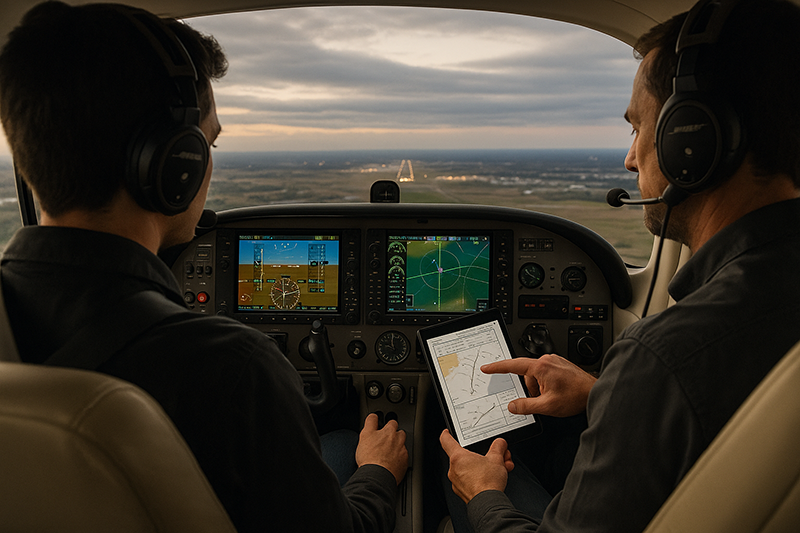
Low-ceiling arrivals demand more from a pilot than simply flying an instrument approach to published minimums. They require disciplined preflight planning, realistic weather interpretation, aircraft and avionics readiness, approach briefing, fuel and alternate thinking, and a clear plan for what happens if the runway environment does not appear when expected. For student pilots, instrument pilots, flight instructors, and aviation professionals, preparing for a low-ceiling arrival is one of the most practical exercises in judgment and workload management.
The challenge is not only the cloud base. A low ceiling often arrives with other operational pressures: reduced visibility, wet or contaminated runways, gusty winds, terrain, night conditions, traffic flow constraints, fatigue, and the subtle urge to “try just one more approach.” This article explains how to think through low-ceiling arrival scenarios before they become high-workload cockpit events. The goal is not to replace regulations, aircraft procedures, or instructor guidance, but to help pilots build a more reliable mental model for safe decision-making in instrument meteorological conditions.
What Counts as a Low-Ceiling Arrival?
A low-ceiling arrival is any arrival where the cloud base is low enough to materially affect approach planning, visual acquisition of the runway environment, missed approach readiness, or the pilot’s margin for error. The term is operational rather than a single universal number. A ceiling that feels routine at a well-equipped airport with multiple precision approaches, flat terrain, and strong lighting may be much more demanding at a non-towered airport with limited weather reporting, rising terrain, or only nonprecision procedures.
For a pilot, the key question is not simply, “Is the weather legal?” The better question is, “Do the ceiling, visibility, runway, aircraft equipment, pilot proficiency, and available alternatives create a plan that is both legal and wise?” A published approach minimum is a defined operational limit for that procedure, but it is not a personal guarantee that the arrival will be comfortable, stable, or successful. Minimums are the floor for the procedure, not a substitute for judgment.
Low ceilings also change the timing of pilot decisions. In visual conditions, a pilot may have plenty of time to assess the airport, align visually, evaluate wind correction, and judge runway environment cues. In a low-ceiling approach, the transition from instruments to visual references may occur late. That transition can be abrupt, especially at night or in precipitation. The pilot must be mentally prepared to continue only if the aircraft is in a position from which a normal descent and landing can be made, and must be equally prepared to execute the missed approach without delay if the required conditions are not met.
Why This Matters in Real-World Aviation
Low-ceiling operations are common in real-world flying. Coastal fog, winter stratus, frontal weather, upslope flow, marine layers, low-level moisture, and post-rain saturation can all produce ceilings that turn a normal arrival into a demanding instrument task. Even pilots who fly mostly in fair weather can encounter unexpectedly low ceilings when a forecast improves later than expected or when destination conditions deteriorate faster than planned.
For instrument students, low-ceiling arrival preparation is where textbook knowledge becomes cockpit decision-making. The pilot must connect weather products, approach charts, aircraft systems, navigation accuracy, performance, fuel planning, and human factors into one coherent plan. This is also where instructors can evaluate whether a student is merely following approach steps or truly managing an arrival.
For certificated pilots, the same scenario tests proficiency and personal minimums. A pilot may be legally current but not recently practiced in actual instrument conditions, missed approaches, partial-panel thinking, autopilot management, or circling decision-making. Low ceilings expose weak habits quickly because there is less time for correction near the ground.
For aviation operators and flight departments, low-ceiling arrivals also affect standard operating procedures, dispatch decisions, passenger expectations, and diversion planning. A safe arrival is not just the result of flying the final approach course accurately. It is the product of planning layers that reduce surprises before the aircraft begins descent.
How Pilots Should Understand Low-Ceiling Arrivals
The best way to understand low-ceiling arrivals is to view them as a sequence of decision gates rather than a single approach event. Each gate either supports continuing or points toward holding, delaying, diverting, or discontinuing the approach. The first gate happens before departure, when the pilot evaluates weather trends, destination suitability, alternate options, fuel, and aircraft readiness. The second gate occurs en route, when actual conditions and updated forecasts may confirm or challenge the original plan. The third gate occurs before approach clearance or descent from cruise, when the pilot briefs the procedure and decides whether the approach remains appropriate. The final gate occurs at the decision altitude, decision height, or missed approach point, depending on the type of procedure being flown.
This sequence matters because low ceilings can tempt pilots into late decision-making. A pilot who waits until short final to start thinking about the missed approach, alternate airport, or fuel state has already accepted unnecessary workload. In contrast, a pilot who has briefed the missed approach, reviewed the first altitude and heading, confirmed navigation setup, and discussed the go-around plan with any other crewmember is much better prepared to act decisively.
Low-ceiling preparation also requires an honest understanding of approach types. Precision and approach-with-vertical-guidance procedures can provide a defined descent path, which may reduce workload when properly flown and monitored. Nonprecision approaches may require additional attention to descent planning, step-down fixes, vertical descent angle information when available, and timing or distance awareness. Circling approaches introduce their own demands because visual maneuvering at low altitude in marginal weather can quickly become unforgiving. Pilots should select the procedure that best matches aircraft capability, airport conditions, pilot proficiency, and operational risk.
The presence of an autopilot can be helpful, but it should not create complacency. In low-ceiling arrivals, the pilot must know what the automation is doing, what modes are active, and how to disconnect or revert to a simpler mode if needed. Automation confusion near minimums is a poor trade for reduced workload earlier in the approach. A pilot should brief not only the approach but also the automation plan: what will be armed, what will be monitored, and what action will be taken if the aircraft deviates or the system behaves unexpectedly.
Weather Factors Beyond the Ceiling
Ceiling is only one part of the arrival picture. Visibility, precipitation, wind, temperature, runway condition, and lighting can be just as important. A low ceiling with good visibility below the cloud layer may feel different from a slightly higher ceiling with fog, mist, heavy rain, or blowing snow. In many arrivals, the ability to see and identify the runway environment is affected by forward visibility and contrast as much as by cloud height.
Weather trends deserve special attention. A destination reporting marginally above approach minimums may not remain that way. If the ceiling is lowering, visibility is fluctuating, or nearby stations are worse, the pilot should avoid treating the latest observation as a promise. Conversely, a gradual improving trend may support a different plan, but it still requires fuel and diversion discipline. The practical question is whether the pilot has enough margin if the next report is less favorable than the current one.
Temperature and dew point spread can help pilots recognize conditions that may support fog or low cloud development, although it should not be used as a standalone forecast tool. Nighttime cooling, moist ground, calm wind, and recent precipitation can all contribute to reduced visibility or low ceilings. Terrain and local geography matter as well. Valleys, coastal areas, lakes, and mountain slopes can create localized conditions that differ from broader area forecasts.
Wind also matters. A strong crosswind near minimums increases workload during the transition to visual flight and touchdown. Gusts can destabilize the approach, while tailwind components may affect landing distance and descent planning. Pilots must use aircraft performance information, runway data, and applicable operating limitations rather than relying on habit or optimism.
Approach Briefing for Low Ceilings
An approach briefing for a low-ceiling arrival should be more than reading chart items aloud. It should create a shared plan or, in single-pilot operations, a clear mental rehearsal. The briefing should answer practical questions: Which approach will be flown? What are the published minimums for the aircraft and equipment being used? What is the missed approach procedure? What altitude restrictions or step-down fixes require special attention? What runway lighting or approach lighting is expected? What is the plan if the approach becomes unstable?
In single-pilot IFR, a useful briefing reduces the number of decisions that must be made late in the approach. The pilot should set navigation frequencies or database procedures, verify the correct runway and approach, brief the final approach course, identify the final approach fix, confirm minimums, review the missed approach, and determine how the autopilot or flight director will be used. If the aircraft is equipped with terrain, traffic, or synthetic vision displays, those tools should be treated as aids, not as permission to descend below required limits or continue an unstable approach.
For two-pilot or instructor-student operations, the briefing should include callouts and transfer of controls if relevant. Instructors should be careful not to let the scenario become a guessing game. The training value comes from building the student’s decision framework, not from surprising the student at the worst possible moment. A well-taught low-ceiling approach includes both precision in aircraft control and clarity in decision-making.
Personal Minimums and Proficiency
Personal minimums are especially important for low-ceiling arrivals because legal minimums may not match a pilot’s current capability. A pilot who has recently practiced approaches, missed approaches, and actual instrument operations may have a different comfort level than a pilot who has only maintained currency in benign conditions. Currency is not the same as proficiency. A logbook entry does not guarantee smooth workload management in rain, turbulence, darkness, or busy airspace.
Personal minimums should be specific enough to be useful. “I will be careful” is not a minimum. A more practical approach considers ceiling, visibility, crosswind, runway length, approach type, lighting, terrain, alternate availability, time of day, and recency of experience. These limits can evolve with training and experience, but they should not be adjusted downward in the air simply because the pilot wants to reach the destination.
Flight instructors can help students and instrument-rated pilots develop personal minimums by using scenario-based training. Rather than asking only whether an approach is legal, the instructor can ask: What is your plan if the ceiling drops? What makes this alternate suitable for you? How much fuel margin do you want before starting the approach? Which approach gives you the best workload profile? What would cause you to divert before attempting the approach?
Fuel, Alternates, and the Discipline to Divert
Low ceilings make fuel planning more than a regulatory exercise. Fuel is decision-making time. Extra fuel may allow holding for improving conditions, flying an approach and missed approach, diverting to a better airport, or choosing a safer runway and procedure. Minimal fuel margins can quietly pressure a pilot into continuing an approach that should be abandoned.
Alternate planning should be realistic. A suitable alternate is not merely an airport listed somewhere on a route plan. It should offer weather, runway, approach capability, fuel services if needed, and terrain considerations that make it a credible option. The pilot should consider whether the alternate weather is meaningfully better than the destination, whether the approaches are compatible with the aircraft equipment, and whether the airport environment is within the pilot’s comfort level.
In actual operations, diversion decisions are often harder emotionally than technically. Passengers may be waiting. Schedules may be tight. The destination may be only a few miles away. Yet the best time to divert is often before the situation becomes urgent. A pilot who decides in advance, “If the reported weather drops below my planned threshold, I will not start the approach,” reduces the chance of rationalizing a poor decision later.
Workload Management in the Descent and Terminal Area
Many low-ceiling arrival problems begin before the approach, during the descent and setup phase. A pilot who is late configuring avionics, late loading the approach, late obtaining weather, or late briefing the missed approach enters the terminal area already behind. Low ceilings punish that delay because the approach itself leaves little spare attention.
Good workload management starts early. The pilot should obtain updated weather, review notices and runway information as applicable, set up radios and navigation, calculate landing performance when required, brief the approach, and decide on automation use before the aircraft is close to the final approach fix. In busy airspace, pilots should also anticipate vectors, speed assignments, and possible runway changes. If a runway or approach change would create excessive workload, asking for delaying vectors or additional time may be the safer option.
Configuration discipline is also important. A stabilized aircraft is easier to monitor and easier to transition visually. Pilots should use aircraft-specific procedures for power, flaps, gear, speed, and descent rate. The details vary by aircraft, but the principle is consistent: do not allow low-ceiling pressure to produce rushed configuration changes close to the ground.
The Missed Approach Is Part of the Arrival
One of the most valuable mindset shifts in low-ceiling flying is to treat the missed approach as a normal part of the arrival plan, not as a failure. If the runway environment is not visible when required, if the aircraft is not in a position to continue safely, or if the approach becomes unstable, the missed approach is the correct outcome.
Briefing the missed approach should include the first action, initial heading or track, initial altitude, navigation source, and any known terrain or obstacle considerations depicted for the procedure. The pilot should know how the aircraft will be configured, what pitch and power targets are appropriate for the aircraft, and how automation will be managed. In many aircraft, the first seconds of a missed approach involve a rapid sequence of power application, pitch change, configuration adjustment, navigation tracking, and communication. That sequence should not be improvised at minimum altitude.
A missed approach also leads to the next decision. Will the pilot try another approach, hold, request a different procedure, or divert? The answer depends on weather, fuel, aircraft status, pilot workload, and whether another attempt offers a meaningful improvement. Repeating the same approach into the same weather without a clear reason can be a warning sign that external pressure has entered the cockpit.
Common Mistakes or Misunderstandings
One common misunderstanding is treating an approach minimum as a target rather than a limit. The pilot’s job is not to descend until something appears and then salvage the landing. The job is to fly a stable, properly configured approach and continue only when the required visual references and aircraft position support a normal landing.
Another mistake is focusing on ceiling while underestimating visibility. A pilot may hear that the ceiling is above minimums and feel reassured, but poor visibility can still make runway acquisition difficult. Haze, mist, rain, snow, glare, and darkness can all reduce contrast and visual cues. The transition from instrument scan to outside references may be more demanding than expected.
A third mistake is failing to respect local conditions. Published procedures provide essential guidance, but each airport environment has its own character. Terrain, runway lighting, approach lighting, surrounding development, water, snow cover, and nearby obstacles can affect the visual segment. Pilots should review airport diagrams, chart notes, runway data, and available imagery or local knowledge when appropriate, especially before operating into unfamiliar airports.
Automation misuse is another frequent risk. Autopilots, flight directors, navigators, and moving maps can reduce workload, but only when the pilot understands them. Mode confusion, incorrect approach loading, failure to verify the active leg, or overreliance on vertical guidance can create an unstable situation. The pilot remains responsible for navigation, altitude compliance, and aircraft control.
Finally, pilots sometimes underestimate the psychological pressure of being close to the destination. The closer the aircraft gets, the easier it becomes to justify continuing. This is why pre-briefed decision points are so valuable. A decision made calmly before the approach is usually better than one made under pressure near minimums.
Practical Example: A Marginal Arrival After Sunset
Consider an instrument-rated private pilot flying a well-equipped single-engine airplane to a familiar airport after sunset. The destination has an instrument approach to the preferred runway, pilot-controlled lighting, and a nearby alternate with better weather and a longer runway. The forecast called for marginal conditions improving, but the latest weather shows a low overcast layer and visibility that varies with light rain. The pilot has adequate fuel for the approach, a missed approach, and diversion, but not enough to hold indefinitely.
A weak preparation plan would focus only on whether the reported ceiling is above the published minimum for the approach. The pilot might load the procedure, continue inbound, and hope that the runway lights appear in time. That plan leaves too many decisions for the final segment of flight.
A stronger plan starts earlier. The pilot obtains updated weather for the destination and alternate, reviews the approach chart, verifies the correct procedure in the navigator, sets a clear minimum altitude reminder, briefs the missed approach, and confirms how the lighting will be activated. The pilot also decides before starting the approach that if the approach is missed, the next step will be a diversion unless updated weather shows a meaningful improvement or air traffic control can offer a better approach option.
On the approach, the pilot uses the autopilot to reduce workload but monitors course, altitude, descent path, and airspeed actively. Before the final approach fix, the aircraft is configured according to the pilot’s normal procedure and stabilized. At minimums, the pilot either has the runway environment in sight and the aircraft positioned for a normal descent to landing, or the pilot executes the missed approach immediately. Because the missed approach and diversion decision were already briefed, the pilot does not need to negotiate with hope at low altitude.
This example is intentionally ordinary. Most low-ceiling risk does not come from dramatic emergencies. It comes from small delays, vague plans, incomplete briefings, and decisions made too late. The antidote is disciplined preparation.
Best Practices for Pilots
Preparing for low-ceiling arrival scenarios is a habit pattern. The details vary by aircraft, operation, and airport, but several principles apply broadly. Pilots should begin weather evaluation early, update it often, and interpret it as a trend rather than a single number. They should choose approaches that reduce workload when possible and should brief the missed approach as carefully as the landing.
Before descent, the pilot should have a clear answer to three questions: What will I fly? What will I do if I do not see what I need to see? Where will I go next if this approach does not work? If those answers are uncertain, the aircraft is not yet fully prepared for a low-ceiling arrival.
- Build the arrival around weather trends, fuel margin, alternate quality, and pilot proficiency, not just the latest reported ceiling.
- Brief the approach and missed approach early enough that terminal workload does not force rushed decisions.
- Use automation deliberately, with clear mode awareness and a plan for hand flying if needed.
- Maintain stabilized approach criteria appropriate to the aircraft and operation.
- Decide in advance what conditions will trigger a missed approach, delay, or diversion.
Instructors should teach low-ceiling arrivals through realistic scenarios rather than isolated procedure drills. Students should practice not only tracking courses and descending on profile, but also choosing an approach, setting personal minimums, briefing a diversion, and making the missed approach decision without hesitation. The most important skill is not squeezing an aircraft into marginal weather. It is knowing when continuing is appropriate and when stopping the attempt is the safer professional choice.
Training Techniques for Instructors and Instrument Students
Low-ceiling arrival training is most effective when it combines technical flying with aeronautical decision-making. An instructor can simulate weather at or near minimums, but the lesson should not be limited to whether the student can reach the missed approach point. The more meaningful evaluation is whether the student recognizes workload buildup, keeps the aircraft configured and stabilized, verbalizes decision points, and executes the missed approach promptly when the scenario requires it.
Scenario-based training can include changing destination weather, a runway change, an unexpected hold, a failed approach lighting expectation, or a diversion discussion. These scenarios should be conducted in a way that supports learning and safety. The purpose is not to trap the pilot, but to develop calm, repeatable decision-making under realistic pressure.
Instrument students should also practice the language of low-ceiling decisions. Saying “I will go missed if I do not have the required visual references at minimums” is useful, but saying it while also pointing to the first missed approach altitude, identifying the navigation mode, and naming the diversion plan is better. Clear verbalization builds cockpit discipline.
Single-Pilot IFR Considerations
Single-pilot IFR is demanding in low ceilings because there is no second crewmember to catch chart errors, monitor altitude deviations, manage radios, or challenge a questionable decision. This does not mean single-pilot low-ceiling operations are inherently inappropriate, but they require conservative planning and strong organization.
A single pilot should reduce avoidable tasks before the approach begins. That may include completing checklists early, setting bugs and reminders, reviewing the airport diagram, organizing charts, and confirming the missed approach instructions. If workload increases unexpectedly, requesting delay vectors, holding, or additional time is often a mark of good cockpit management rather than weakness.
Communication discipline matters as well. A pilot who is task saturated may miss radio calls or accept clearances without fully understanding them. If a clearance, vector, or approach change is unclear, the pilot should ask. Clarity is safer than pretending to be caught up.
Frequently Asked Questions
Is a low-ceiling arrival the same as an approach to minimums?
Not always. An approach to minimums is a specific situation where weather is near the published limits for that procedure. A low-ceiling arrival is broader. It includes any arrival where the ceiling meaningfully affects planning, workload, visual transition, missed approach readiness, or diversion decisions.
Should pilots attempt an approach if the weather is reported above minimums?
Reported weather above minimums may make an approach legally possible, but it does not automatically make it the best decision. Pilots should also consider visibility, trends, wind, runway condition, aircraft equipment, terrain, fuel, alternate options, and their own proficiency.
What is the most important part of preparing for a low-ceiling arrival?
The most important part is making the critical decisions before workload peaks. Know the approach, the minimums, the missed approach, the fuel situation, and the diversion plan before starting down the final segment. A clear plan reduces hesitation near the ground.
How does automation affect low-ceiling arrival safety?
Automation can reduce workload when it is correctly set up and actively monitored. It can also create risk if the pilot does not understand the modes, fails to verify the active procedure, or becomes dependent on the system. Pilots should be ready to intervene or hand fly when appropriate.
Why is the missed approach so important in low ceilings?
The missed approach is the safety exit when the approach cannot be continued safely. In low ceilings, there may be little time to decide. Briefing the missed approach before descent makes it a normal, expected maneuver rather than a surprise.
How should student pilots learn about low-ceiling arrivals?
Student pilots should first understand weather interpretation, instrument procedures, and decision-making concepts appropriate to their training level. Instrument students should practice realistic scenarios with an instructor, including approach briefing, missed approach execution, and diversion planning.
Key Takeaways
- Prepare for low-ceiling arrivals as decision-making scenarios, not just instrument approach procedures.
- Use weather trends, fuel margin, approach type, aircraft readiness, and personal proficiency to decide whether continuing is wise.
- Brief the missed approach and diversion plan before workload increases, and treat going missed as a normal safety outcome when conditions require it.