
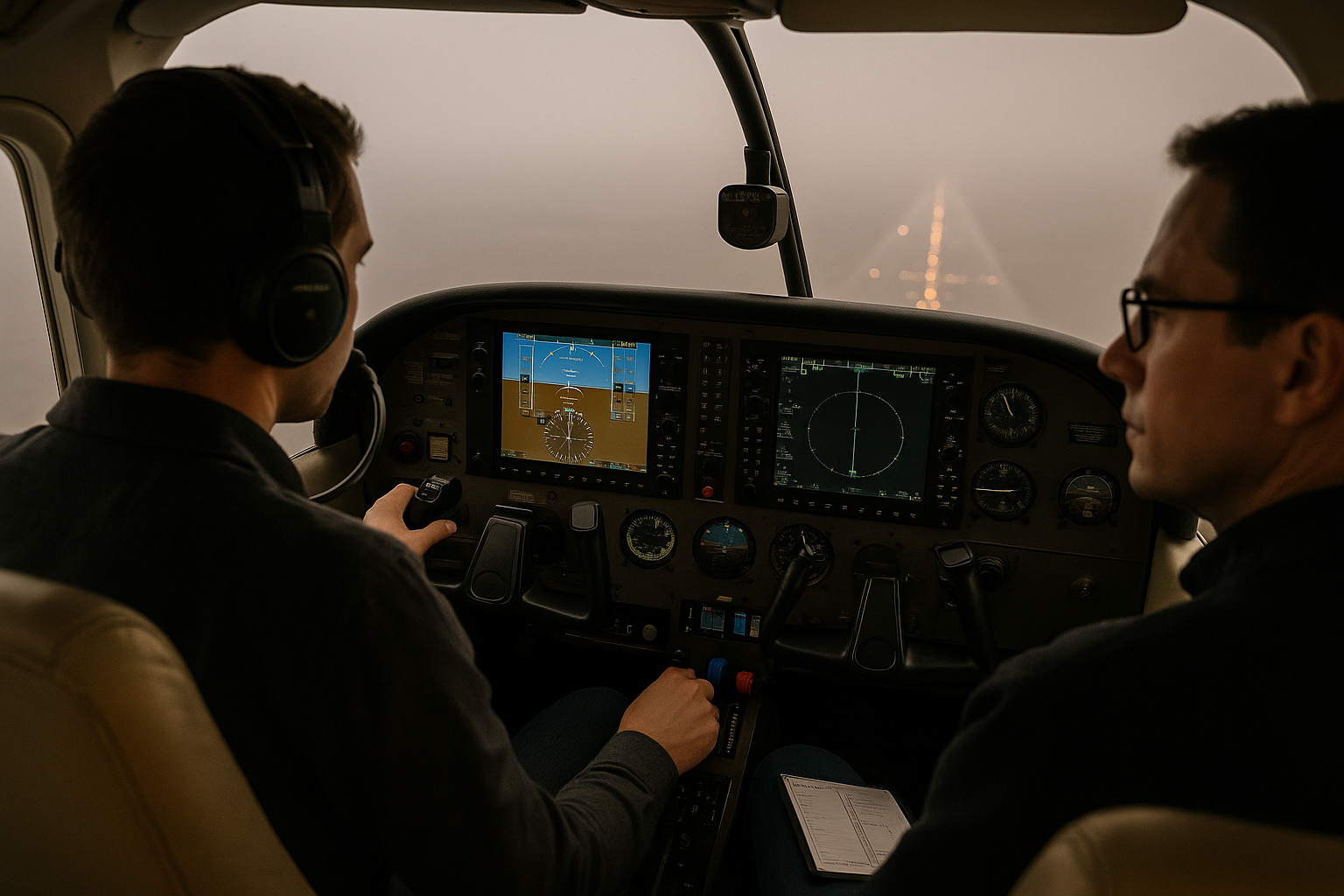
Instrument Landing System approaches are a foundational instrument procedure for pilots learning precision approaches and for instrument-rated pilots maintaining currency. Mastering ILS approaches accelerates overall instrument proficiency because the procedure trains precise lateral and vertical control, radio navigation interpretation, and stable approach discipline. In this article ILS approaches is used as the primary keyword to focus the discussion on practical flight training, operational decision-making, and safety-centered technique.
The practical value of this article is immediate. If you are a student pilot preparing for your instrument rating, an instructor structuring effective lessons, or a professional pilot maintaining precision-approach competence, the skills described here shorten the learning curve. You will find operational guidance for cockpit setup, scan technique, intercept and tracking tips, energy management, and how to integrate automation without losing manual flying skill. The emphasis is on repeatable habits that produce safer, more consistent approaches under varying weather and traffic conditions.
Core Principles of ILS Approaches
An ILS approach couples a localizer for lateral guidance and a glide slope for vertical guidance, supported by marker beacons or DME for position verification depending on the installation. At its heart an ILS requires precise cross-checking of instruments, stabilized flight path control, and timely configuration and checklist discipline. Learning to fly the ILS correctly builds judgment about when to continue and when to execute a missed approach, because the procedure places the pilot in a high-stakes phase of flight where small deviations magnify at low altitudes.
Flying the ILS effectively requires three simultaneous skill sets: accurate instrument interpretation, tight aircraft control to hold the guidance signal, and decision-making about continuation, approach minima, and missed approach execution. These are not independent. For example, a late decision to go missed complicates aircraft control tasks and increases workload, while poor instrument scan increases the chance of misinterpreting guidance and descending below a safe profile.
Why This Matters in Real-World Aviation
ILS approaches remain widely used at towers and busy terminals because they provide precise guidance in poor visibility. In real operations, a reliable ILS technique reduces workload during final stages of flight when traffic, ATC changes, or environmental factors like wind shear and microbursts may appear. For flight instructors and training managers, an ILS syllabus that emphasizes instrument scan, interception geometry, and energy management yields safer pilots who transition more quickly to other precision and visual approaches.
Operationally, ILS proficiency supports go/no-go decisions and improves coordination with air traffic control. Pilots who can establish the localizer early, capture the glide slope cleanly, and maintain a stable approach path are better positioned to comply with ATC vectors, reduce runway go-arounds, and manage automation transitions. In training environments, practicing ILS work under simulated failures, partial panel, and varying crosswind conditions develops resilience and problem-solving in a controlled setting.
How Pilots Should Understand ILS Approaches
Think of an ILS approach as a dynamic guided descent where the avionics provide a path but the pilot must supervise and fly the airplane in three domains: lateral, vertical, and energy. Lateral control means keeping the aircraft centered on the localizer. Vertical control means following the glide slope or maintaining a published descent profile when the glide slope is unreliable or unusable. Energy control combines airspeed, power, and pitch to keep a stable descent rate and landing configuration.
Approach setup begins well before final descent. Key cockpit items include: selecting the correct NAV source and frequency, confirming the inbound course, setting minimums on the approach brief, pre‑setting the autopilot or flight director modes you plan to use, and verifying altimeter and monitor audio warnings. Establishing a standardized briefing routine reduces errors and allows you to sequence tasks when workload increases on final.
Instrument scan technique is crucial. A fluid, prioritized scan gives the pilot timely information to correct deviations. On an ILS the scan tends to focus on the flight director or PFD for guidance cues, the attitude indicator for aircraft control, the CDI or HSI for lateral tracking, and the vertical speed indicator or flight path marker for descent rate. Efficient scanning is not a random glance but a repeatable sweep that returns to the primary guidance instrument frequently.
Common Mistakes or Misunderstandings
Misconceptions about ILS approaches often stem from incomplete training or overreliance on automation. Common pitfalls include:
Poor briefing and preparation. Pilots who start the approach without verifying inbound course, missed approach procedure, and required configuration often find themselves behind the aircraft on final.
Delayed capture planning. Waiting too long to anticipate the localizer intercept or glide slope capture increases the need for large control inputs that destabilize the approach.
Overreliance on autopilot. Using the autopilot to fly the entire approach can mask degraded manual flying skill. If the autopilot disconnects at a critical moment, the pilot may struggle to transition smoothly.
Fixating on a single instrument. Tunnel vision on the CDI or PFD without cross-checking attitude and airspeed can lead to slow recognition of energy or attitude deviations.
Ignoring wind and drift early. Not accounting for wind correction on the inbound segment results in excessive crab or corrective roll inputs near the runway.
Training programs that treat the ILS as only a radio navigation exercise miss the operational complexity of approach management. An ILS flown without a disciplined energy profile, stable configuration, and decision criteria is still hazardous even when the nav signals are nominal.
Practical Example
Imagine a single-pilot instrument approach into a mid-size terminal at night with a moderate crosswind. You receive vectors to final and intercept the localizer at a 15-degree intercept angle while the autopilot is engaged in NAV mode. Before intercept you brief landing runway, minimums, the missed approach, and your plan for autopilot engagement or hand-flying. You confirm the inbound course on the HSI and set local altimeter and approach minima on a backup notepad.
At intercept, you ease the aircraft onto the localizer using small heading corrections. The glide slope is intercepted from below; you monitor descent rate and adjust power gradually to maintain a stable 500–800 feet per minute descent while keeping approach speed within the recommended range for your aircraft. As you capture the glide slope, you check the landing lights, gear, and flaps sequence so the aircraft reaches final configuration well before the final approach fix. With the autopilot engaged on approach mode, you verify lateral and vertical tracking and cross-check airspeed, configuration, and runway alignment.
At the decision point you evaluate visual cues, runway environment, and the aircraft state. If the runway environment is not in sight or the approach is unstable, you initiate the missed approach promptly. If visual and aircraft state criteria are met, you smoothly transition to landing, disengaging automation as required and completing the landing checklist. Throughout, clear communication with ATC maintains situational awareness and provides the option to request an approach or go-around if conditions change.
Best Practices for Pilots
Adopt disciplined habits to make ILS approaches predictable and safe. Good habits reduce cognitive load and improve error recovery when distractions arrive. The practices below focus on cockpit setup, automation management, and approach stabilization.
Standardize the approach briefing. Use a concise verbal or written brief that covers inbound course, runway, minimums, missed approach, and automation plan. Repeat critical items out loud.
Set up avionics early. Confirm NAV frequency, inbound course, and any required DME or marker indications before the final vector. Reduce last-minute tuning during high workload.
Plan the intercept geometry. Decide the intercept angle and whether you will capture the localizer and then the glide slope or capture both together. A shallower intercept reduces overshoot and the need for large corrections.
Manage energy proactively. Use power and pitch together to control airspeed and descent rate. Stabilize configuration—gear and flaps—before the final approach fix to minimize changes close to touchdown.
Use automation deliberately. If the autopilot handles the capture and tracking, remain the pilot flying by monitoring and verbalizing mode changes. If hand-flying, practice smooth control and keep a precise instrument scan.
Practice missed approach procedures. Rehearse the missed approach from different points on the approach so the maneuver becomes a practiced response rather than an improvisation.
Include partial-panel and failure scenarios in training. Fly approaches with simulated GPS or glide slope outages, and practice identifying when to revert to other instruments or navaids.
Instrumentation and Automation: Practical Guidance
Modern cockpit displays and autopilot systems change how ILS approaches are flown, but the underlying principles remain. Use flight director bars or attitude cues as your primary reference for small corrections and reserve large heading changes for wind or major tracking errors. When the autopilot is engaged, monitor the engaged mode annunciations and be prepared to take manual control with a smooth, anticipatory transfer rather than abrupt inputs.
If the glide slope signal becomes unreliable or unusable, fly the localizer only and transition to a published nonprecision profile or stabilized visual approach when appropriate. Know the differences between full-capture autopilot modes and localizer-only capture modes in your aircraft and how they affect vertical guidance behavior. When uncertainty exists, commit to a conservative approach profile and be ready to go missed if the vertical guidance is suspect.
Training Exercises to Accelerate Skill Development
Structured practice accelerates proficiency. Build training sequences that layer complexity gradually: start with localizer interception and tracking, add glide slope capture and tracking, then introduce night, crosswind, and partial-panel variations. Include scenarios where the pilot must capture the localizer after being vectored, intercept the glide slope from above or below, or perform a circling maneuver to a different runway after capturing the ILS.
Simulators and flight training devices are especially effective for repetition without the expense or risk of live flight. Use them to practice missed approaches and automation failures, then consolidate those skills with real-world flights under instructor supervision. Always debrief each practice approach with specific feedback on scan discipline, configuration timing, and decision-making.
Common Mistakes Revisited With Corrective Guidance
Here are frequent errors with corrective recommendations that instructors can use during debriefs.
Error: Aggressive control inputs when intercepting signals. Correction: Use small, anticipatory corrections and brief the expected capture. Adopt a standard intercept angle and practice it until it becomes automatic.
Error: Letting airspeed float late in the approach. Correction: Prioritize airspeed management early and adjust power for descent changes. Assign a simple rule of thumb for when to adjust flap or gear settings relative to glideslope capture.
Error: Delayed missed approach initiation. Correction: Define clear criteria for a missed approach during the briefing and rehearse the go-around so it becomes a practiced, confident action.
Error: Confusing CDI deflection with crosswind correction. Correction: Translate instrument deviation into heading adjustments and monitor the attitude indicator to avoid overbanking.
Advanced Considerations for Single-Pilot and Multi-Crew Operations
Single-pilot operations require setting priorities and sequencing tasks to avoid fixation and overload. Use simple callouts to mark configuration and approach stages, and consider using brief checklist items as memory aids. In a multi-crew cockpit, clear role definition and concise sterile cockpit discipline during the final approach phase improve performance. The pilot monitoring should call deviations, confirm mode annunciations, and manage radio comms so the pilot flying can focus on flying the aircraft.
In complex or glass cockpits, ensure both pilots understand what each automation state will do. For example, different autopilot coupling modes handle glide slope capture and level-off behavior differently. Practicing transitions between manual and automated flight in both day and night conditions improves confidence and reduces the chance of mode confusion during an approach.
Weather, Windshear, and Turbulence: Operational Risk Management
ILS approaches reduce workload in low visibility, but weather hazards still affect safety. Crosswinds, windshear, and turbulence can destabilize a precise ILS path and require timely energy management. Build conservative personal minimums and remember that a stable ILS flown slightly higher with a normal power setting and a timely visual landing is preferable to a low, unstable approach that forces a late go-around.
When conditions suggest windshear or microburst potential, brief a more aggressive missed approach plan and remain vigilant for sudden airspeed and vertical speed changes near the runway. Use the aircraft's performance tools and alerts, but treat them as supplementary; continue to trust your instruments and basic flying technique first.
Practical Checklist for an ILS Approach (Conceptual)
This is a conceptual sequence focused on decision flow rather than a prescriptive checklist. Always use the published checklists and aircraft-specific procedures for actual operations.
Brief: inbound course, runway, minima, missed approach plan, automation plan.
Nav setup: tune and identify localizer frequency, set inbound course, verify DME or markers if required.
Configuration: select approach flaps and landing configuration well ahead of the final approach segment.
Cross-check: confirm altimeter, approach minima, and autopilot/FD mode annunciations.
Stabilize: ensure speed, descent rate, and alignment are within acceptable parameters before the decision point.
Decide: at the decision point commit to landing or go missed based on visual cues and aircraft state.
Frequently Asked Questions
How should I intercept the localizer and glide slope for a stable approach?
Intercept the localizer at a planned angle that allows a smooth capture without excessive roll or bank, then follow the flight director or autopilot guidance to center the CDI or HSI. Once established on the localizer, capture the glide slope with measured power reductions and pitch adjustments to control descent rate while maintaining airspeed. Practice these intercepts in a controlled training environment to refine timing and small control inputs.
When is it better to hand-fly an ILS rather than use the autopilot?
Hand-flying can be useful for maintaining manual flying proficiency and when automation creates mode confusion. Conversely, autopilot use reduces workload and can improve precision during high traffic or low-visibility conditions. Decide before the approach whether you will hand-fly or use autopilot, and if using autopilot, remain actively engaged in monitoring modes and performance.
What should I watch for when the glide slope signal is unreliable?
If the glide slope is unreliable indicated by a flag or inconsistent needle behavior, revert to localizer-only procedures or an alternate nonprecision approach profile as appropriate. Rely on published missed approach guidance and your briefed plan. Practicing these scenarios in the simulator builds confidence for real-world occurrences.
How do crosswinds affect ILS tracking?
Crosswinds require heading adjustments to maintain localizer centering. Use small, continuous corrections rather than large intermittent inputs to avoid overshoot. When transitioning from the final approach to touchdown, convert the crab technique to a sideslip or apply appropriate rudder and aileron coordination as your training and aircraft type prescribe.
How often should I practice ILS approaches to maintain proficiency?
Proficiency frequency depends on your recent experience and the operational environment. Regular training sessions that include ILS work, partial-panel practice, and missed-approach rehearsals help maintain skills. Incorporate simulated failures and off-nominal conditions into routine practice rather than only flying perfect scenarios.
Instructor Guidance: Structuring Effective ILS Lessons
As an instructor, design lessons that break the ILS into teachable chunks. Start with ground briefings that include intercept geometry and automation plans, then progress to simple localizer captures in clear weather. Add glide slope tracking and approach stabilization. Use targeted debriefs with specific performance metrics: how steady was the CDI/HSD centering, what were the descent rate trends, and when did configuration changes occur relative to the final approach fix.
Use scenario-based training to create realistic workload and decision points. Introduce radio delays, communications from ATC, or runway changes so the student practices the mental model of priorities: fly the aircraft, fly the approach, navigate, and communicate in that order. Encourage students to verbalize their plan and callouts during the approach to reinforce memory and situational awareness.
Key Takeaways
- Practical takeaway: Standardize cockpit setup and a concise approach brief to reduce last-minute workload and improve intercept timing.
- Safety takeaway: Maintain a stabilized energy profile and commit to an early missed approach when the approach becomes unstable.
- Training takeaway: Practice intercept geometry, partial-panel, and missed approach procedures in a simulator and flight training device to accelerate safe skill development.
Final Thoughts
Developing faster, reliable ILS approach skills is less about shortcuts and more about disciplined preparation, consistent flying technique, and realistic training. Pilots who invest time in structured practice, clear briefings, and thoughtful use of automation will find their approach stability, decision making, and confidence improve rapidly. Use the strategies described here as a framework and adapt them to your aircraft, operation, and local procedures. Where uncertainty remains about aircraft-specific behaviors or operational minima, consult the aircraft flight manual, operator guidance, or a qualified instructor before applying a new technique in flight.