
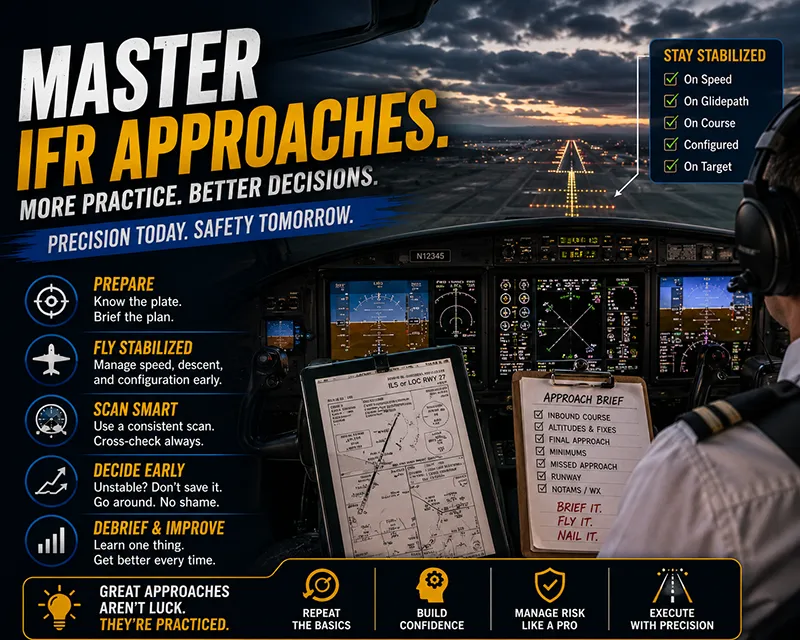
Learning and refining IFR approaches is one of the highest-value skills a pilot can develop. IFR approaches are a concentrated exercise in aircraft control, instrument scanning, navigation management, and decision-making. For pilots, student pilots, and instructors who want measurable improvement in instrument proficiency, focused practice on IFR approaches provides faster, safer progress than random, unfocused flying.
This article explains how to accelerate instrument-approach skill development without cutting corners. It focuses on practical cockpit techniques, training design, risk management, and instructor‑led practices that translate directly to safer operating performance. The primary keyword, IFR approaches, appears early because mastering approaches is the foundation of dependable IFR flying.
Clear Main Section
At its core, an IFR approach is a task where the pilot reduces a larger flight problem to a series of manageable steps: configuring the aircraft, flying a stabilized path, managing navigation and avionics, monitoring vertical and lateral guidance, and making timely decisions when conditions or airplane performance deviate from expectations. Faster skill development comes from deliberate practice that isolates one element at a time, builds automatic responses, and then reintegrates the elements into full-procedure practice.
Deliberate practice for IFR approaches follows three principles: focused repetition, progressive complexity, and immediate feedback. Focused repetition means rehearsing a single skill—such as intercepting a localizer, flying the missed approach, or stabilizing the final approach—until it becomes predictable. Progressive complexity means starting with simple procedures, then adding real-world variables like crosswinds, partial panel, or workload from communications and automation. Immediate feedback is achieved with either an instructor debrief, flight data logging, or targeted simulation playback. These three principles shorten the learning curve because they convert conscious effort into reliable, subconscious performance.
Why This Matters in Real-World Aviation
IFR approaches matter because they are where many critical decisions and risk points occur. Approaches demand precise aircraft control while managing descending energy and configuration. They often happen in high workload environments—near busy airports, in low visibility, or when passengers create additional pressure. Improving approach proficiency reduces the likelihood of unstable approaches, missed approach confusion, late go-arounds, and mismanaged automation. From an operational perspective, better approach skills reduce delays caused by repetitive missed approaches and improve dispatch reliability for charter and airline operations.
For instructors and training organizations, teaching approaches effectively shortens training time and increases safety margins. Instead of broad hour-building, targeted approach training builds the core competencies that matter in an instrument flight test or operational checkride: precision with lateral and vertical tracking, timely configuration, energy management, and sound aeronautical decision making.
How Pilots Should Understand This Topic
Understand IFR approaches as a sequence of controllable variables rather than a single, monolithic procedure. Those variables include navigation timeline, aircraft configuration, flight path stability, instrument cross-check, automation mode awareness, and decision points. Breaking the approach into these variables helps you practice deliberately.
Navigation timeline: Plan your route and identify fix points where configuration changes, descent planning, or course intercepts occur. Anticipate when you will need to descend, slow, and configure for final approach. Keep the approach plate and brief handy and verbalize the timeline when necessary.
Aircraft configuration: Make configuration changes early enough to be completed before the high‑work segment of the approach—final intercept and descent. Stabilize airspeed and power, set flaps incrementally where required, and ensure landing gear is managed in a way that supports a stable profile. Practicing configuration flows until they are reflexive reduces distraction during the final segment.
Flight path stability: A stabilized approach is predictable in pitch, power, and descent rate for a given aircraft and weight. Train to recognize the signs of instability early—deviations in glide path, airspeed fluctuations, or ragged flight director performance—and take corrective action promptly, including initiating a missed approach when required.
Instrument cross-check: Efficient instrument scanning is not about speed alone; it’s about purposeful scanning. Identify the primary instruments for each phase (navigation display, CDI/HSI on final; attitude indicator and airspeed on final) and use secondary instruments for trend monitoring. Practicing a consistent scan pattern reduces fixation on one instrument and improves situational awareness.
Automation mode awareness: Modern cockpits rely on automation. Know which guidance mode the autopilot or flight director is in and what it will do if engaged or disconnected. Mode confusion is a common source of approach errors. During training, deliberately hand-fly approaches, then compare the same approach when using autopilot to develop intuition for how the system will behave in transitions.
Decision points: Identify the decision points in every approach. These include where to descend to the next altitude, when to complete final configuration, and where to execute a go-around. Make these decision points explicit in the brief. Practicing clear decision rules speeds the cognitive process during actual instrument conditions.
Common Mistakes or Misunderstandings
Pilots often approach instrument work with intentions that sound correct but produce poor results when examined. Here are common errors and why they matter:
- Fixing on the autopilot: Relying on automation without monitoring modes or verifying outcomes leads to surprises. Autopilots follow their selected guidance; if the guidance is wrong or a mode is misunderstood, the autopilot will simply follow the wrong instructions. Build routine mode checks into every segment.
- Late configuration: Waiting too long to slow and lower flaps or gear increases workload on the final approach and often produces an unstable approach. Practice configuring earlier and use visual or instrument cues to trigger configuration flows.
- Poor scan discipline: Breaking the scan into too many targets or fixating on a single needle degrades lateral and vertical control. Train a concise, phase-specific scan and rehearse it consistently.
- Ignoring energy management: Approaches require balancing descent rate, airspeed, and power. Over-control or delayed power adjustments commonly create oscillations and unstable conditions.
- Unclear missed approach execution: Hesitation or ambiguity when initiating a missed approach can lead to spatial disorientation or traffic conflicts. Practice and brief missed approach procedures, including obstacle and terrain considerations, before the approach begins.
Practical Example
Scenario: A single‑engine IFR-equipped aircraft is conducting an instrument approach to a busy regional airport under low ceilings and light crosswind. The pilot is single-pilot IFR, current but not practiced recently.
Pre-brief: Before descent, the pilot briefs the approach: inbound course, final approach fix, expected altitudes, missed approach climb and initial heading, runway in use, likely automation modes, and the planned configuration timeline. The pilot sets the inbound course, arms the approach mode, and configures the autopilot to capture localizer and glide path if available.
Step 1 — Establish descent timeline: The pilot calculates top-of-descent and verbalizes the point to begin slowing from cruise speed to approach speed. The pilot sets intermediate altitudes in the autopilot and arms altitude capture to avoid level busts.
Step 2 — Configuration flow: At a predetermined fix, the pilot runs an abbreviated flow: power reduction, flap increment one, confirm airspeed, landing lights on, gear down when appropriate. The pilot does this before intercepting final so that the final segment can be flown in a stabilized condition.
Step 3 — Final intercept: The approach intercept is managed with a primary instrument focus on the navigation indicator for lateral guidance and the vertical guidance instrument for glide path if available. The pilot monitors the autopilot modes. If flying manually, the pilot uses small, anticipatory control inputs to keep the localizer needle centered and the glide path followed.
Step 4 — Decision and go-around readiness: The pilot prepares for the missed approach at the published missed approach point or when stabilized approach criteria are lost. The missed approach procedure is briefed again and the pilot reviews power and pitch settings mentally in advance to avoid hesitation.
After landing, the pilot conducts a short debrief focusing on one or two areas for improvement: approach stability at decision height, scan discipline during final, and timing of flap extension. This targeted feedback reinforces learning for the next session.
Best Practices for Pilots
Accelerated learning depends on how you practice. The following best practices support rapid, safe improvement.
- Design short, focused practice sessions: Rather than long, unfocused flights, schedule 30 to 60 minute sessions that concentrate on a single approach profile or skill, such as ILS glide path capture or circle‑to‑land transitions.
- Use simulation intentionally: High-fidelity simulators and desktop scenario builders are effective for repeating rare events like partial panel or missed approach procedures. Use them to practice decision-making under pressure at low cost.
- Record and review: Use cockpit voice and data recording where permitted, or have an instructor provide immediate feedback. Playback of a single approach can reveal scan problems, late configurations, or mode misunderstandings that are hard to sense in real time.
- Train both hand-flying and automation use: Effective IFR pilots can hand-fly precisely and also manage automation correctly. Alternate sessions between manual approaches and autopilot-coupled approaches to build both skill sets.
- Master approach briefings: A concise, consistent briefing reduces cognitive load. Include inbound course, outbound intercept, key fix points, minimums and missed approach actions, and any runway or NOTAM considerations.
- Standardize cross-checks: Create short, repeatable check points—such as a three-item scan on final—so that critical items are not missed during high workload phases.
- Practice missed approaches deliberately: Missed approaches are as important as successful landings. Rehearse initial climb, course reversal, and communications, so the action is immediate and predictable when needed.
- Focus on decision criteria: Define specific personal criteria for diverting or executing a missed approach. Making rules explicit reduces hesitation during high-stress moments.
Frequently Asked Questions
How often should I practice IFR approaches to stay proficient?
Proficiency depends on recency and quality of practice. Short, focused sessions every few weeks that simulate the range of approach types you fly are more effective than infrequent long flights. Prioritize practice on approach types you use most in your flying environment.
Should I hand-fly approaches or rely on the autopilot?
Both skills are essential. Hand-flying builds fundamental control and scan discipline; automation management reduces workload and can enhance safety when used correctly. Alternate training so you remain adept at both, and always monitor automation modes and the aircraft's behavior.
What is the best way to reduce unstable approaches?
Start by planning early: manage energy and configuration before the final segment, use simple, consistent configuration flows, and set clear decision points. Practice detecting instability early and make a go-around decision sooner rather than later when stability criteria are not met.
How can I practice missed approaches safely?
Use simulators for repeated missed approach practice when possible. In real aircraft training, brief and execute missed approaches to safe altitudes and headings, ideally in VMC or with an instructor present, and ensure airspace and traffic considerations are managed.
What common automation mistakes should I watch for?
Mode confusion, failing to arm the correct capture modes, and not verifying autopilot engagement are common mistakes. Make a habit of announcing autopilot modes aloud and confirming expected behavior when engaging or changing modes.
Key Takeaways
- Practical takeaway: Break IFR approaches into manageable variables—navigation timeline, configuration, stability, scan, and decision points—and practice each deliberately.
- Safety takeaway: Detect and correct instability early. A timely missed approach is a safe outcome when stabilized approach criteria are not met.
- Training/decision-making takeaway: Use short, focused practice sessions, simulation, and immediate feedback to accelerate skill development. Alternate manual and automated approaches to build comprehensive competence.
Building faster IFR approach skills is not about shortcuts. It is about deliberate, well-structured practice that targets the high-leverage actions that reduce workload and increase predictability: early configuration, consistent scanning, automation mode awareness, and clear decision criteria. Instructors who structure training around these principles and pilots who rehearse them regularly will see real, measurable improvement in both competence and confidence.
Finally, keep safety at the center of training decisions. Practice scenarios that stress your decision-making and configuration discipline, and always prioritize stabilized flight profiles over attempting to salvage a deteriorating approach. These habits translate directly into safer operations in real-world IFR conditions.