
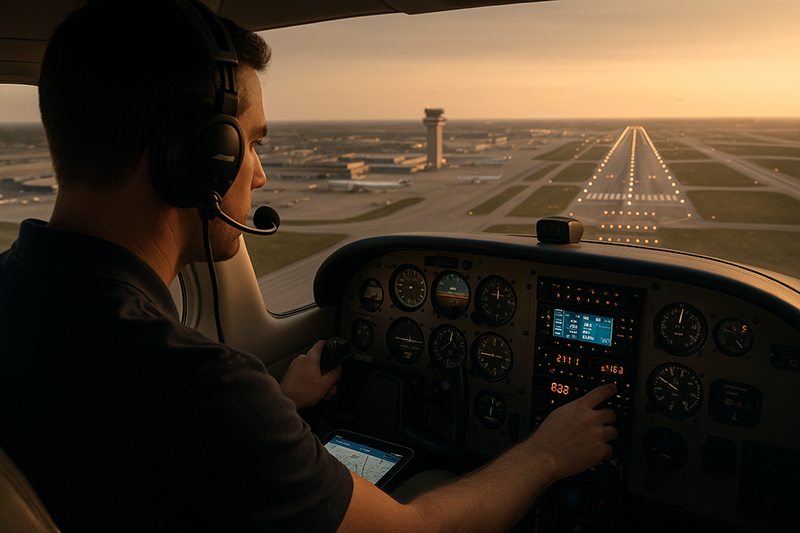
High-density airspace operations challenge pilots in ways that ordinary cross-country flying often does not. More aircraft, faster radio exchanges, complex arrival and departure flows, changing clearances, and busy tower or approach frequencies can quickly raise workload. For student pilots, flight instructors, instrument pilots, and aviation professionals, the difference between a smooth flight and a stressful one often comes down to preparation before the aircraft ever moves.
Preparing for busy airspace is not just about knowing how to talk on the radio. It is a complete operating mindset that includes chart study, airspace awareness, aircraft configuration planning, avionics discipline, workload management, traffic scanning, and a realistic understanding of personal proficiency. A pilot who enters high-density airspace with a clear plan, organized cockpit, and predictable communication habits gives air traffic control and other pilots the best chance to work safely and efficiently.
This article explains how pilots should prepare for high-density airspace operations from a practical flight training and operational perspective. It focuses on what pilots can do before departure, en route, during arrival, and in the terminal area to reduce task saturation and improve decision-making. It also addresses common mistakes, realistic training scenarios, and best practices that apply whether the flight is in a training aircraft, a high-performance piston airplane, a turbine aircraft, or a professionally operated aircraft.
What High-Density Airspace Really Means
High-density airspace is not a single regulatory category. It is an operational description of airspace where aircraft volume, communication load, navigation complexity, or procedural demands are higher than normal. A large Class B terminal area is an obvious example, but pilots can also experience high-density conditions near busy Class C airports, satellite airports under major arrival corridors, non-towered airports during peak training periods, popular fly-in destinations, airspace surrounding special events, and coastal or mountain corridors with limited routing options.
The practical issue is workload. A pilot may be asked to maintain a heading, climb or descend, follow traffic, change frequency, expect a runway change, comply with a speed request, or remain outside certain airspace until a clearance is received. At the same time, the pilot must fly the aircraft, monitor engine and systems indications, navigate accurately, scan for traffic, manage passengers, and anticipate the next phase of flight.
In less busy environments, a small delay in tuning a frequency or reviewing an arrival plan may not create much difficulty. In high-density airspace operations, small delays compound quickly. A missed radio call can lead to confusion. A late descent can create an unstable approach. A misunderstood instruction can put the aircraft somewhere the pilot did not intend to be. The solution is not to rush. The solution is to prepare, simplify, and stay ahead of the aircraft.
Why This Matters in Real-World Aviation
Busy airspace is where many skills must come together at once. A pilot may have good stick-and-rudder ability but still struggle if cockpit organization is weak. Another pilot may be comfortable with avionics but become task saturated when radio calls arrive rapidly. A student may understand airspace on paper but hesitate when approach control issues a clearance that changes the expected route. A flight instructor may need to teach not only what to say, but when to stop talking and fly the airplane.
High-density airspace also magnifies the consequences of small misunderstandings. If a pilot mishears a heading in quiet airspace, there may be time to correct the issue before it affects anyone else. In a busy terminal environment, that same misunderstanding can disrupt sequencing or reduce separation margins. Good pilots recognize that the radio is not a performance stage. It is a control and coordination tool. Clarity matters more than speed, and confirmation matters more than pretending to understand.
For instrument pilots, high-density airspace introduces additional layers of complexity. The pilot may be flying a published procedure, responding to vectors, briefing an approach, configuring the airplane, and receiving traffic advisories or runway changes. For VFR pilots, the challenge may be different but equally important: remaining clear of airspace until properly authorized, navigating around shelves and corridors, maintaining situational awareness near multiple airports, and avoiding distraction from busy radio traffic.
In professional operations, preparation for congested airspace is part of crew resource management. In single-pilot operations, the same principles still apply, but the pilot must deliberately create structure. That means building a cockpit flow, briefing the plan aloud when helpful, using automation appropriately, and identifying the moments when workload will peak.
Preflight Planning for Busy Airspace
Effective preparation begins with a realistic look at the route, destination, alternate options, and surrounding airspace. A pilot should not wait until approaching the terminal area to discover that the arrival route crosses multiple airspace boundaries or passes near a busy training airport. The goal is to understand the big picture before focusing on details.
Start by studying current aeronautical charts and airport information. Look at the airspace structure, including floors, ceilings, lateral boundaries, nearby controlled airports, special use airspace when applicable, published VFR routes, instrument procedures, arrival and departure corridors, terrain, obstacles, and likely traffic flows. If the flight will involve a towered airport, review runway layout, taxiway geometry, likely landing runways based on wind, and potential hot spots or complex intersections shown in current airport information.
For VFR pilots, planning should include entry points, landmarks, altitude choices, and a clear method for remaining outside controlled airspace until the required communication or clearance has been established. A common mistake is to assume that calling early solves every problem. Early communication helps, but it does not replace the need to know where the aircraft is relative to airspace boundaries.
For IFR pilots, planning should include expected routing, filed routing, preferred routing where available, likely arrival procedures, approach options, missed approach considerations, and fuel planning for delays or reroutes. Even when flying on an IFR clearance, pilots should maintain geographic awareness. Automation can draw a route line, but the pilot must still know what that route means in relation to terrain, weather, traffic flows, and aircraft performance.
Weather deserves particular attention. Marginal VFR, low ceilings, reduced visibility, convective activity, strong winds, or rapidly changing conditions can make busy airspace more demanding. A terminal environment that feels manageable in clear weather may become significantly more challenging when pilots are maneuvering around clouds, accepting amended clearances, or changing runways. Preflight planning should include personal minimums and decision points, not just a legal go or no-go conclusion.
Understanding Airspace Before You Enter It
Pilots preparing for high-density airspace operations must understand both the regulatory structure and the operational flow. Regulatory knowledge tells the pilot what is required. Operational understanding tells the pilot what is likely to happen next.
Controlled airspace around major airports is designed to organize traffic moving at different speeds, altitudes, and performance levels. Large airports often have structured flows for arrivals and departures. Smaller airports near those areas may sit under or beside more complex airspace. A VFR pilot landing at a satellite airport might be operating below a major arrival path. An IFR aircraft departing that same airport may be assigned a heading or altitude to fit into a larger sequence.
Chart study should answer several practical questions. Where are the airspace boundaries? What altitude keeps the aircraft comfortably clear of a shelf? What frequency is appropriate for the area? Are there nearby airports with intense training activity? Is there a published route or transition that helps VFR aircraft move through the area predictably? Is the destination airport layout straightforward or complex? Are there noise-sensitive areas, special procedures, or runway configurations that may affect the arrival?
Airspace knowledge must be current. Frequencies, procedures, runway closures, taxiway changes, charted notes, and temporary flight restrictions can change. Good preparation includes reviewing current data close enough to the flight that it remains operationally meaningful. A pilot who relies on memory from a previous trip may be surprised by a changed frequency, altered procedure, or unavailable runway.
Communication Discipline in High-Density Airspace
Radio communication is one of the most visible parts of high-density airspace operations, but effective communication is not about speaking quickly. It is about being accurate, concise, and predictable. Controllers and pilots both benefit when transmissions contain the necessary information without extra words.
Before calling, listen. A few seconds of monitoring can reveal the frequency rhythm, active runway, controller workload, traffic flow, and whether another aircraft has a similar call sign. Interrupting an already saturated frequency with a long, unprepared initial call increases everyone’s workload. A well-prepared pilot has the call sign, position, altitude, ATIS or weather information when applicable, and request ready before keying the microphone.
Readbacks matter. Clearances, runway assignments, hold short instructions, headings, altitudes, and frequencies should be read back accurately when required or operationally important. If a pilot is unsure, the correct response is to ask for clarification. In busy airspace, pretending to understand an instruction is far more hazardous than requesting a repeat.
Pilots should also guard against expectation bias. If a pilot expects runway 27 and hears a clearance for runway 22, the brain may try to fit the instruction into the expected plan. This is especially common during high workload. Writing down key instructions, using a heading bug, setting altitude preselect when installed, and verbalizing the clearance can reduce the chance of acting on what the pilot expected rather than what was actually said.
Good radio technique includes knowing when not to transmit. If an aircraft is being vectored close to final, or if the controller is issuing rapid traffic instructions to multiple aircraft, a non-urgent question can often wait a few seconds. On the other hand, safety-critical issues should be communicated promptly. If the pilot cannot comply with an instruction, is uncertain of the clearance, has lost situational awareness, or needs help, the pilot should say so plainly.
Cockpit Workload Management
High-density airspace exposes weak cockpit habits. Loose charts, unbriefed avionics, uncertain frequencies, and last-minute approach setup all compete for attention when the pilot most needs capacity. Workload management begins with reducing avoidable tasks.
Before departure, organize the cockpit so that the most important tools are accessible. Program the expected route into the navigation system, but also verify it against the clearance or planned route. Load likely frequencies where practical. Review how to quickly activate a leg, change an approach, suspend or sequence a waypoint, display traffic, and return to basic navigation if the system becomes confusing. Avionics proficiency is not measured by how many features a pilot can demonstrate on the ground. It is measured by whether the pilot can use the system correctly without neglecting aircraft control.
During flight, prioritize tasks in the correct order. Aviate, navigate, and communicate remains a useful principle because it assigns priority when workload rises. The aircraft must be controlled first. Navigation keeps the aircraft where it is supposed to be. Communication coordinates the aircraft with the system. In a busy environment, pilots sometimes reverse that order by focusing on the radio while altitude, airspeed, or heading begins to wander.
Automation can help, but it can also distract. Autopilots, flight directors, moving maps, and traffic displays are valuable tools when used deliberately. They can reduce manual workload and improve situational awareness. However, programming changes at the wrong time can pull the pilot’s eyes inside the cockpit when traffic scan or aircraft control is more important. A disciplined pilot knows when to use automation, when to simplify it, and when to hand-fly or request delaying vectors or additional time.
Traffic Awareness and See-and-Avoid Limitations
High-density airspace naturally increases the importance of traffic awareness. Pilots should use every available tool appropriately: visual scanning, radio listening, traffic advisories, onboard traffic displays when installed, and clear communication with air traffic control. None of these tools replaces the others.
Visual scanning requires discipline. In busy areas, pilots often look where they expect traffic to be rather than scanning systematically. A traffic call from ATC may include relative position, distance, direction of movement, and altitude information if known. The pilot must convert that information into a visual search. If traffic is not in sight, the pilot should say so rather than imply visual contact.
Traffic displays can improve awareness, but they have limitations. Displayed traffic may be delayed, incomplete, filtered, or dependent on equipment and system performance. A pilot should not maneuver solely based on a cockpit display unless trained and authorized under the applicable system and operating rules. For most general aviation pilots, the display is an aid that helps direct the visual scan and support situational awareness.
High-density operations also require predictable flight paths. Erratic altitude changes, last-second turns, extended pattern entries without clear communication, or improvised routing near busy airports increase risk. Pilots operating VFR near towered and non-towered airports should think about how their aircraft appears to others. Predictability is a safety tool.
VFR Operations Near Complex Terminal Areas
VFR pilots often face a unique challenge in high-density airspace: they must maintain freedom to maneuver while also respecting airspace requirements and traffic flows. The key is to plan the route so that it remains manageable if communication is delayed or a requested transition is not immediately approved.
A practical VFR plan should include a primary route, an alternate route, and a clear hold-outside point. If the pilot intends to request a transition through controlled airspace, the plan should still work if the answer is delayed or if the controller instructs the aircraft to remain clear. That means selecting altitudes and landmarks that provide enough space to maneuver without drifting into airspace that requires authorization.
Pilots should avoid skimming airspace boundaries with no margin. GPS makes it tempting to fly precisely along a shelf edge, but wind correction, distraction, GPS database depiction, and pilot workload can all affect the actual ground track. A more conservative route may be slightly longer but much easier to manage.
At non-towered airports near busy terminal areas, pilots should not assume the environment is quiet simply because there is no control tower. Training flights, helicopters, business aircraft, banner towing, skydiving, and transient traffic may all operate nearby. Clear pattern entries, standard phraseology, and disciplined scanning are essential.
IFR Operations in Busy Airspace
Instrument flight in high-density airspace requires careful attention to clearance compliance, procedure management, and energy planning. IFR pilots may be vectored off a planned route, assigned an unexpected altitude, cleared for a different approach, or sequenced behind faster or slower traffic. The pilot must be able to adapt without losing control of the basic flight path.
Briefing is critical, but briefing must be practical. Before arrival, review likely approaches, minimum safe altitudes relevant to the operation, missed approach instructions, runway layout, and taxi plan. If several approaches are possible, understand the major differences rather than memorizing every detail of each one. A pilot who knows the airport, runways, terrain considerations, and avionics setup will adapt more easily if the clearance changes.
Energy management becomes especially important when ATC assigns speed, heading, or altitude changes. A late descent or high-energy vector to final can create an unstable approach. Pilots should be willing to communicate early if a descent, speed, or turn will not support a safe approach. Professional-sounding compliance is not the goal. A stable, well-managed flight path is the goal.
Single-pilot IFR deserves special caution. The pilot may be managing weather, avionics, checklists, communications, and aircraft control without another crewmember. When workload rises, simplify. Ask for delay vectors if appropriate, request clarification, reduce unnecessary cockpit tasks, and use automation only if it is helping rather than distracting.
Training for High-Density Airspace Operations
High-density airspace proficiency should be trained progressively. A student pilot should not be thrown into the busiest possible environment without preparation, but avoiding busy airspace entirely can create a different problem: the pilot may become certificated without confidence in real-world communication and traffic management.
Flight instructors can build skill in layers. Start with ground-based scenario training using charts, airport diagrams, and sample clearances. Practice radio calls before flight so the student understands the sequence and purpose of each exchange. Then introduce moderate workloads in flight, such as contacting approach control, entering a towered airport pattern, or transitioning near controlled airspace with a clear escape plan.
As proficiency improves, training can include more complex tasks: unfamiliar airports, runway changes, short-notice frequency changes, simulated avionics confusion, or arrival planning while maintaining aircraft control. The purpose is not to overwhelm the pilot. The purpose is to teach recovery from rising workload before it becomes unsafe.
Debriefing should focus on decision-making and awareness, not just radio performance. Did the pilot know where the aircraft was in relation to airspace? Was the aircraft configured early enough? Were instructions read back correctly? Did the pilot ask for help when appropriate? Did workload affect altitude or heading control? These questions develop judgment.
Common Mistakes and Misunderstandings
One common mistake is treating high-density airspace as primarily a radio challenge. Communication is important, but it is only one part of the operation. A pilot with polished phraseology can still become unsafe if navigation is poor, altitude control is weak, or cockpit tasks are disorganized.
Another misunderstanding is believing that air traffic control will prevent every conflict. ATC services are valuable, but pilots remain responsible for operating the aircraft safely and complying with applicable rules and clearances. In visual conditions, pilots must continue to scan for traffic even when receiving radar services or traffic advisories.
Some pilots over-rely on moving maps. A moving map can greatly improve situational awareness, but it can also encourage head-down flying. In congested airspace, the pilot must balance cockpit information with outside scanning, especially when operating VFR or in the traffic pattern.
Expectation bias is another frequent trap. Pilots may hear the runway, altitude, or route they expected instead of the one actually assigned. This is especially likely when a pilot has flown the same route many times and assumes the operation will be routine. Busy airspace rewards fresh attention, not habit alone.
Late planning is also a recurring problem. If the pilot waits until ten miles from the airport to review the airport diagram, brief the approach, calculate descent needs, or find the next frequency, workload will spike. Good pilots use quiet periods early in the flight to prepare for busy periods later.
Finally, some pilots hesitate to admit uncertainty. In aviation, uncertainty should trigger clarification. A simple request such as asking for a repeat, confirming an altitude, or advising unable is a sign of professionalism, not weakness.
Practical Example: VFR Arrival Near a Busy Class B Area
Consider a private pilot flying a single-engine piston aircraft to a satellite airport located under the outer shelves of a large terminal area. The weather is clear, winds favor a runway that points toward the city, and several training aircraft are operating at nearby airports. The pilot plans to remain VFR and request flight following during the arrival.
Before departure, the pilot studies the chart and identifies the airspace shelves along the route. The pilot selects an altitude that provides terrain clearance, keeps the aircraft below a shelf until communication is established, and avoids a known cluster of training airports. The pilot notes a visual reporting point ten miles from the destination and chooses a fallback route that remains outside the busier airspace if approach control is unable to accommodate a direct transition.
En route, the pilot obtains the current destination information and listens to approach control before making the initial call. The call is concise: aircraft identification, position, altitude, destination, and request. Approach responds with a transponder code and later issues a restriction to remain outside the Class B airspace. Because the pilot planned for that possibility, there is no scramble. The aircraft turns toward the alternate route, remains clear of the boundary, and continues toward the satellite airport.
As the aircraft nears the destination, the pilot switches to the tower frequency after the appropriate handoff and hears several aircraft in the pattern. Instead of rushing into the airport environment, the pilot slows early, confirms the runway assignment, identifies the airport, and reviews the traffic pattern entry. A downwind extension follows because of arriving traffic. The pilot maintains assigned altitude and spacing, avoids unnecessary radio calls, and configures the aircraft in a deliberate sequence.
The flight is not difficult because the pilot is unusually skilled. It is manageable because the pilot anticipated the busy points. The route had margins. The radio call was prepared. The cockpit was organized. Most importantly, the pilot had a plan that still worked when the first request was not approved.
Best Practices for Pilots
The best preparation for high-density airspace operations is deliberate simplicity. Pilots should remove unnecessary complexity wherever possible and preserve attention for the moments that matter most. That means preparing early, slowing the aircraft when appropriate, using standard procedures, and communicating clearly.
Before flying into busy airspace, build a mental model of the operation. Know where the aircraft will be when the workload increases. Identify the likely handoff points, altitude changes, runway assignments, and decision points. Brief what you will do if the expected plan changes. A pilot who has already considered alternatives can adapt quickly without improvising under pressure.
Use cockpit tools to support, not replace, pilot judgment. A heading bug can help capture an assigned heading. An altitude reminder can reduce the chance of leveling at the wrong altitude. A moving map can help monitor position relative to airspace. A kneeboard or electronic note can capture clearances. These tools work best when the pilot uses them consistently and does not allow them to become distractions.
Maintain conservative margins when operating VFR near controlled airspace. If a clearance or authorization has not been received, remain clear. If the route is becoming compressed by weather, terrain, traffic, or airspace boundaries, choose an alternate path early. Waiting until the aircraft is nearly at the boundary leaves little room for correction.
For IFR pilots, stabilize early. Configure the aircraft in time, brief the approach before the final workload spike, and communicate if a clearance or vector will not allow a safe descent or stable approach. Accepting a clearance does not require accepting an unsafe outcome. If more time is needed, ask for it.
For instructors, teach busy airspace as a decision-making environment, not a memorized script. Students should understand why they are making a call, why they are choosing an altitude, why they are delaying a frequency change, and why they are asking for clarification. This approach produces pilots who can handle unfamiliar airspace, not just repeat a local routine.
- Prepare frequencies, routes, airport diagrams, and likely procedures before workload rises.
- Use concise communication, accurate readbacks, and timely clarification.
- Maintain airspace margins and have a plan if a requested transition or clearance is delayed.
- Balance avionics use with visual scanning and aircraft control.
- Ask for help, delay vectors, or clarification before task saturation becomes unsafe.
Risk Management Before and During the Flight
Risk management in high-density airspace is not a one-time preflight exercise. It is continuous. Conditions change, traffic changes, runways change, and pilot workload changes. The pilot must keep evaluating whether the original plan still makes sense.
Before departure, assess personal readiness. Recent experience matters. A pilot who has not operated in controlled or congested airspace recently may want to fly with an instructor, choose a less busy time of day, or practice radio procedures in a lower-stress environment first. Fatigue, unfamiliar avionics, passenger distractions, and marginal weather all increase workload.
During flight, watch for signs of task saturation. These include missed radio calls, fixation on the moving map, altitude deviations, late configuration, uncertainty about position, rushed checklist use, and difficulty understanding clearances. When these signs appear, simplify the operation. Fly the aircraft, ask for clarification, request additional time if needed, and avoid adding nonessential tasks.
Passenger management is also part of risk management. Before entering busy airspace, brief passengers that the cockpit may become quiet and that nonessential conversation should stop. In training aircraft, instructors should clarify when the student should handle the radio and when the instructor may take over to preserve safety.
How Instructors Can Build Confidence Without Overload
Flight instructors play a central role in preparing pilots for busy airspace. The objective is not to create fear of complex environments. The objective is to build respect, awareness, and repeatable habits.
A useful training progression starts with chair flying and radio rehearsal. Students can practice listening to sample transmissions, identifying required readbacks, and forming concise requests. Then, in the aircraft, the instructor can introduce controlled airspace gradually. A first exposure might involve contacting a tower at a familiar airport. Later lessons can include approach control, transitions, busier patterns, and unfamiliar airport layouts.
Instructors should avoid making radio work the only measure of success. A student who delivers a perfect radio call while drifting off altitude has not managed the operation well. Conversely, a student who pauses, flies the airplane, and asks the controller to repeat an instruction may be demonstrating good judgment.
Scenario-based training is particularly valuable. Ask the student what they will do if the controller says to remain clear, if the expected runway changes, if the frequency is congested, if traffic is not in sight, or if the avionics route does not match the clearance. These scenarios teach flexibility and reduce surprise.
Frequently Asked Questions
What is the most important skill for high-density airspace operations?
The most important skill is workload management. Radio communication, chart knowledge, aircraft control, avionics use, and traffic awareness all matter, but the pilot must manage them in the right priority. A pilot who stays ahead of the aircraft and asks for clarification when needed is far better prepared than one who simply tries to sound fast on the radio.
Should student pilots train in busy airspace?
Yes, when it is introduced progressively and supervised appropriately. Student pilots benefit from learning how controlled airspace, towered airports, and busy frequencies work in real flight conditions. The training should match the student’s stage of learning and should include thorough preflight briefing and postflight debriefing.
How can a VFR pilot avoid accidentally entering controlled airspace?
A VFR pilot should study current charts, choose routes and altitudes with margins, identify visual checkpoints, monitor position continuously, and have an alternate plan if communication or clearance is delayed. Avoid flying directly along airspace boundaries with no room for wind correction, distraction, or navigation error.
What should I do if I do not understand an ATC instruction?
Ask for clarification immediately. Use plain, concise language and confirm the specific item that is unclear, such as heading, altitude, runway, route, or frequency. It is better to request a repeat than to act on an incorrect assumption.
How much should I rely on traffic displays in busy airspace?
Traffic displays can be very helpful for situational awareness, but they should not replace visual scanning, radio awareness, or compliance with ATC instructions. Treat the display as an aid that helps direct attention, not as a complete picture of all traffic.
When should a pilot ask ATC for more time or help?
A pilot should speak up when workload is becoming excessive, when an instruction cannot be safely complied with, when the aircraft is not positioned for a stable approach, or when situational awareness is degraded. Timely communication gives ATC more options and helps prevent a manageable issue from becoming urgent.
Key Takeaways
- High-density airspace operations are best managed through early planning, organized cockpit habits, concise communication, and conservative airspace margins.
- Safety depends on balancing aircraft control, navigation, communication, traffic awareness, and avionics use without allowing any single task to dominate attention.
- Pilots should train progressively, verify current procedures and airspace information, and ask for clarification or additional time whenever uncertainty or workload begins to rise.