
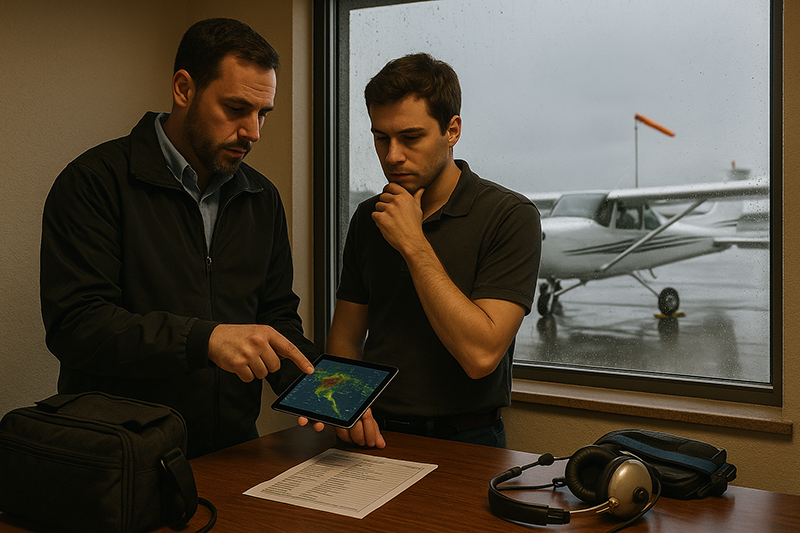
Delaying a flight is sometimes the most professional decision a pilot can make. In training, pilots spend a great deal of time learning how to launch, navigate, communicate, and land. Less time is often spent practicing the discipline of not launching yet. That gap matters because many unsafe flights do not begin with a dramatic emergency. They begin with a pilot trying to stay on schedule while weather, fatigue, aircraft condition, passenger pressure, or operational uncertainty quietly reduces the margin of safety.
For student pilots, private pilots, flight instructors, and aviation professionals, the decision to wait is not a sign of weakness or indecision. It is a form of active risk management. A delay can give weather time to improve, allow maintenance personnel to evaluate a discrepancy, provide the pilot time to rest, or create space for a more complete preflight planning process. This article explains how to think about delaying a flight in practical terms, how to recognize conditions that deserve a pause, and how to communicate that decision with confidence.
Delaying a Flight Is an Operational Decision, Not a Failure
Aviation culture values completion, precision, and reliability. Those values are important, but they can create a subtle trap when pilots begin to treat the planned departure time as a goal that must be defended. The safer mindset is different: the departure time is a plan, and plans are subject to change when the risk picture changes.
Delaying a flight does not mean the pilot was unprepared. It may mean the pilot was prepared enough to detect a developing risk before it became an airborne problem. A delay can be a short pause to review weather trends, a longer wait for convective activity to move through, an overnight stop because of fatigue, or a maintenance hold because something about the aircraft does not look or feel right. In each case, the delay buys information, margin, or capability.
The key distinction is between inconvenience and safety margin. Inconvenience affects the schedule. Reduced safety margin affects the flight. A pilot who can separate those two ideas is better equipped to make decisions that protect passengers, aircraft, and the broader operation.
In practical flight training, instructors should present delay decisions as normal operational behavior. A student who sees an instructor delay a flight for low ceilings, gusty crosswinds beyond the student's current capability, aircraft discrepancies, or poor personal readiness learns an important lesson: judgment is demonstrated before takeoff as much as it is demonstrated in the traffic pattern or during an emergency procedure.
Why This Matters in Real-World Aviation
Real-world flying rarely presents decisions in perfect textbook form. Weather forecasts may be legal but not comfortable. A mechanical issue may be minor but unresolved. A pilot may be current but tired. A runway may be usable but challenging because of wind, contamination, lighting, terrain, or traffic flow. Each factor may appear manageable in isolation, yet the combination can erode the overall safety buffer.
Delays matter because aviation risk is cumulative. A marginal weather day becomes more demanding when the pilot is fatigued. A busy airspace environment becomes less forgiving when the aircraft has an intermittent radio or avionics issue. A long cross-country becomes more complex when the destination is forecast to deteriorate around the planned arrival time. The purpose of a delay is often not to eliminate all risk. It is to prevent several manageable risks from stacking into a situation that leaves little room for error.
For general aviation pilots, schedule pressure often comes from passengers, business obligations, aircraft reservations, daylight, rental minimums, or personal expectations. For instructors, it may come from a full training schedule or a student's desire to complete a lesson before a deadline. For aviation professionals, it may come from customer service expectations, dispatch pressures, repositioning needs, or operational flow. The specific environment changes, but the human factors are familiar.
A delay also protects decision quality. When pilots feel rushed, they are more likely to accept incomplete information, skip steps, or rationalize warning signs. Waiting creates time to gather better weather data, consult maintenance, brief passengers, coordinate with dispatch or flight school staff, and build a more realistic plan. Even a 20-minute pause can turn a reactive launch decision into a deliberate operational choice.
How Pilots Should Understand This Topic
The decision to delay should be understood as a risk control. It is one option among several: continue as planned, change the route, change the altitude, change the destination, add fuel, bring another qualified pilot, wait, or cancel. The important point is that a delay is not merely the absence of action. It is a deliberate action taken to improve the conditions under which the flight will occur.
Several broad categories commonly support a delay decision: weather, aircraft condition, pilot readiness, airport or runway conditions, airspace or operational complexity, and passenger or mission pressure. None of these categories should be viewed in isolation. A day with moderate turbulence may be reasonable for one pilot and inappropriate for another based on experience, aircraft type, passenger needs, and mission necessity. A legal fuel plan may still deserve reconsideration if winds are uncertain, alternates are limited, or the pilot expects delays at the destination. A flight that is technically possible may not be wise for the pilot, aircraft, and environment involved.
Weather is one of the most common reasons to delay. Low ceilings, reduced visibility, thunderstorms, icing potential, strong surface winds, gusty crosswinds, mountain obscuration, turbulence, fog, and rapidly changing conditions all deserve careful evaluation. The safer question is not simply, "Can I legally go?" It is, "Can I complete this flight with appropriate margins if the forecast is imperfect, the workload increases, or conditions change faster than expected?"
Aircraft condition is another major reason to wait. A pilot does not need to be an aircraft mechanic to recognize that a discrepancy deserves attention. Unusual smells, fluid leaks, abnormal indications, rough engine operation, damaged components, questionable tires, avionics problems, or missing required equipment should not be waved away because the schedule is tight. If the pilot is uncertain about airworthiness or the significance of a discrepancy, the prudent action is to stop and get qualified maintenance guidance before flight.
Pilot readiness is often the least visible factor and one of the most important. Fatigue, illness, medication, stress, dehydration, emotional distraction, lack of recent experience, and inadequate preparation can all reduce performance. A pilot can be certificated, current, and still not fit for a particular flight at a particular time. Delaying for personal readiness is sometimes difficult because it requires honesty, but it is a core part of professional airmanship.
Operational conditions can also justify a delay. Night operations, high-density altitude, short runways, unfamiliar airports, temporary flight restrictions, complex airspace, special procedures, or a busy training environment can increase workload. If those conditions are combined with marginal weather, aircraft limitations, or pilot fatigue, waiting may be the safest and most efficient decision.
The Difference Between Legal and Smart
Pilots are trained to understand regulations, and compliance is the baseline. But legality is not the same as safety margin. A flight can be legal and still be unwise for the pilot's experience level, aircraft equipment, passenger situation, weather trend, or mission profile. This is especially important for developing pilots who may assume that if a regulation permits a flight, the flight is automatically a good idea.
Sound judgment asks broader questions. How much experience does the pilot have in these conditions? What is the escape plan if the weather deteriorates? Is there enough daylight for the planned operation and reasonable contingencies? Are alternates practical, not just theoretical? Is the pilot mentally prepared to divert early? Is the aircraft properly equipped for the environment? Are passengers likely to become uncomfortable, airsick, or distracting? Is the pilot trying to make the flight fit the schedule rather than making the schedule fit the flight?
This legal-versus-smart distinction is a useful teaching point. For example, a student pilot may be authorized to fly within specific limitations, but an instructor may still delay a solo flight because winds are gusty, traffic is heavy, or the student has not recently demonstrated strong performance in similar conditions. A private pilot may be legally current for night flight but choose to delay a long night cross-country after a demanding workday. An instrument-rated pilot may be legal to file IFR but delay because freezing levels, convective potential, equipment issues, or personal fatigue make the overall risk unacceptable.
Professional judgment lives in that space between the minimum requirement and the prudent decision. Regulations define important boundaries. Pilots still must evaluate the real conditions, the real aircraft, and their real capability on that day.
Common Mistakes or Misunderstandings
One common mistake is treating delay as cancellation. Delaying a flight does not always mean abandoning the mission. It may mean departing after the fog lifts, waiting for winds to decrease, giving a frontal passage time to clear the route, resolving a maintenance question, or allowing the pilot to recover from fatigue. When pilots view delay as a flexible tool, they are more likely to use it early, before options narrow.
Another misunderstanding is believing that only severe weather justifies waiting. Many delay decisions involve ordinary but compounding conditions. A slightly tired pilot, a crosswind near personal comfort limits, a passenger who is anxious, and a destination with limited services may not sound dramatic. Together, they may create a flight that is less forgiving than it appears on paper.
A third mistake is relying on optimism instead of trends. Weather decision-making should consider movement, development, timing, and uncertainty. If conditions are improving, a delay may be the most efficient way to reduce risk. If conditions are deteriorating, launching immediately to "beat the weather" can become a dangerous form of time pressure. Pilots should be especially cautious when a plan depends on everything happening exactly as hoped.
Pilots also sometimes confuse confidence with competence. Confidence is valuable when it is built on experience, preparation, and realistic self-assessment. It becomes hazardous when it causes a pilot to dismiss discomfort, ignore new information, or continue with a plan because changing it feels embarrassing. The cockpit rewards disciplined humility. If the situation is causing repeated concern during planning, that concern deserves attention before the aircraft moves.
Passenger management is another frequent weak point. Pilots may delay too late because they do not want to disappoint friends, family, customers, or colleagues. In reality, passengers usually respond better to a calm and professional explanation than to a tense flight conducted under marginal conditions. A simple statement such as, "The weather is below my comfort level for this flight right now, so we are going to wait and reassess," is often enough. The pilot does not need to over-explain or apologize for making a safety decision.
Finally, some pilots underestimate the value of written personal minimums. Personal minimums are self-imposed operating boundaries that may be more conservative than regulatory minimums. They help reduce emotional decision-making by defining in advance what conditions require additional caution, a delay, a different plan, or no flight. The value of personal minimums is not that they replace judgment. Their value is that they support judgment when pressure is high.
Practical Example: A Cross-Country That Should Wait
Consider a private pilot planning a weekend cross-country in a normally aspirated single-engine airplane. The route is familiar, the aircraft is available, and two passengers are expecting to arrive before dinner. The morning forecast shows marginal ceilings along part of the route with improvement expected by midday. Surface winds at the destination are forecast to be gusty but within the pilot's personal limits if they remain aligned with the runway. The pilot also had a long workweek and slept poorly the night before.
Individually, none of these factors may force a cancellation. The pilot could argue that the flight is possible. But the better question is whether launching early provides enough safety margin. The ceilings are not yet improving, the pilot is fatigued, passengers may increase pressure to continue, and a late arrival could create additional stress. If the weather improves as forecast, the flight may become much simpler a few hours later. If it does not improve, the delay prevents the pilot from being airborne while trying to solve a problem that was visible on the ground.
A good decision might be to delay departure until the weather trend is confirmed, brief the passengers early, review alternates, reassess fuel planning, and set a firm latest departure time that preserves daylight and reduces fatigue-related risk. If conditions do not improve by that time, the pilot can reschedule or choose ground transportation. The delay is not a failure to complete the trip. It is a controlled decision that keeps options open and prevents the schedule from becoming the controlling factor.
In a training environment, a similar example might involve a student pilot scheduled for a solo cross-country. The weather is technically acceptable, but visibility is hazy, winds are increasing, and the student seems rushed because of an upcoming checkride timeline. A flight instructor who delays the solo is not holding the student back. The instructor is modeling the judgment the student is expected to carry forward after certification.
Best Practices for Pilots
The best delay decisions are made before the pressure peaks. Pilots should identify likely delay triggers during preflight planning, not at the hold short line with the engine running and passengers watching. A preflight briefing should include weather trends, aircraft readiness, fuel options, alternates, runway and airport conditions, pilot fitness, and mission flexibility.
Use personal minimums as a starting point. Review them regularly and adjust them as experience, proficiency, aircraft type, and operating environment change. A newly certificated pilot may use conservative wind, ceiling, visibility, and night-operation limits. An experienced pilot may still set conservative limits when flying an unfamiliar aircraft, carrying nervous passengers, operating at night, or flying into challenging terrain.
Build decision points into the plan. For example, a pilot might decide to reassess before engine start, before taxi, before takeoff, at a waypoint, and before continuing beyond a suitable diversion airport. These decision points are not meant to create anxiety. They are meant to prevent passive continuation. A pilot who has already decided when to reassess is less likely to drift into deteriorating conditions without a deliberate choice.
Communicate early and plainly. If passengers, students, dispatchers, aircraft owners, or family members are involved, tell them that the flight is weather and safety dependent from the start. This reduces surprise when a delay becomes necessary. It also establishes the pilot as the decision-maker for flight safety.
When a delay is being considered, focus on the specific margin that needs improvement. Waiting is most useful when it changes something meaningful: weather improves, daylight increases, maintenance signs off a discrepancy, fatigue is reduced, fuel options improve, or traffic and workload decrease. A vague delay without a reassessment plan can become another source of uncertainty. A good delay includes a reason, a reassessment time, and a next step.
Practical habits that support safer delay decisions include:
- Reviewing weather trends rather than relying only on a single snapshot.
- Setting personal minimums before the day of flight.
- Separating passenger expectations from pilot-in-command responsibility.
- Asking whether the flight would still seem wise if the schedule pressure disappeared.
- Getting qualified maintenance input when aircraft condition is uncertain.
- Using conservative judgment when multiple small risks appear together.
Instructors can strengthen these habits by making delay decisions visible during training. Instead of simply telling a student that the lesson is postponed, explain the operational reasoning: wind trend, ceiling trend, student workload, aircraft issue, or training objective. Students learn that good pilots do not just fly well. Good pilots manage the entire operation well.
How to Communicate a Delay Professionally
Many pilots know when they should delay but struggle with how to say it. Professional communication should be brief, factual, and calm. Avoid sounding uncertain if the decision has already been made. Avoid debating safety with passengers who do not share the pilot's training or responsibility.
A useful structure is: state the decision, give the safety reason, explain the next reassessment point, and offer options. For example: "We are going to delay departure because the ceilings along the first part of the route are lower than I want for this flight. I will reassess at 11:00, and if the improvement is not clear by then, we will look at a later departure or another travel plan." This approach is clear without being defensive.
In a flight school, instructors can use similar language with students: "The crosswind is above what we need for today's solo objective, so we are delaying the solo and using the time for ground review. We will reassess after the next observation." This keeps the decision tied to training value and safety rather than emotion.
Professional operators may have formal dispatch, maintenance, and operational control procedures. Even in less formal general aviation settings, pilots can benefit from the same mindset: document the concern, involve the right people, reassess with updated information, and avoid launching until the risk is understood and acceptable.
The Role of Fatigue and Personal Readiness
Fatigue deserves special attention because it often feels normal to the person experiencing it. A tired pilot may still speak clearly, complete checklists, and appear functional, yet have reduced attention, slower reaction time, and weaker decision-making. Aviation tasks require sustained mental performance, especially in changing weather, busy airspace, night conditions, or abnormal situations.
Delaying for rest can be difficult because fatigue is not as visible as a thunderstorm or a flat tire. Pilots may feel guilty about inconveniencing passengers or losing a reservation slot. However, fatigue affects the pilot's ability to manage every other risk. A rested pilot can interpret weather more clearly, communicate more effectively, and respond better when the unexpected occurs.
Personal readiness also includes health, medication, stress, hydration, nutrition, and emotional state. A pilot who is distracted by a personal crisis, recovering from illness, or taking medication that may affect performance should be cautious. The question is not whether the pilot wants to fly. The question is whether the pilot is fit to serve as the final authority for the safety of the flight.
When Waiting Is Better Than Launching and Diverting
Diversion is an important aviation skill, but it should not become an excuse for launching into a doubtful situation. A pilot might think, "If it looks bad, I will just divert." That may be a reasonable backup plan when the initial risk is acceptable. It is less reasonable when the flight depends on a diversion plan from the beginning.
There are times when waiting on the ground is safer than launching with the hope of sorting it out in the air. On the ground, the aircraft is not consuming fuel in flight, passengers are not exposed to turbulence or weather, and the pilot has better access to planning resources, maintenance support, restrooms, food, shelter, and alternate transportation. In the air, options may narrow quickly due to fuel, terrain, weather movement, airspace, or passenger stress.
This does not mean pilots should avoid all flights with uncertainty. Aviation always contains uncertainty. The point is to recognize when the uncertainty is better managed before takeoff. If a pilot already expects a high workload, marginal conditions, and a strong chance of diverting, delaying may be the cleaner decision.
Frequently Asked Questions
Is delaying a flight the same as canceling it?
No. A delay means the pilot is waiting for a specific condition to improve or for more information before making the next decision. A cancellation means the flight will not be conducted as planned. A delay may lead to a safe departure later, a revised route, a different aircraft, or a cancellation if conditions do not improve.
What are common reasons pilots should delay a flight?
Common reasons include adverse or uncertain weather, pilot fatigue, illness, aircraft discrepancies, unresolved maintenance questions, strong or gusty winds, low ceilings or visibility, passenger pressure, inadequate planning time, or operational conditions that exceed the pilot's current comfort or proficiency level.
How can a pilot know whether a delay is justified?
A delay is justified when waiting is likely to improve safety margin, decision quality, aircraft readiness, pilot readiness, or operational clarity. If the pilot is repeatedly trying to rationalize a concern, that concern deserves a pause and a structured reassessment.
Should flight instructors delay training flights more conservatively?
Instructors should match the flight to the training objective, student capability, aircraft, and conditions. A condition that is acceptable for dual instruction may not be appropriate for solo flight. Delaying a lesson can be a valuable teaching moment when the instructor explains the operational reasoning clearly.
How should pilots handle passenger pressure to depart?
Pilots should communicate early that the flight depends on safety conditions and that the pilot in command makes the final go or no-go decision. A calm explanation, a reassessment time, and alternative options usually work better than a lengthy debate. Passenger convenience should never control the safety decision.
Can a flight be legal but still worth delaying?
Yes. Regulations establish minimum requirements, but pilots must still evaluate real-world conditions, personal proficiency, aircraft capability, passenger needs, and operational risk. A legal flight may still have too little margin for the specific pilot, aircraft, or mission.
Key Takeaways
- Delaying a flight is an active risk management decision that can preserve safety margin before options narrow.
- Weather, fatigue, aircraft condition, passenger pressure, and operational complexity often become most hazardous when they combine.
- Good pilot judgment means looking beyond legality and asking whether the flight is wise for the conditions, aircraft, pilot, and mission today.