
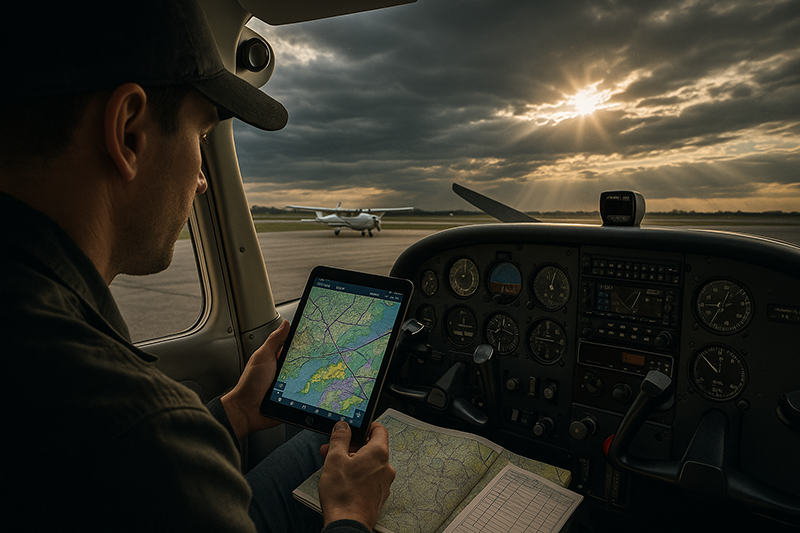
Cross-country planning is where a pilot’s training begins to look less like a classroom exercise and more like real aviation decision-making. Basic planning teaches the essential mechanics: choose a route, calculate time, fuel, heading, and distance, check the weather, review performance, and file or activate a flight plan when appropriate. Beyond the basics, however, cross-country planning becomes a disciplined process of managing uncertainty before the airplane ever leaves the ground.
For student pilots, private pilots, instrument pilots, flight instructors, and aviation professionals, better planning is not about creating a thicker nav log or memorizing more acronyms. It is about understanding what can change, where margins can disappear, and how to build a plan that remains usable when the flight does not unfold exactly as expected. Good cross-country planning helps a pilot anticipate weather trends, terrain, airspace, fuel options, aircraft performance, workload, and diversion choices in a practical, connected way.
This article focuses on the next level of planning: the habits and judgment that separate a technically complete plan from an operationally useful one. The goal is not to replace an approved checklist, operating handbook, flight school procedure, or regulatory requirement. The goal is to help pilots think more clearly about the entire flight as a system.
What Advanced Cross-Country Planning Really Means
Advanced cross-country planning starts with the understanding that a flight is not a straight line between two airports. It is a sequence of decisions made under changing conditions. The route you draw on a chart is only one part of the plan. The more important question is whether that route gives you acceptable options if the wind is stronger than forecast, the ceiling lowers, turbulence increases, fuel burn differs from expectation, a passenger becomes uncomfortable, or the destination airport becomes less suitable.
At the basic level, pilots often focus on the planned route. At the advanced level, pilots focus on the planned route, the escape routes, the decision points, and the resources available along the way. That difference is especially important in single-engine aircraft, night operations, mountain or remote terrain, marginal visual conditions, busy airspace, and flights with passengers who may not understand aviation risk.
A strong cross-country plan answers several practical questions. What conditions are required for this flight to remain safe and legal? Where will I turn around, divert, climb, descend, or land if those conditions do not develop as expected? What do I need to know before I commit to crossing a weather system, a large area of sparse airports, high terrain, or complex airspace? How much fuel margin do I want beyond the minimum required for the operation? How will I reduce workload during departure, arrival, and any high-density traffic environment?
The best plans are specific enough to guide action but flexible enough to survive reality. A route that looks perfect on a screen may not be the best operational route if it offers poor emergency landing options, weak communication coverage, few alternates, or difficult terrain with limited weather reporting. Likewise, the shortest route may not be the safest or most efficient route once winds, airspace, terrain, fuel availability, passenger comfort, and pilot workload are considered.
Why This Matters in Real-World Aviation
Cross-country flying exposes pilots to a wider range of variables than local training flights. Weather can differ significantly across even a modest route. Winds aloft may change the fuel picture. A layer that looks harmless near departure may become a ceiling problem near the destination. A headwind that seemed manageable during planning may become a reason to stop earlier than planned. Airspace that is familiar on a chart may become busy and demanding during a high-workload arrival.
In training, cross-country flights are often used to develop navigation, weather interpretation, communication, fuel management, and aeronautical decision-making. In real operations, those skills merge. A pilot does not get to manage weather separately from fuel, or airspace separately from workload. Every decision affects the rest of the flight.
For example, a pilot who chooses to remain low to stay below a cloud layer may face stronger turbulence, reduced radio range, fewer landing options, and higher workload in complex airspace. A pilot who climbs to improve glide range and ride quality may encounter stronger headwinds or oxygen considerations depending on altitude and duration. A pilot who delays a fuel stop to save time may reduce flexibility exactly when weather or winds are becoming less favorable.
Real-world cross-country planning also matters because passengers often change the decision environment. A student pilot on a solo cross-country may be focused on navigation and requirements. A certificated pilot carrying family, colleagues, or clients may feel subtle pressure to complete the trip. Advanced planning helps reduce that pressure by identifying acceptable alternatives before emotions and expectations enter the cockpit.
Professional pilots and flight instructors recognize that a good plan is not proven by reaching the original destination. It is proven by making safe, timely decisions when the original plan is no longer the best choice. That mindset is just as valuable in a training aircraft as it is in more complex operations.
How Pilots Should Understand Route Planning
Route planning should begin with the mission, not the magenta line. The mission includes the aircraft, pilot qualifications and proficiency, passengers, weather, terrain, time of day, airport environment, fuel availability, and operational constraints. A route that is appropriate for a proficient instrument pilot in a well-equipped aircraft may be a poor choice for a student pilot on a day VFR training flight. A route that works well in calm morning weather may be less suitable during afternoon convective development or gusty surface winds.
When selecting a route, pilots should consider whether each segment provides reasonable options. That does not mean every mile must be over an airport. It means the pilot should understand where suitable landing areas, alternates, and decision points exist. In flatter areas with many airports, this may be straightforward. In mountainous terrain, coastal areas, deserts, forests, or sparsely populated regions, route selection may require more conservative choices.
Airspace should be viewed as both a navigation issue and a workload issue. Some pilots plan around controlled or special-use airspace simply to avoid communication or clearance complexity. Others plan directly through busy areas without considering workload. Neither habit is ideal by itself. The better question is whether the route matches the pilot’s proficiency, equipment, weather, and expected traffic environment. Sometimes the most efficient and safest plan is to use air traffic services and fly a direct route through controlled airspace. Sometimes a small routing change reduces workload and improves situational awareness.
Terrain is another planning factor that deserves more than a quick glance. Pilots should evaluate minimum safe altitudes, obstruction clearance, emergency landing options, wind effects near terrain, and the performance needed for climb and cruise. Terrain planning also includes human factors. A route over visually similar terrain, water, or remote areas can increase navigation workload and reduce useful outside references, especially for pilots with limited experience in those environments.
Modern flight planning tools make route generation fast, but they can also create a false sense of completeness. A route produced by software still needs pilot judgment. The pilot should verify that the proposed altitude, route, fuel stop, and alternates make sense for the aircraft and conditions. Automation can calculate, display, and alert. It cannot decide how much uncertainty is acceptable for a particular flight.
Weather Planning Beyond a Go or No-Go Decision
Weather planning is often taught as a preflight gate: if conditions meet the pilot’s limitations and legal requirements, the flight may proceed. Advanced planning treats weather as a timeline. The pilot evaluates what the weather is doing now, what it is expected to do next, where the uncertainties are, and how those uncertainties affect each phase of flight.
A useful weather plan looks at departure, en route, destination, and alternate areas as connected parts of one system. A clear departure does not guarantee a usable destination. Good conditions at the destination do not eliminate the need to consider weather along the route. A favorable ceiling may not be enough if visibility, terrain, wind, turbulence, icing potential, convective activity, or night conditions introduce risk beyond the pilot’s capability or aircraft equipment.
For VFR pilots, one of the most important planning skills is avoiding the trap of legal but uncomfortable conditions. Visual flight rules define certain minimum conditions, but a pilot’s personal minimums should account for experience, terrain, airspace, lighting, and workload. A day VFR flight over familiar flat terrain with several nearby airports is different from a late-day route over rising terrain with a lowering ceiling and limited alternates.
For instrument-rated pilots, advanced planning includes more than asking whether the flight can be flown under IFR. It includes departure and arrival weather, approach availability, alternate options when required or prudent, aircraft equipment, pilot currency and proficiency, potential icing, convective hazards, fuel planning, and missed approach considerations. An instrument clearance is a powerful tool, but it does not remove the need for conservative judgment.
Weather planning also benefits from timing flexibility. Departing two hours earlier or later may substantially change convective exposure, surface winds, temperature, turbulence, or ceiling trends. Advanced pilots often plan not only a route, but also a timing strategy. The question becomes: when is the best window for this aircraft, pilot, and mission?
Fuel Planning as a Decision-Making Tool
Fuel planning is not just arithmetic. It is one of the clearest indicators of how much flexibility a pilot has. Required reserves establish a minimum standard for legal planning, but many pilots choose larger margins based on weather, terrain, airport spacing, night conditions, wind uncertainty, and passenger considerations. The proper margin depends on the operation, aircraft, and conditions, but the principle is consistent: fuel gives choices.
Advanced fuel planning begins with accurate aircraft performance data. Pilots should use the appropriate aircraft documents, current weight and balance, expected power settings, forecast winds, climb time, cruise performance, descent planning, taxi fuel, and any operational factors that affect fuel burn. In aircraft with fuel totalizers or advanced avionics, those tools can be helpful, but they should be understood and cross-checked. A fuel computer is only as accurate as its inputs and the system supporting it.
Fuel stops should be selected with more thought than price or convenience. A good fuel stop has suitable runway length and surface for the aircraft, favorable expected winds, available services when needed, reasonable weather, and a practical departure path after refueling. Pilots should also consider whether fuel availability has been confirmed, especially at smaller airports, after hours, or during unusual local conditions.
One of the strongest advanced planning habits is identifying fuel decision points. Rather than waiting until fuel becomes a concern, the pilot decides before departure what fuel quantity, time, or location will trigger a diversion or stop. This reduces the risk of continuing because the destination is close, the passenger wants to arrive, or the pilot expects conditions to improve.
Fuel planning should also account for winds that differ from forecast. A modest headwind error over a long leg can erode reserve margins. The practical solution is not anxiety. It is monitoring groundspeed, estimated time en route, and fuel remaining throughout the flight. If the plan is not matching reality, the pilot should adjust early while good options remain.
Performance, Weight, and Balance in Cross-Country Context
Aircraft performance planning is sometimes treated as a departure calculation only. For cross-country flying, performance matters throughout the trip. Takeoff distance, climb rate, cruise speed, fuel burn, landing distance, and go-around capability can all be affected by weight, density altitude, runway condition, wind, temperature, and aircraft configuration.
A pilot departing early in the morning at a comfortable weight may still need to consider the return flight or later fuel stop. Higher temperature, higher field elevation, shorter runway, obstacles, or a heavier loading condition can change the performance picture. The aircraft may be within limits and still require careful judgment about runway margin and climb performance.
Weight and balance also affect handling, performance, and loading flexibility. Advanced planning means understanding how baggage, passengers, fuel burn, and seating arrangements influence the aircraft across the entire flight. In some aircraft, burning fuel can move the center of gravity in a direction that matters operationally. Pilots should use the aircraft’s approved data and avoid assumptions based on previous flights with different loading.
Performance planning is also where pilots must be honest about runway environment. A runway that is long enough in the performance chart may still be challenging if it is unfamiliar, narrow, sloped, contaminated, surrounded by obstacles, affected by gusty crosswinds, or located in high terrain. Published performance data and pilot technique are both important. Conservative margins are especially valuable when operating near the edge of personal experience.
Planning for Workload, Fatigue, and Human Factors
Cross-country planning beyond the basics includes planning the pilot, not just the airplane. Workload increases during taxi, departure, airspace transitions, weather deviations, arrival, approach, and abnormal situations. Fatigue, dehydration, heat, passenger distractions, and schedule pressure can reduce the pilot’s ability to manage those tasks effectively.
Human factors are often subtle. A pilot may feel fully capable during preflight but become task saturated when weather requires a route change while air traffic control is busy, a passenger is asking questions, and the aircraft is nearing a complex arrival area. Good planning reduces the chance that several demanding tasks arrive at once.
One effective technique is to identify high-workload segments before departure. These might include a busy Class B or Class C transition, a mountain pass, a fuel stop at an unfamiliar airport, a non-towered airport arrival with active training traffic, or an instrument approach after several hours of flight. The pilot can then brief frequencies, altitudes, expected clearances, runway layouts, taxi routes, and missed or diversion options in advance.
Fatigue planning deserves specific attention. A legal flight may still be unwise if the pilot is tired, rushed, hungry, or emotionally distracted. Longer cross-country flights often involve early departures, changing weather, and time pressure. A realistic plan includes rest, food, hydration, and a willingness to stop before fatigue becomes a safety issue.
Using Technology Without Letting It Replace Judgment
Electronic flight bags, moving maps, GPS navigation, datalink weather, traffic displays, and performance tools have improved situational awareness for many pilots. They can make planning faster and in-flight monitoring more precise. The risk is not the technology itself. The risk is assuming that a beautiful display equals a complete plan.
Advanced pilots use technology as a decision support tool. They still understand the route, fuel, weather, airspace, terrain, and alternates. They know what the avionics are telling them, what the limitations of the display may be, and what they will do if a device overheats, loses power, loses signal, or displays information that does not match outside conditions.
Datalink weather, where available, is especially useful but must be understood as strategic information rather than a tool for close tactical maneuvering around fast-changing hazards. Pilots should know that displayed weather can be delayed or incomplete depending on system, coverage, and conditions. The practical takeaway is to give weather more space, not less, when uncertainty exists.
Technology should also be configured before high-workload phases. Flight plans, procedures, frequencies, performance data, and display settings should be prepared on the ground when possible. In flight, the pilot should avoid spending excessive heads-down time troubleshooting or editing while close to terrain, airspace boundaries, traffic, or weather.
Common Mistakes or Misunderstandings
One common mistake is treating cross-country planning as a paperwork requirement instead of a risk management process. A completed nav log does not guarantee that the pilot has understood the operational problem. The numbers matter, but the decisions behind the numbers matter more.
Another mistake is building the plan around the destination rather than the conditions. Pilots sometimes become attached to the original airport, the original arrival time, or the original route. Advanced planning reduces that attachment by identifying acceptable alternatives before takeoff. A diversion is not a failure. It is often evidence that the pilot is actively managing the flight.
A third misunderstanding is assuming that more direct is always better. Direct routing may save time and fuel in many cases, but it may also cross poor landing terrain, reduce access to alternates, increase exposure to weather, or create communication and airspace challenges. A slightly longer route can sometimes provide a much better safety margin.
Some pilots also overestimate the reliability of forecast winds and underestimate how quickly fuel margins can change. The solution is not to distrust every forecast. It is to monitor actual groundspeed and fuel progress early enough to respond. A fuel problem rarely appears all at once. It usually develops gradually as small assumptions fail to match reality.
Another frequent planning gap is inadequate arrival preparation. Many pilots plan departure and en route navigation carefully, then arrive tired at an unfamiliar airport with limited knowledge of runway layout, pattern procedures, terrain, nearby airspace, or taxi complexity. The arrival is one of the busiest parts of a cross-country flight. It deserves deliberate preparation.
Finally, pilots sometimes allow technology to narrow their attention. A moving map may show position precisely while the pilot loses awareness of weather trends, fuel state, traffic, terrain, or personal fatigue. The best use of technology is to broaden situational awareness, not to replace active thinking.
Practical Example: A VFR Cross-Country With Changing Conditions
Consider a private pilot planning a 240 nautical mile day VFR flight in a normally aspirated single-engine training aircraft. The direct route crosses a stretch of lightly populated terrain with few airports, then passes near a busy terminal area before reaching a non-towered destination. Forecast weather is VFR, but ceilings are expected to lower slightly near the destination later in the afternoon. Winds aloft are forecast to be a light headwind, but surface winds are expected to become gusty.
A basic plan might draw the direct route, calculate fuel, identify checkpoints, and depart if the weather meets the pilot’s minimums. An advanced plan asks more. Is the direct route the best choice if the headwind is stronger than expected? Are there better emergency landing options along a slightly longer route? Where are the practical fuel stops? What airport will be used if the destination winds exceed the pilot’s comfort level? How will the pilot handle the busy airspace transition? What time must the aircraft be past the halfway point to arrive before ceilings lower?
The pilot chooses a route that adds a few minutes but stays closer to airports and better terrain. A fuel stop is identified as optional but easy to use if groundspeed is lower than planned. The pilot sets a fuel decision point: if actual groundspeed is below the planning value by a meaningful margin after the first hour, the fuel stop becomes the new plan rather than a last-minute decision. The destination and an alternate are reviewed for runway orientation, traffic pattern information, expected winds, and nearby airspace.
During flight, the headwind is stronger than forecast. The pilot notices early because groundspeed and estimated time en route are monitored against the plan. Rather than continuing with a shrinking margin, the pilot lands at the planned fuel stop. While on the ground, the pilot checks updated weather and finds the destination remains VFR, but gusts are increasing. The pilot waits briefly, updates the route, and continues with a better fuel margin and a clearer arrival plan.
Nothing dramatic happens. That is the point. Advanced planning often prevents drama. The flight becomes safer not because the pilot predicted every variable perfectly, but because the pilot created options and used them early.
Best Practices for Pilots
Strong cross-country planning habits are developed through repetition, instruction, and honest post-flight review. The following practices are useful for pilots at many experience levels, but they should be adapted to the aircraft, operation, and training environment.
- Plan decision points, not just checkpoints. A checkpoint tells you where you are. A decision point tells you what you will do if conditions are not meeting expectations.
- Use personal minimums that reflect the flight. Minimums should consider weather, terrain, day or night conditions, pilot proficiency, passenger comfort, and aircraft capability.
- Build fuel flexibility into the route. Identify realistic fuel stops and decide early when a stop becomes the safer choice.
- Brief the arrival before the workload rises. Review runway layout, traffic pattern or approach expectations, terrain, frequencies, and taxi considerations before reaching the terminal area.
- Keep technology in its proper role. Use it to improve awareness and decision-making, but maintain independent understanding of the route and risks.
- Review the flight afterward. Compare planned winds, fuel burn, timing, weather, and workload against what actually happened. This is where planning skill improves.
Instructors can help students by asking planning questions that require judgment rather than recitation. Instead of asking only for heading, distance, and fuel burn, ask what would make the pilot divert, where the best diversion airports are, what weather trend would change the plan, and what the pilot will do if the passenger becomes uncomfortable. These questions build the decision-making habits that matter after certification.
How Flight Instructors Can Teach Beyond-the-Basics Planning
Flight instructors have an important role in moving cross-country planning from arithmetic to judgment. Early lessons must teach the mechanics, but later lessons should require students to explain why their plan is operationally sound. A student who can calculate a wind correction angle but cannot identify a reasonable diversion airport is not yet thinking like a cross-country pilot.
Scenario-based instruction is especially effective. The instructor can introduce realistic changes: a stronger headwind, an unexpected runway closure, a passenger who feels ill, a destination crosswind beyond the student’s comfort level, or a lowering ceiling along the route. The goal is not to surprise the student for entertainment. The goal is to teach flexible thinking in a controlled environment.
Instructors should also model conservative decision-making. Students notice when instructors press into marginal situations, dismiss fuel stops, or rely entirely on avionics. They also notice when instructors slow down, re-brief, divert, or delay for good reasons. The habits demonstrated during training often become the habits used after the checkride.
A useful post-flight discussion can be brief but focused. What part of the plan worked well? What assumption was least accurate? Did the workload occur where expected? Were alternates realistic? Did the pilot notice changes early? This type of review turns every cross-country flight into a planning lesson.
Frequently Asked Questions
What is the biggest difference between basic and advanced cross-country planning?
Basic planning often focuses on completing the route calculations and confirming that the flight can be conducted as planned. Advanced planning focuses on managing uncertainty. It includes decision points, alternates, fuel flexibility, workload, weather timing, terrain, and the pilot’s own limitations.
Should pilots always choose the most direct route?
No. The most direct route may be appropriate, but it is not automatically the best route. Pilots should consider terrain, airspace, alternates, weather, fuel options, emergency landing areas, communication coverage, and workload. A slightly longer route may offer better choices if conditions change.
How much fuel reserve should a pilot plan?
Pilots must comply with the applicable fuel requirements for their operation, but many flights call for additional practical margin. Weather uncertainty, night conditions, sparse airports, headwinds, terrain, and passenger considerations may justify more conservative fuel planning. The aircraft’s actual performance data and current conditions should guide the calculation.
How should VFR pilots plan around marginal weather?
VFR pilots should think beyond whether conditions are technically legal. Terrain, visibility, ceiling trends, daylight, pilot experience, airspace complexity, and available alternates all matter. A conservative plan includes a clear point at which the pilot will turn around, divert, land, or delay rather than continue into deteriorating conditions.
Is an electronic flight bag enough for cross-country planning?
An electronic flight bag can be an excellent planning and situational awareness tool, but it is not a substitute for pilot judgment. Pilots should understand the route, fuel plan, weather, airspace, terrain, and alternates independently. They should also have a practical backup plan for power, display, data, or connectivity issues.
What should pilots review after a cross-country flight?
Pilots should compare the plan with the actual flight. Useful review items include winds, fuel burn, timing, weather accuracy, workload, radio performance, passenger management, arrival preparation, and any point where the pilot felt rushed or uncertain. That review improves future planning more than simply logging the flight time.
Key Takeaways
- Cross-country planning beyond the basics is about creating useful options before the flight, not just completing route and fuel calculations.
- Weather, fuel, terrain, airspace, aircraft performance, workload, and human factors should be evaluated together because they affect one another in flight.
- Decision points, conservative margins, realistic alternates, and honest personal minimums help pilots make safer choices when the original plan changes.