
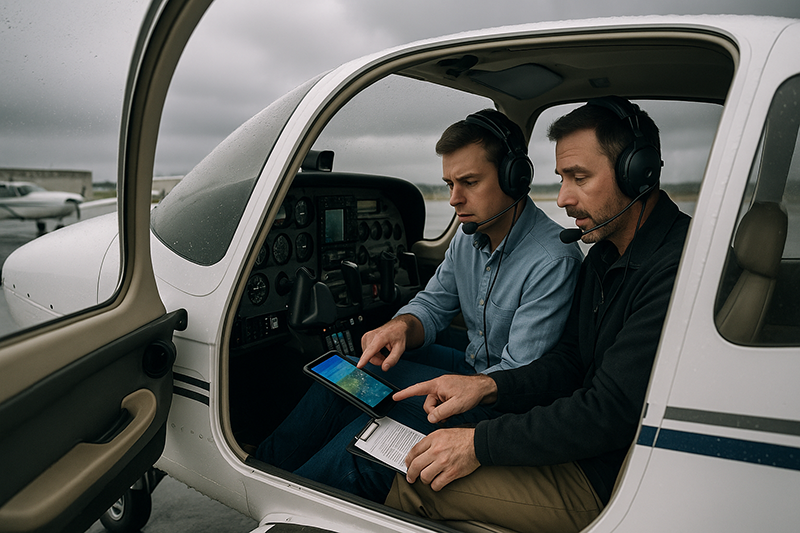
Confirmation bias in aviation is the tendency to notice, favor, and trust information that supports what a pilot already believes while discounting information that points in another direction. It is not a sign of poor character or weak training. It is a normal human thinking pattern that can become hazardous when it shapes weather decisions, aircraft troubleshooting, traffic scanning, fuel planning, navigation, maintenance communication, or go/no-go judgment.
For pilots, student pilots, flight instructors, dispatchers, maintenance professionals, and aviation managers, the issue is not whether confirmation bias exists. It does. The real question is whether the aviation system around the decision is strong enough to detect it before it becomes an operational error. This article explains how confirmation bias shows up in everyday flying, why it is difficult to recognize in the moment, and how pilots can build practical habits that make better decision-making more likely.
What Confirmation Bias Means in Aviation
Confirmation bias occurs when a person forms an expectation and then interprets new information in a way that confirms that expectation. In aviation, the expectation may be simple: the weather will improve, the engine roughness is only carburetor ice or a fouled plug, the runway in sight is the intended runway, the fuel will be enough, or the air traffic controller meant what the pilot expected to hear. Once the mind has selected a likely answer, it can begin filtering the environment to support that answer.
This matters because flying requires continuous interpretation. Pilots rarely receive perfect information. Weather reports are snapshots. Instruments provide data that must be cross-checked. Air traffic instructions must be heard, understood, and applied in context. Aircraft performance must be predicted from available information and then verified in the real world. In that environment, the pilot's mental model can be either a safety tool or a trap.
A mental model is the internal picture a pilot builds of what is happening. For example, on an instrument approach the pilot may have a model of aircraft position, altitude, course guidance, descent profile, missed approach procedure, nearby terrain, and expected traffic flow. A good mental model helps the pilot anticipate and act smoothly. Confirmation bias becomes a problem when the pilot protects the model instead of testing it.
In practical terms, confirmation bias sounds like, “That must be the airport,” “The ceiling should be high enough,” “The vibration is probably nothing,” “ATC cleared us for what we filed,” or “The forecast showed VFR, so this haze layer will break up.” None of those statements is automatically unsafe. The risk is that the pilot stops asking, “What evidence would prove me wrong?”
Why This Matters in Real-World Aviation
Aviation is built on disciplined verification. Preflight inspection, checklist use, instrument cross-check, readbacks, weather briefing, performance planning, and maintenance signoffs all serve the same broad purpose: reduce the chance that a single human assumption becomes the final answer. Confirmation bias works in the opposite direction. It narrows attention and makes selected evidence feel stronger than it really is.
In flight training, confirmation bias often appears when a student has been taught the “right” answer and then tries to make the airplane fit that answer. A student practicing navigation may see a road, lake, or town and decide it must be the planned checkpoint because the timing seems close. A student practicing landings may assume the approach is stable because the runway is centered, even while airspeed or descent rate says otherwise. A student under the hood may chase one instrument because it supports the desired attitude while ignoring another instrument that shows the beginning of a deviation.
In more advanced operations, the bias can be subtle. A professional crew may expect a certain taxi route and hear a clearance through that expectation. A pilot flying with advanced avionics may assume the automation is following the intended lateral and vertical path because the airplane is generally moving in the right direction. A maintenance team may troubleshoot toward the most familiar fault and give less weight to a less common symptom. A dispatcher or flight coordinator may evaluate changing weather through the lens of schedule pressure, aircraft availability, or customer expectations.
The common thread is not recklessness. It is the ordinary human tendency to seek coherence. Pilots are trained to make sense of incomplete information quickly. That skill is necessary. But when the pressure rises, the same skill can harden into premature certainty.
Confirmation bias is especially relevant in weather decision-making. Weather creates ambiguity, and ambiguity invites interpretation. A pilot who wants to depart may focus on improving observations, favorable pilot reports, or a route segment with higher ceilings. A pilot who wants to continue may treat deteriorating visibility as temporary, isolated, or less significant than it is. A pilot who wants to complete an approach may see runway environment cues earlier than they are actually usable. The danger is not optimism by itself. The danger is optimism that has stopped cross-checking.
Aircraft abnormal situations can produce the same problem. If the first suspected cause seems plausible, a pilot may build the entire response around it. For example, an unusual engine indication might be interpreted as an instrument problem because the engine sounds normal. That may be correct, but it must be tested against other information: fuel flow, oil pressure, temperature trends, electrical system behavior, vibration, smell, performance, and recent maintenance. Good troubleshooting asks what else could explain the evidence.
How Pilots Should Understand This Topic
Pilots should understand confirmation bias as a threat to information quality. It does not mean a pilot is unable to make decisions. It means the decision process can become contaminated when the pilot becomes attached to a conclusion too early. The antidote is not endless doubt. Aviation still requires timely decisions. The goal is disciplined skepticism, especially when the decision carries operational risk.
A useful way to think about confirmation bias is to separate evidence from interpretation. Evidence is what can be observed or verified: the altimeter setting, the fuel quantity indication, the calculated fuel burn, the reported wind, the aircraft position, the checklist item, the annunciation, the runway markings, or the controller's actual words. Interpretation is the meaning assigned to that evidence: “We are on profile,” “The fuel is sufficient,” “That is our runway,” or “This weather is manageable.”
Both evidence and interpretation are necessary. The problem begins when interpretation starts selecting the evidence. A pilot who believes the destination is still usable may give more weight to reports from earlier in the hour than to more recent deterioration. A pilot who believes the aircraft is correctly configured may not notice that a checklist item was skipped. A pilot who expects a left base entry may mishear or misremember an instruction that does not fit the expectation.
In aviation training, instructors can help by teaching students to verbalize the evidence behind a decision. Instead of accepting, “I think we are high,” the instructor can ask, “What are you using to decide that?” Instead of accepting, “The weather is okay,” the instructor can ask, “Which observation, forecast, and alternate plan support that?” This does not turn every flight into an academic exercise. It builds the habit of linking decisions to verifiable data.
Confirmation bias also interacts with other human factors. Plan continuation bias, sometimes described as the pull to continue with an original plan, can be reinforced by confirmation bias. Stress can narrow attention. Fatigue can reduce mental flexibility. Time pressure can reward the first plausible answer. Authority gradient can make a less experienced pilot hesitate to challenge a conclusion. Automation can create a false sense of certainty when the pilot assumes the system is doing what was intended.
For single-pilot operations, the challenge is greater because there may be no second crewmember to challenge the mental model. The pilot must deliberately create moments of self-review. That can be as simple as pausing before departure and asking, “If I were trying to talk myself out of this flight, what would I point to?” It can happen before descent: “What would make this approach unstable, and where will I go around if it happens?” It can happen during an abnormal indication: “What evidence supports my first theory, and what evidence does not fit?”
Where Confirmation Bias Commonly Appears
Confirmation bias can affect almost every aviation task, but several areas deserve special attention because they involve ambiguity, workload, or strong motivation to reach a preferred outcome.
Weather and go/no-go decisions
Weather planning is one of the most common places where pilots must evaluate uncertainty. A pilot may focus on the most favorable forecast element while underweighting lower ceilings, stronger winds, convective potential, freezing levels, or visibility trends. The decision may still be reasonable, but it should be made with an honest view of adverse information. The question is not, “Can I find data that supports going?” The better question is, “What data would make this plan unsuitable, and is that data present or likely?”
Navigation and position awareness
In visual navigation, confirmation bias can make a pilot identify the wrong landmark as the planned checkpoint. In instrument flying, it can make a pilot accept a course or fix identification that appears to fit the expected route while overlooking conflicting indications. With moving maps, the display can reduce some errors, but it can also encourage passive acceptance if the pilot does not verify the active flight plan, waypoint sequencing, navigation source, and aircraft track.
Approach and landing decisions
Approach and landing involve strong goal pressure. The runway is close, the flight is nearly complete, and the pilot may have invested time and effort in getting there. Confirmation bias can cause a pilot to interpret a marginally stable approach as acceptable, rationalize excess speed, or believe a runway sighting is adequate for continued descent when the overall picture calls for a missed approach or go-around. A go-around is not a failure. It is a normal maneuver that protects the margin.
Aircraft system abnormalities
When an aircraft presents an abnormal indication, the first explanation may be right or wrong. Confirmation bias can make the pilot stop troubleshooting too early. In piston aircraft, a rough engine, unusual temperature trend, electrical issue, or fuel-related concern may have multiple possible causes. In turbine and technically advanced aircraft, annunciations and system logic can be misunderstood if the pilot jumps to a familiar explanation. The safest habit is to fly the aircraft, manage the immediate risk, use the appropriate checklist or procedure, and continue comparing the suspected cause with the observed evidence.
Communication and expectation
Pilots often hear what they expect to hear. Similar call signs, busy frequencies, expectation of a standard clearance, and task saturation can all increase the chance of a communication error. Readbacks and hearbacks are not just formalities. They are defenses against expectation-driven mistakes. When something sounds unusual, incomplete, or inconsistent with aircraft position or clearance limits, the professional response is to clarify.
Common Mistakes or Misunderstandings
One common misunderstanding is that confirmation bias only affects inexperienced pilots. Experience can reduce many risks, but it can also create strong expectations. A pilot who has flown a route many times may expect the same runway, arrival, turbulence pattern, cloud break, or ATC phraseology. Familiarity can be valuable, but it can also make contradictory information feel like an exception rather than a warning.
Another mistake is treating confidence as evidence. A pilot may feel certain because the plan is familiar, the aircraft is capable, or the previous flight was uneventful. Confidence can be useful when it reflects preparation and proficiency. It is less useful when it substitutes for current verification. The airplane, weather, traffic, and operating environment do not respond to confidence. They respond to physics, procedures, limitations, and real conditions.
A third mistake is using checklists mechanically while allowing the mind to remain committed to a desired conclusion. A checklist is a powerful tool, but it is not magic. If the pilot rushes, skips verification, or reads items without looking at the actual switch, control, gauge, annunciation, or configuration, the checklist may not catch the bias. The point of a checklist is not to finish it. The point is to verify the aircraft is in the intended state.
Pilots may also misunderstand the role of technology. Advanced avionics, datalink weather, autopilots, traffic displays, terrain awareness tools, and electronic flight bags can improve situational awareness when used correctly. They can also create confirmation traps if the pilot uses them only to support an existing decision. For example, datalink weather can help show broad weather patterns, but pilots must understand that displayed information may not represent the exact real-time condition at the aircraft's location. A moving map can show position very clearly, but it cannot decide whether the pilot loaded the correct procedure, selected the correct navigation source, or briefed the correct missed approach.
Instructors sometimes see another misunderstanding in training: students may believe that changing a decision proves the first decision was bad. In reality, revising a plan is often evidence of good airmanship. Aviation decisions are made with the best information available at the time. When new information changes the risk picture, changing the plan is not indecision. It is effective decision-making.
Finally, pilots may assume that bias can be eliminated through awareness alone. Awareness helps, but it is not enough. A pilot who says, “I know about confirmation bias,” is still vulnerable. The practical defense is a process: cross-check, seek disconfirming evidence, brief decision points, invite challenge, and create clear triggers for diverting, delaying, discontinuing an approach, or asking for help.
Practical Example: The Marginal VFR Cross-Country
Consider a private pilot planning a daytime cross-country in a familiar single-engine airplane. The route is within the pilot's experience, the airplane is airworthy, and the destination event is important but not urgent. The morning briefing shows VFR conditions along much of the route, with areas of lower ceilings near the destination and a trend that may improve later in the day.
The pilot wants the trip to work. That desire is normal. During planning, the pilot notices several favorable data points: the departure airport is clear, the first half of the route looks good, and one forecast discussion suggests improvement. The pilot also sees less favorable information: recent observations near the destination show lower ceilings than expected, visibility varies, and an alternate airport farther away has better conditions but would complicate ground transportation.
Confirmation bias may enter quietly. The pilot spends more time examining the improving forecast than the current observations. The pilot chooses a route that avoids the worst reported conditions but does not define a firm turnaround point. During the flight, the first hour is smooth, which reinforces the original decision. As the aircraft approaches the destination area, the ceiling appears lower and the horizon becomes less distinct. The pilot recognizes the change but interprets it as a temporary local layer because that explanation supports continuing.
A better decision process would not require fear or cancellation at the first sign of uncertainty. It would require structured skepticism. Before departure, the pilot could identify specific conditions that would trigger delay, diversion, or return. In flight, the pilot could compare actual conditions with those triggers instead of with the preferred outcome. The pilot could ask air traffic control for updated weather, contact flight service if appropriate, monitor nearby airport observations, and evaluate fuel, daylight, terrain, and escape routes. If the conditions no longer support the plan, diverting early preserves options.
The important lesson is that confirmation bias does not usually announce itself as a dramatic mistake. It often feels like reasonable persistence. The pilot is not ignoring everything. The pilot is simply giving favorable information more authority than unfavorable information. That is why decision points matter. They move the decision from emotion and momentum back to evidence.
Best Practices for Pilots
The best defenses against confirmation bias are practical habits that fit naturally into normal flying. Pilots do not need to become psychologists to manage human factors. They need repeatable methods for testing assumptions before those assumptions reduce safety margins.
First, define what would change the plan before the pressure rises. Before takeoff, decide what weather, aircraft condition, fuel state, passenger issue, runway condition, or timing problem would lead to a delay, diversion, or cancellation. Before an approach, define what stable approach criteria mean for that flight and what will trigger a go-around. Before entering complex airspace, brief the clearance limit, altitude assignments, navigation setup, and expected next instruction while staying open to what actually occurs.
Second, separate the desired outcome from the safe outcome. Wanting to complete a flight is normal. Pilots carry passengers, schedules, training goals, business needs, and personal expectations. The problem is not motivation. The problem is allowing motivation to decide which evidence counts. A professional mindset allows the pilot to say, “I want this to work, so I need to be extra careful about information that says it may not.”
Third, use the airplane and the environment as feedback. If the climb performance is not what was expected, investigate rather than rationalize. If groundspeed is lower than planned, recalculate fuel and arrival conditions. If the approach does not look or feel stable, verify against objective cues. If a passenger expresses concern, do not dismiss it automatically. The concern may be based on limited aviation knowledge, but it may still point to workload, weather, turbulence, fatigue, or communication that deserves attention.
Fourth, invite challenge when another qualified person is available. In a training flight, the instructor can ask the student to make and defend decisions using evidence. In crewed operations, crewmembers can use standard callouts, briefings, and assertive communication to prevent one person's assumption from becoming the cockpit's shared error. In maintenance and dispatch environments, a second set of eyes can help prevent a familiar explanation from crowding out less obvious possibilities.
Fifth, treat uncertainty as information. Pilots sometimes feel pressure to replace uncertainty with a quick answer. But uncertainty itself is useful. If the pilot is not sure the runway is correct, not sure the clearance was understood, not sure the fuel reserve is adequate for changing winds, or not sure the weather ahead is acceptable, that uncertainty should trigger verification. Asking, holding, delaying, diverting, or going around are operational tools, not admissions of weakness.
- Ask, “What evidence would prove my current assumption wrong?”
- Compare actual conditions with preplanned decision points.
- Use checklists as verification tools, not memory aids to rush through.
- Clarify any clearance, instruction, indication, or procedure that does not fit the situation.
- Practice go-arounds, diversions, and abnormal scenarios enough that changing the plan feels normal.
These habits are especially valuable for flight instructors. Students learn not only from what instructors say, but from how instructors think out loud. When an instructor verbalizes uncertainty, evaluates contrary evidence, and changes the plan when conditions warrant, the student learns that good pilots do not force reality to match the lesson plan. They adapt.
Instructor Strategies for Teaching Confirmation Bias
Confirmation bias is best taught through scenario-based training rather than lecture alone. A student may understand the definition but still fall into the trap during a realistic flight scenario. Instructors can create safe, controlled opportunities for students to practice recognizing when their assumptions are getting ahead of the evidence.
One effective method is the “evidence question.” During preflight planning, enroute navigation, or approach briefing, ask the learner to identify the evidence supporting the decision. If the student says the weather is acceptable, ask which observations, forecasts, trends, and escape options support that conclusion. If the student says the aircraft is on profile, ask which airspeed, altitude, descent rate, configuration, and runway picture support that conclusion. This builds precision without embarrassing the learner.
Another useful method is to ask for the opposite case. If a student recommends continuing, ask, “What would be the best argument for diverting?” If a student recommends landing, ask, “What would be the best argument for going around?” This is not meant to create indecision. It trains the student to search for disconfirming evidence before committing to a higher-risk action.
Instructors can also use postflight debriefing to separate outcome from decision quality. A flight that ends uneventfully was not necessarily well managed, and a flight that required a diversion was not necessarily poorly managed. The key questions are whether the pilot gathered relevant information, recognized changing conditions, used available resources, and made timely decisions. This helps students avoid learning the wrong lesson from a lucky outcome.
For advanced learners and aviation professionals, confirmation bias can be integrated into crew resource management, threat and error management, and automation management discussions. When crews brief expected threats, they can also brief what would invalidate the plan. When pilots use automation, they can verify mode awareness and aircraft behavior instead of assuming the system shares their intent. When teams review an event, they can ask how the original assumption formed and why contradictory cues were accepted or missed.
Building a Cockpit Culture That Challenges Assumptions
Confirmation bias is not only an individual issue. It is also shaped by cockpit culture, training culture, and organizational culture. In a healthy safety culture, questioning an assumption is treated as a contribution, not an annoyance. That applies in a two-pilot flight deck, a flight school, a maintenance hangar, a dispatch office, and a small general aviation operation.
For pilots flying with passengers, culture begins with preflight communication. A pilot can tell passengers that delays, diversions, and go-arounds are normal safety decisions. That simple statement reduces social pressure later. When passengers understand that changing the plan is part of professional flying, the pilot is less likely to feel trapped by expectations.
For flight schools, instructors and managers can reinforce that weather cancellations, maintenance squawks, and conservative decisions are legitimate parts of training. If students believe the only successful lesson is one that launches, they may learn to seek information that supports launching. If they see instructors model careful decision-making, they learn that the preflight decision is as much a piloting skill as steep turns or crosswind landings.
For professional aviation teams, standard briefings and challenge-and-response habits help prevent authority gradient from silencing useful information. A junior crewmember, dispatcher, technician, or line service professional may notice a detail that does not fit the prevailing assumption. The system should make it easy to raise that concern. Confirmation bias becomes more dangerous when people are reluctant to interrupt the story that everyone else appears to believe.
The strongest aviation cultures do not demand pessimism. They demand accuracy. They encourage people to say, “Here is what we know, here is what we are assuming, here is what could prove us wrong, and here is what we will do if conditions change.” That mindset is valuable in a training aircraft, a corporate jet, an airline cockpit, and every aviation decision room in between.
Frequently Asked Questions
Is confirmation bias the same as poor judgment?
No. Confirmation bias is a normal human tendency that can influence good pilots and experienced aviation professionals. Poor judgment may result if the bias is not recognized and managed, but the bias itself is part of how humans process information. The practical goal is to build decision habits that test assumptions before they become unsafe actions.
How can a pilot recognize confirmation bias during a flight?
A useful warning sign is strong attachment to one explanation despite conflicting information. If the pilot is explaining away weather changes, aircraft indications, navigation inconsistencies, unstable approach cues, or communication doubts, it is time to pause and verify. Asking, “What evidence does not fit my current belief?” is a simple in-flight defense.
Does advanced avionics reduce confirmation bias?
Advanced avionics can improve situational awareness, but they do not eliminate confirmation bias. Pilots can still load the wrong procedure, misread a mode, overlook a data age limitation, or interpret a display through expectation. Technology is most helpful when pilots actively verify setup, mode awareness, aircraft behavior, and outside conditions.
What should flight instructors do when a student shows confirmation bias?
Instructors should guide the student back to evidence rather than simply giving the answer. Ask what information supports the student's conclusion, what information conflicts with it, and what decision point should apply. Scenario-based training, thoughtful questioning, and debriefing decision quality are effective ways to build better habits.
Can confirmation bias affect maintenance and dispatch decisions?
Yes. Any aviation role that involves interpreting incomplete or competing information can be affected. A technician may favor a familiar fault explanation. A dispatcher may emphasize favorable weather trends. A pilot may accept an aircraft status or route plan because it supports the schedule. Cross-checks, documentation, and second opinions help reduce the risk.
What is the simplest habit for reducing confirmation bias?
The simplest habit is to look deliberately for disconfirming evidence. Before committing to a decision, ask what would prove the current assumption wrong. In aviation, that question can improve weather decisions, navigation verification, abnormal troubleshooting, approach management, and communication clarity.
Key Takeaways
- Confirmation bias in aviation occurs when pilots favor information that supports what they already believe while discounting information that challenges the plan.
- The safest pilots do not eliminate uncertainty by force. They verify assumptions, compare actual conditions with decision points, and remain willing to delay, divert, clarify, or go around.
- Flight instructors and aviation leaders can reduce confirmation bias by teaching evidence-based decisions, encouraging respectful challenge, and treating changed plans as normal safety management.