
A chain of errors in aviation rarely feels dramatic at the beginning. It often starts with something small: a late departure, a rushed preflight, a misunderstood clearance, a fuel planning assumption, a distraction during taxi, or a quiet sense that the weather is not matching the forecast. The danger is not usually one isolated mistake. The danger is allowing several manageable problems to connect until the pilot has fewer options, less time, and a much higher workload.
For pilots, student pilots, flight instructors, and aviation professionals, learning how to identify a chain of errors before it grows is one of the most practical safety skills in aviation decision-making. It is not about being perfect. It is about noticing when the flight is drifting away from the plan, interrupting the sequence early, and making a deliberate correction before the aircraft, crew, or situation demands more than the pilot can safely manage.
This article explains how error chains develop, what early warning signs look like in real flight operations, and how pilots can use practical habits to break the sequence. The goal is to help pilots recognize the difference between a normal in-flight adjustment and a developing safety problem that deserves immediate attention.
What Is a Chain of Errors in Aviation?
A chain of errors is a sequence of decisions, omissions, assumptions, distractions, or external pressures that gradually reduces safety margins. One link in the chain may be minor. Two or three links may still be recoverable. But as the links accumulate, the pilot may lose time, situational awareness, aircraft performance margin, or decision-making clarity.
The concept is closely related to aeronautical decision-making, risk management, threat and error management, and crew resource management. In plain language, it means that aviation accidents and serious incidents are often preceded by a pattern of smaller problems. Those problems may be technical, environmental, procedural, human, or organizational. The key point for everyday flying is that a pilot does not need to wait for an emergency to take corrective action.
A chain can begin before the engine starts. A pilot may arrive late, skip a careful weather review, accept a tight schedule, and brief the departure while already feeling rushed. Nothing has gone wrong yet in the aircraft, but the flight is already carrying extra risk. Another chain may begin in cruise when a pilot notices lowering ceilings ahead, continues because the destination is close, and then accepts a higher workload while navigating around terrain, airspace, and deteriorating visibility.
Not every unexpected event is part of a dangerous chain. Aviation requires constant adjustment. Winds shift, traffic changes, controllers amend clearances, and equipment behaves in ways that require attention. The issue is whether those changes are being recognized, managed, and resolved, or whether they are accumulating while the pilot continues as if the original plan is still intact.
Why Chains of Errors Grow So Quietly
Error chains grow quietly because each individual item can seem reasonable in isolation. A pilot may think, “I can save a few minutes on the preflight because I know this airplane.” Another may think, “The visibility is lower than expected, but I can still see well enough.” A third may think, “I will sort out that avionics issue after takeoff.” Each statement may feel manageable at the time. The problem appears when several of them exist together.
Human beings are good at adapting. That strength can become a weakness when adaptation turns into normalization of risk. If the first shortcut seems harmless, the next one may feel acceptable. If the first weather concern is rationalized, the next concern may be easier to dismiss. If the pilot is busy, fatigued, or under schedule pressure, the mind may focus on keeping the plan moving rather than stepping back to evaluate whether the plan still makes sense.
Another reason error chains grow is that pilots often expect the next step to fix the last problem. A pilot running behind may expect a quick taxi to recover time. A pilot uncertain about weather may expect conditions to improve closer to the destination. A pilot who misses a radio call may assume the controller will repeat it. Sometimes that is true. Sometimes the next step adds another link.
Good pilots do not avoid every error. They identify errors early, communicate clearly, and reset the situation before the workload becomes unmanageable. The skill is not perfection. The skill is interruption.
Early Warning Signs of a Developing Error Chain
The earlier a pilot notices a chain of errors, the easier it is to break. Early warning signs usually appear in how the flight feels operationally. The pilot may be behind the aircraft, uncertain about the next task, or spending too much mental energy on problems that should already be resolved.
One common warning sign is repeated deviation from the plan. A single change may be ordinary. Several changes in a short period deserve attention. For example, a route change, an unexpected headwind, a fuel stop that is now questionable, and a passenger asking about arrival time may combine into a larger decision-making problem. None of those items alone is necessarily unsafe, but together they change the risk picture.
Another warning sign is task saturation. Task saturation occurs when the number of tasks competing for attention exceeds the pilot’s ability to manage them effectively. In a single-pilot cockpit, this may show up as missed radio calls, delayed checklist use, altitude or heading deviations, uncertainty about aircraft configuration, or a feeling that the cockpit is moving faster than the pilot can process.
Emotional cues matter too. Frustration, embarrassment, impatience, and the desire to “just get it done” can all reduce judgment. A pilot who is irritated by a delay may be more vulnerable to rushing. A student who is embarrassed after a mistake may stop communicating openly. An experienced pilot who does not want to disappoint passengers may continue toward a destination when a diversion would be the cleaner decision.
Physical cues also provide information. Fatigue, dehydration, hunger, airsickness, heat, and stress can degrade attention and decision-making. These factors may not appear on a flight plan, but they affect the pilot’s ability to manage changing conditions. A pilot who recognizes those cues early can slow the operation down, ask for help, use automation appropriately, or choose a safer option.
Why This Matters in Real-World Aviation
In training, pilots often learn maneuvers, procedures, and regulations as separate subjects. In real operations, those subjects interact. Weather affects fuel planning. Airspace affects workload. Aircraft performance affects runway selection. Passenger expectations affect decision-making. Maintenance discrepancies affect dispatch decisions. A chain of errors often develops in the spaces between these categories.
For a student pilot, the chain may be instructional. A missed checklist item, a weak radio call, and uncertainty about traffic pattern spacing can combine quickly. A good instructor helps the student recognize the pattern, not just the individual mistake. That is where training becomes judgment.
For a certificated pilot, the chain may develop through familiarity. Repeated flights to the same airport can create confidence, but they can also reduce vigilance. A familiar airplane, familiar route, and familiar procedure can still produce surprises when weather, traffic, weight, runway condition, or pilot condition changes. Familiarity should reduce workload, not replace active evaluation.
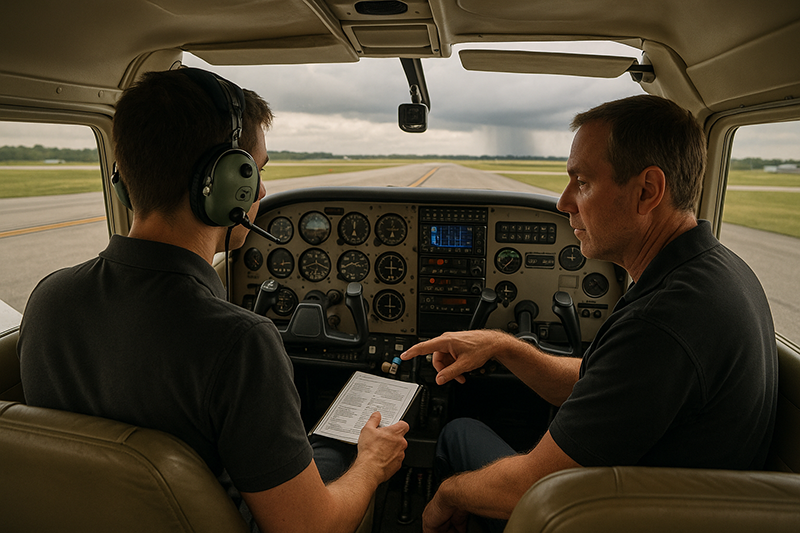
For flight instructors, the chain-of-errors concept is especially important because instructors manage two levels of safety at once. They monitor the aircraft and the learner. They must decide when to let a student work through a manageable error and when to intervene before the instructional event becomes unsafe. Teaching the student to verbalize developing concerns is often more valuable than simply correcting the aircraft.
For aviation organizations, error chains are relevant to standard operating procedures, dispatch decisions, maintenance communication, and safety culture. A professional environment should make it acceptable to pause, clarify, delay, divert, or discontinue a flight when the risk picture changes. Pilots are more likely to break an error chain when the culture supports conservative decision-making.
How Pilots Should Understand This Topic
The most practical way to understand an error chain is to think in terms of margins. Aviation safety depends on maintaining margins in time, altitude, fuel, weather, performance, airspace, communication, and human capacity. When one margin shrinks, the pilot should become more alert. When several margins shrink at once, the flight deserves a deliberate reset.
A reset does not always mean canceling or diverting. Sometimes it means slowing down. It may mean asking air traffic control for a delay vector, requesting clarification, climbing or descending to a more suitable altitude, holding outside a busy airport area, running a checklist again, transferring controls during training, or taking a moment on the ground before taxi. The action should match the situation, but the mindset is the same: stop the chain from continuing unnoticed.
Pilots can also understand error chains through threats and errors. A threat is something that increases operational challenge, such as weather, traffic, runway length, terrain, unfamiliar airspace, a passenger need, or a maintenance issue. An error is a pilot or crew action that departs from the intended plan or safe practice, such as misreading an altitude, missing a checklist item, or accepting a clearance without fully understanding it. Not every threat or error leads to an undesired aircraft state, but unrecognized threats and unmanaged errors can move the flight in that direction.
Good threat and error management begins before departure. A pilot who identifies the day’s most likely threats is better prepared to recognize when the chain is starting. For example, if the departure is at night from an unfamiliar airport, the pilot might brief taxi routing, lighting, terrain, and departure procedures more carefully. If convective weather is in the region, the pilot might define conservative decision points before takeoff. If the pilot is tired, the plan may need more margin or a different go/no-go decision.
The important point is that risk management should be active during the flight, not only completed during preflight planning. A pilot should periodically ask, “What has changed, and does the original plan still fit?” That question is simple, but it is one of the strongest tools for interrupting a chain of errors.
Common Mistakes and Misunderstandings
One common misunderstanding is believing that an error chain is only relevant after something serious happens. In reality, the concept is most valuable before the situation becomes serious. The best time to break a chain is when the pilot still has several good options.
Another mistake is treating a small error as a personal failure instead of operational information. If a pilot misses a checklist item, forgets a frequency, or becomes momentarily uncertain, the useful response is not denial or self-criticism. The useful response is to pause, correct the issue, and ask whether the error is isolated or part of a larger pattern. Was the pilot rushed? Distracted? Fatigued? Confused by a procedure? If so, the underlying condition matters as much as the immediate correction.
Pilots also sometimes underestimate the role of pressure. Schedule pressure, passenger pressure, financial pressure, training pressure, and ego pressure can all influence decisions. The pressure may be subtle. A pilot may not feel forced to continue, but may still feel reluctant to disappoint someone, lose a reservation, delay a lesson, or admit that conditions are outside personal minimums. Naming the pressure out loud can reduce its influence.
A further mistake is assuming that automation eliminates the chain of errors. Autopilots, GPS navigators, flight directors, and electronic flight displays can reduce workload when used correctly. They can also create new risks if the pilot is uncertain about modes, programming, navigation source selection, or automation status. When automation does something unexpected, the pilot should prioritize aircraft control, simplify the system if needed, and avoid becoming fixated on troubleshooting while basic flying tasks suffer.
Instructors should watch for a training-specific misunderstanding: allowing a student to continue struggling because the mistake appears educational. Productive struggle has limits. If the student’s workload is rising, aircraft control is degrading, or situational awareness is narrowing, the instructor should intervene at an appropriate level. The lesson can continue after the aircraft and operation are stabilized.
Practical Example: A VFR Cross-Country That Starts to Drift
Consider a private pilot planning a daytime VFR cross-country to a familiar airport. The forecast supports the flight, fuel planning looks comfortable, and the aircraft is available. The pilot arrives later than intended because of traffic on the way to the airport. During preflight, a passenger asks several questions, and the pilot responds while moving around the aircraft. The pilot notices the fuel is adequate but less than originally expected because the previous flight ran longer. Rather than pause to recalculate carefully, the pilot decides the planned fuel stop is still unnecessary.
At this point, the flight has not become unsafe, but the first links are present: time pressure, distraction during preflight, and a fuel assumption. A good interruption would be simple. The pilot could stop, review fuel requirements and personal reserves, recheck the route, and decide whether a fuel stop makes sense. If that happens, the chain is broken early.
Now imagine the pilot continues. After departure, the headwind is stronger than expected. The passenger begins to feel uncomfortable and asks how much longer the flight will take. The pilot looks down to adjust the GPS estimate and misses a radio call. A few minutes later, the visibility ahead looks lower than expected. The pilot continues because the destination is familiar and appears close enough on the display.
The chain is now more developed. Fuel margin, passenger pressure, workload, weather uncertainty, and communication are all involved. The pilot still has options, but the quality of those options may be decreasing. A deliberate reset might include leveling the workload, asking the passenger to remain quiet for a few minutes, contacting air traffic control or flight service as appropriate, evaluating nearby airports, and deciding whether to land short of the destination. The safest action may be a routine diversion, not because an emergency exists, but because the chain is growing.
The lesson is not that every headwind or passenger question requires a diversion. The lesson is that multiple small changes can alter the risk picture. The pilot who notices the pattern early can make a calm decision while the aircraft is still stable, the weather is still workable, and the alternatives are still convenient.
Breaking the Chain Before It Becomes an Emergency
Breaking a chain of errors requires awareness, communication, and action. Awareness means recognizing that the flight is drifting from the plan. Communication means saying the concern clearly, whether to another pilot, an instructor, air traffic control, passengers, dispatch, or oneself. Action means doing something that restores margin.
One of the most effective habits is to verbalize changes. A pilot might say, “We are behind schedule, the winds are stronger than planned, and fuel margin is lower than expected. I am going to reassess before continuing.” That statement turns vague unease into a defined operational problem. Once the problem is defined, it becomes easier to solve.
Another useful habit is to create decision points before the flight. For example, a pilot may decide before departure that if the ceiling is below a personal minimum at a certain checkpoint, the flight will divert. Or the pilot may decide that if groundspeed falls below a certain planning value, a fuel stop will be made. These decision points reduce the temptation to renegotiate standards in flight when workload and pressure are higher.
Checklist discipline also matters. Checklists are not just memory aids. They are structured interruptions that help prevent omissions during routine and abnormal operations. When a flight feels rushed, that is a reason to use the checklist more deliberately, not less. The same principle applies to briefings. A clear departure, arrival, approach, or emergency briefing helps the pilot detect when reality no longer matches the plan.
In a crew environment, breaking the chain depends on assertive communication and mutual monitoring. In single-pilot operations, the pilot must create substitutes for the missing crew member. That may include using written notes, standard callouts, personal minimums, automation used within proficiency, and timely assistance from air traffic control when available. Single-pilot resource management is not a slogan. It is the practice of using every available resource while preserving the pilot’s responsibility to fly the aircraft.
Best Practices for Pilots
Best practices for identifying a chain of errors are most effective when they become normal habits rather than special procedures used only during abnormal events. The goal is to build a cockpit rhythm that makes risk visible early.
Start with a realistic preflight mindset. Ask what could make this flight harder today. The answer may involve weather, aircraft status, passenger needs, terrain, airspace, night operations, currency, fatigue, or unfamiliar procedures. A pilot does not need to be pessimistic. The pilot needs to be honest.
During the flight, compare the actual operation to the planned operation. Are fuel, weather, groundspeed, altitude, traffic, and workload about where expected? If not, what changed? A small deviation may simply require adjustment. A cluster of deviations may require a new plan.
Use personal minimums as decision tools. Personal minimums should be practical, conservative, and based on proficiency, aircraft capability, environment, and mission. They are most useful when they are established before the pilot is under pressure. If a pilot repeatedly changes personal minimums in flight to fit the desired outcome, the minimums are not functioning as a safety tool.
Protect the basics when workload rises. Aviate, navigate, and communicate remains a useful priority model because aircraft control comes first. If a pilot becomes overloaded, the solution may be to simplify. Maintain control, establish a safe flight path, reduce unnecessary tasks, use checklists, and communicate needs clearly.
The following habits can help pilots catch a chain early without turning every flight into an exercise in anxiety:
- Pause when two or more things have changed from the original plan.
- Treat rushing as a warning sign, especially before engine start, taxi, takeoff, and landing.
- Verbalize concerns early, even when flying alone.
- Use checklists and briefings more carefully when distracted or interrupted.
- Define diversion, delay, and fuel decision points before departure.
- Ask for clarification rather than accepting uncertainty in clearances, procedures, or instructions.
- Be willing to discontinue an approach, delay a takeoff, or land short when safety margins shrink.
These habits are not complicated, but they require humility. The pilot must be willing to admit that the situation has changed. That admission is not weakness. It is professional airmanship.
How Flight Instructors Can Teach Error Chain Recognition
Flight instructors can make chain-of-errors training more effective by moving beyond after-the-fact criticism. Instead of simply telling a learner what went wrong, instructors can help the learner identify the first sign that the flight was drifting. This builds judgment rather than dependence on instructor correction.
During scenario-based training, an instructor might introduce a realistic distraction, weather change, simulated equipment issue, or unexpected clearance. The objective is not to trap the learner. The objective is to see whether the learner maintains aircraft control, communicates clearly, uses available resources, and reevaluates the plan. Afterward, the debrief should focus on cues, decisions, and alternatives.
Instructors should also model calm intervention. When the instructor takes control or stops a scenario, the language used matters. A statement such as, “Let’s pause the scenario because we have three risk factors building,” teaches the student how to think. It is more useful than simply saying, “You missed that.”
Students benefit from learning that a go-around, diversion, delay, or request for clarification is not a sign of poor performance. It is often a sign of good judgment. When instructors normalize conservative decisions in training, pilots are more likely to use those decisions in real operations.
Frequently Asked Questions
What is the first sign of a chain of errors?
The first sign is often a small mismatch between the plan and reality that is not fully addressed. Examples include rushing, uncertainty, missed communication, weather that is worse than expected, fuel margin that is shrinking, or workload that feels unusually high. The key is to notice when more than one small issue begins to accumulate.
Does one pilot mistake mean a flight is unsafe?
No. Pilots make and correct small errors in normal operations. A single corrected error does not automatically make a flight unsafe. The concern grows when errors are not recognized, when the same type of problem repeats, or when several threats and errors combine without a deliberate reset.
How can a student pilot practice recognizing error chains?
A student pilot can practice by verbalizing changes during training flights, using checklists consistently, briefing decision points, and discussing scenarios during preflight and postflight debriefs. Instructors can help by asking the student to identify not only what happened, but when the situation first began to drift.
What should a pilot do when the cockpit becomes overloaded?
The pilot should protect aircraft control first, simplify the situation, reduce nonessential tasks, use checklists, and communicate clearly. Depending on the situation, that may mean requesting vectors, holding, climbing or descending, going around, delaying a departure, or diverting. The correct action depends on the flight conditions and aircraft situation.
Are error chains only a concern in instrument flying?
No. Error chains occur in VFR and IFR operations, in training flights and professional operations, and on the ground as well as in the air. Instrument flying can increase workload in certain situations, but visual flying can also produce serious risk when weather, fuel, terrain, traffic, or pilot pressure are not managed well.
Can good preflight planning prevent every chain of errors?
Good preflight planning reduces risk, but it cannot prevent every unexpected development. Conditions can change, equipment can behave unexpectedly, and humans can become distracted or fatigued. The best pilots combine strong preflight planning with active in-flight reassessment.
Key Takeaways
- A chain of errors usually begins with small, manageable problems. The safest pilots notice when those problems start to connect.
- Rushing, task saturation, repeated plan changes, shrinking fuel or weather margins, and uncertainty are practical warning signs that deserve attention.
- Breaking the chain often requires a simple reset: slow down, communicate, use checklists, reassess the plan, and choose the option that restores safety margin.
- Flight instructors should teach learners to recognize the first signs of drift, not only the final mistake.
- Conservative decisions such as delaying, diverting, going around, or asking for clarification are normal tools of professional airmanship.