
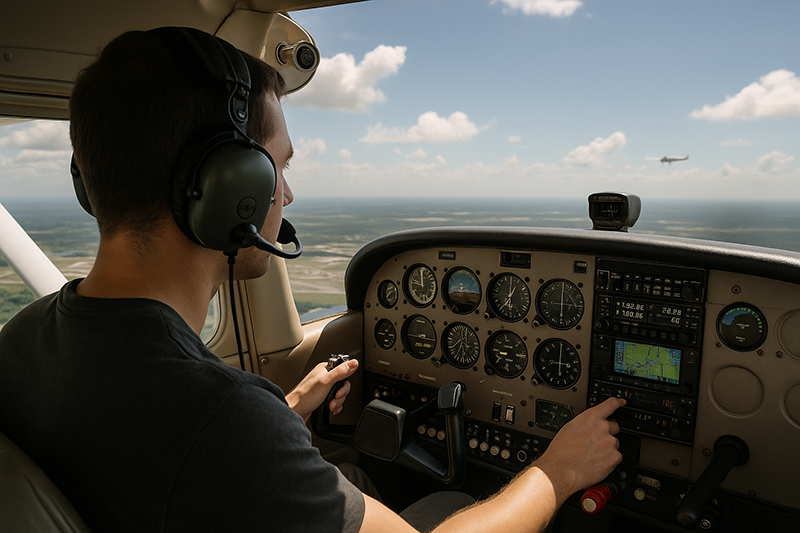
ATC services are some of the most valuable tools available to VFR pilots, yet many pilots use them less often than they should. A pilot flying under visual flight rules remains responsible for aircraft control, navigation, cloud clearance, terrain avoidance, and see-and-avoid, but that does not mean the flight has to be conducted in isolation. Air traffic control can provide traffic information, safety alerts, weather-related assistance, airspace coordination, practice approach support, and emergency help that can materially improve situational awareness.
For student pilots, ATC can seem intimidating at first. For experienced pilots, it can be easy to treat ATC as something used only when required by controlled airspace. Both perspectives miss the larger point. Good VFR pilots learn how to use ATC as part of normal cockpit resource management. The goal is not to transfer responsibility to a controller. The goal is to add another layer of information, communication, and coordination while still maintaining disciplined pilot judgment.
This article explains the ATC services VFR pilots should understand and use more often, including flight following, traffic advisories, safety alerts, airspace transitions, practice approaches, weather assistance, and emergency support. It also addresses common misunderstandings that can lead pilots to overestimate or underuse these services.
The Core Idea: ATC Is a Resource, Not a Substitute for Pilot Responsibility
The most important concept for VFR pilots is that ATC services support the flight, but they do not replace the pilot’s duties. Under VFR, the pilot is still responsible for maintaining visual separation from clouds, avoiding terrain and obstacles, complying with applicable airspace requirements, and seeing and avoiding other aircraft. ATC can provide information and instructions, but the pilot must evaluate whether a clearance, heading, altitude, or suggestion can be accepted safely and legally.
This distinction matters because many VFR ATC services are provided on a workload-permitting basis. A controller may be able to provide excellent radar traffic information in one sector and limited service in another. Radar coverage, radio reception, controller workload, airspace complexity, aircraft equipment, and local procedures all affect what is available. A pilot should request the service when it is useful, understand its limitations, and be ready to continue safely if the service is unavailable or terminated.
ATC communication also creates structure. When a pilot checks in with position, altitude, destination, and request, the flight becomes easier for the controller to understand. When the pilot listens carefully, reads back important instructions, and asks questions early, the controller can often help the pilot move through complex airspace more efficiently. This is especially valuable near busy terminal areas, special-use airspace boundaries, mountainous terrain, congested practice areas, and weather deviations.
VFR Flight Following: The Service Many Pilots Should Use More Often
VFR flight following is one of the most useful ATC services for cross-country and local VFR flying. Pilots commonly use the term “flight following” to describe radar traffic advisory service provided to a VFR aircraft. When available, the controller assigns a discrete transponder code, identifies the aircraft on radar, and provides traffic advisories and other information as workload permits.
Flight following is especially helpful because it gives the pilot access to a controller who is already monitoring the surrounding traffic picture. The controller may call out traffic by clock position, distance, direction of movement, and altitude when known. That information can focus the pilot’s visual scan and help identify traffic that may otherwise be difficult to see.
However, flight following is not a collision-avoidance guarantee. Radar systems and controller displays have limitations. Some aircraft may not be visible to ATC, altitude information may not always be available, and the controller may be handling multiple aircraft. The pilot must continue scanning outside, using onboard traffic displays appropriately if installed, and maneuvering as needed to maintain safe separation.
A useful flight following request is concise and complete. A pilot might call approach or center with: “Potomac Approach, Cessna One Two Three Four Five, VFR request.” After ATC responds, the pilot can provide aircraft type, position, altitude, destination, and request: “Cessna One Two Three Four Five, Skyhawk, five miles west of Frederick, three thousand five hundred, VFR to Charlottesville, request flight following.” That format gives the controller the information needed to identify the aircraft and determine whether service can be provided.
Flight following can also help with airspace awareness. A controller may advise of nearby Class B, Class C, restricted areas, parachute activity, or other operational factors if time and workload permit. The pilot should still plan the route, verify airspace boundaries, monitor charts and navigation equipment, and avoid assuming that ATC will prevent an airspace mistake.
Traffic Advisories and Safety Alerts
Traffic advisories are among the most familiar benefits of ATC radar service. When ATC sees traffic that may be relevant, the controller may issue an advisory using relative position, distance, direction, and altitude when available. A typical advisory might sound like, “Traffic, two o’clock, four miles, opposite direction, altitude indicates three thousand two hundred.” The pilot’s job is to look for the traffic, report it in sight if found, and continue to maneuver as appropriate.
Safety alerts are different. A safety alert is intended to warn a pilot about a situation the controller believes may involve unsafe proximity to terrain, obstacles, or another aircraft. VFR pilots should treat safety alerts seriously and respond promptly. If the controller issues a low altitude alert or traffic alert, the pilot should evaluate the situation immediately and take corrective action if needed.
Even when receiving traffic advisories, pilots should avoid a subtle trap: staring inside at a moving map or traffic display while neglecting the outside scan. Traffic displays are excellent tools, but they are not a complete picture of the sky. The best technique is to use ATC information, avionics, and visual scanning together. If ATC calls traffic at one o’clock and three miles, look outside first, use the display to orient your scan if available, then return your attention outside.
Weather Assistance From ATC
ATC is not a replacement for a proper weather briefing, in-flight weather tools, or pilot weather judgment, but controllers can provide useful weather-related assistance. Depending on the facility, equipment, and workload, ATC may be able to describe areas of precipitation shown on radar, relay pilot reports, suggest deviations, or coordinate route changes. This can be valuable when a VFR pilot encounters lowering ceilings, reduced visibility, developing convective activity, or unforecast conditions.
The pilot should communicate early. A VFR pilot who waits until weather has already eliminated good options may have fewer safe choices. If conditions ahead are questionable, the pilot can tell ATC: “Approach, Cessna Three Four Five is VFR and unable to continue direct due weather ahead. Request deviation west and any available information on precipitation along that route.” That statement is specific, honest, and operationally useful.
VFR pilots must be especially cautious about allowing ATC coordination to create pressure to continue. A clearance through controlled airspace, a suggested heading, or a route around weather does not make VFR conditions safe. If maintaining VFR becomes doubtful, the pilot should turn around, divert, land, or request appropriate assistance before the situation deteriorates.
Airspace Transitions and Clearances
Many VFR pilots first learn ATC communication because they need to operate around controlled airspace. Class B airspace requires an ATC clearance to enter. Class C and Class D operations require appropriate two-way radio communication before entry. In practical terms, this means a pilot must know what kind of airspace lies ahead, call early enough to coordinate, and listen carefully for the required response.
ATC can make airspace transitions smoother, safer, and more efficient. Instead of skirting the edge of complex airspace while dividing attention between navigation, traffic, and frequency changes, a pilot may request a transition through or around the airspace. A professional request might include present position, altitude, destination or requested route, and intentions. For example: “Approach, Cherokee Two Three Four Five Six, ten miles southwest of Metro, two thousand five hundred, VFR to North County, request Class C transition northeastbound.”
In Class B airspace, pilots should listen for an actual clearance before entering. Hearing a transponder code or receiving radar identification is not the same as being cleared into Class B. If there is any doubt, ask. A short clarification such as “Confirm cleared into the Bravo?” is far better than assuming.
For Class C and Class D airspace, the communication requirement is different, but clarity still matters. If the tower or approach controller responds using the aircraft’s call sign, two-way communication has generally been established. If the controller says to remain outside or otherwise restricts entry, the pilot must comply. Good radio discipline and early planning prevent last-minute airspace conflicts.
Practice Approaches for VFR Training
ATC services can be extremely valuable for instrument training conducted in visual conditions. A VFR aircraft may request practice instrument approaches, radar vectors to final, holds, missed approach instructions, or sequencing with other traffic when the facility can accommodate the request. This is common during instrument training, proficiency flights, and flight reviews that include instrument procedures.
For instructors and pilots, the key is to request exactly what is needed. “Request practice ILS Runway Two Seven approach, VFR, with vectors” gives ATC a clear objective. If the aircraft intends to remain VFR, say so. If the pilot wants a published missed approach, a low approach, a full stop landing, or another approach afterward, communicate that plan early.
Practice approaches are not automatically available. ATC may deny, delay, or modify the request due to traffic, runway configuration, weather, local procedures, or controller workload. Pilots should have a backup plan and should avoid becoming so focused on training objectives that they lose awareness of fuel, weather, airspace, or traffic.
Safety pilot and simulated instrument operations also require cockpit discipline. Even with ATC involved, the safety pilot or instructor must maintain the required visual lookout and ensure that the aircraft remains in compliance with VFR weather minimums and operating rules. ATC can help sequence and advise, but it does not remove the need for active crew coordination.
VFR Flight Plans and ATC: Related but Not the Same
A common misunderstanding is that flight following and a VFR flight plan are the same thing. They are not. A VFR flight plan is typically filed for search and rescue alerting purposes and must be activated and closed through the appropriate flight service process. ATC radar service, commonly called flight following, provides traffic advisories and other assistance while the aircraft is in contact with ATC, when available.
Because these services are different, one does not automatically replace the other. A pilot receiving flight following should not assume that a filed VFR flight plan has been opened. Likewise, if flight following is terminated near the destination, that does not close a VFR flight plan. Pilots should use the appropriate process for each service and confirm important status items rather than assuming they happened automatically.
This distinction is especially important on cross-country flights, flights over remote areas, night VFR flights, and routes where radio coverage may be intermittent. A pilot can benefit from both services: a VFR flight plan for alerting and flight following for in-flight traffic and communication support.
ATC Help During Abnormal and Emergency Situations
VFR pilots should never hesitate to use ATC when a situation becomes abnormal, urgent, or uncertain. Controllers can provide vectors to airports, runway and weather information, traffic coordination, frequency changes, emergency equipment notification, and communication support. The sooner a pilot communicates the problem, the more options may be available.
Not every abnormal situation begins as a dramatic emergency. A pilot may be uncertain of position, concerned about fuel, dealing with an electrical problem, encountering smoke or fumes, trying to avoid weather, or becoming task saturated in unfamiliar airspace. In those moments, plain language is acceptable. If a pilot needs help, say what is happening and what is needed.
For example: “Approach, Cessna Four Five Six has a rough-running engine and would like vectors to the nearest suitable airport.” If the situation is urgent or distressing, use the appropriate emergency phraseology. Clear communication helps ATC prioritize, coordinate, and reduce cockpit workload.
Pilots sometimes delay calling ATC because they fear embarrassment or enforcement consequences. That is a dangerous mindset. The priority in the cockpit is safe outcome, not pride. A timely request for assistance can turn a deteriorating scenario into a manageable one.
Why This Matters in Real-World Aviation
VFR flying often combines freedom with complexity. A pilot may depart a non-towered airport, climb through a busy practice area, pass near controlled airspace, cross several approach corridors, work around weather, and arrive at another unfamiliar airport. Each phase involves decisions. ATC services can reduce uncertainty, improve traffic awareness, and help the pilot integrate with the larger airspace system.
For student pilots, using ATC builds confidence and professionalism. Radio communication becomes less intimidating when practiced in normal operations, not saved for high-workload moments. Students who learn to request flight following, ask for clarification, and coordinate airspace transitions develop habits that serve them well beyond the checkride.
For flight instructors, ATC use is an important teaching opportunity. Instructors should demonstrate not only phraseology, but also judgment. When is flight following worth requesting? How early should a pilot call approach? When should a pilot decline a vector? How should a student handle a frequency change near a busy airspace boundary? These are operational skills, not just radio skills.
For experienced pilots, the value is different but equally important. Familiarity can breed complacency. A pilot who has flown the same local route for years may stop requesting services because “nothing ever happens.” Yet traffic patterns, training volume, temporary restrictions, airport configurations, and weather conditions change. ATC communication can add a useful layer of awareness even on familiar routes.
How Pilots Should Understand ATC Services in Practical Terms
The best way to understand ATC services is to think in terms of layers. The first layer is pilot responsibility: aircraft control, navigation, weather avoidance, airspace compliance, and collision avoidance. The second layer is cockpit equipment: charts, radios, transponder, ADS-B equipment if installed, GPS, and weather or traffic displays. The third layer is ATC: communication, traffic information, sequencing, airspace coordination, and assistance.
When all three layers are used well, the pilot has a stronger operating picture. If one layer becomes unavailable, the others still matter. For example, if flight following is unavailable due to workload, the pilot still has charts, onboard equipment, and see-and-avoid. If a traffic display fails, ATC advisories and visual scanning remain valuable. If radio coverage is poor, preflight planning and pilotage skills become more important.
Pilots should also understand that controllers work in a system with priorities. IFR separation, traffic sequencing, emergencies, airspace coordination, and facility workload all affect what a controller can provide. A controller who cannot provide flight following is not being unhelpful. The service may simply be unavailable at that time. The correct pilot response is to acknowledge professionally, continue safely, and try another facility or frequency when appropriate.
Another practical point is that ATC cannot read the pilot’s mind. If you need something, ask. If you are unable to accept a heading because of clouds, terrain, or airspace, say unable and explain briefly. If you are unsure whether a clearance allows what you intend to do, ask for clarification. Good ATC communication is not about sounding perfect. It is about transmitting useful information clearly and at the right time.
Common Mistakes and Misunderstandings
One common mistake is treating flight following as if it guarantees traffic separation. It does not. VFR pilots must continue to see and avoid. ATC traffic advisories are helpful, but they are not a substitute for an outside scan, especially in busy training areas and near airports.
Another mistake is waiting too long to call. A pilot approaching complex airspace at high speed or with limited time to maneuver may leave both the controller and the pilot with fewer options. Early contact is especially important near Class B shelves, Class C outer areas, military operations areas, restricted area boundaries, and major arrival or departure corridors.
A third misunderstanding is confusing a transponder code with an airspace clearance. This is particularly important around Class B airspace. Being assigned a code or told “radar contact” does not by itself mean the pilot is cleared into Class B airspace. The pilot should hear a specific clearance before entering. When uncertain, ask.
Pilots also sometimes accept ATC instructions that put them in an uncomfortable situation. A VFR pilot may receive a heading that points toward lower ceilings, rising terrain, or sun glare that makes traffic scanning difficult. If the instruction cannot be complied with safely or legally, the pilot should say unable and provide a reason. Controllers expect pilots to advise when they cannot accept an instruction.
Another frequent issue is poor initial radio calls. A call that is too vague can waste time. “Approach, Cessna Five Five Five, request” may be a good initial contact on a busy frequency, but the follow-up should be organized. Aircraft type, position, altitude, destination, and request are the core elements for most VFR service requests.
Finally, some pilots avoid ATC because they are embarrassed by imperfect phraseology. Precise phraseology is valuable, but clarity is more important than sounding polished. A pilot who communicates plainly and professionally is far better off than one who remains silent because of radio anxiety.
Practical Example: A VFR Cross-Country Near Busy Airspace
Consider a private pilot flying a Cessna 172 on a daytime VFR cross-country from a non-towered airport to a destination on the far side of a busy metropolitan area. The direct route passes near Class B shelves, several satellite airports, and a commonly used practice area. The weather is legal VFR, but there are scattered clouds that may require small course deviations.
Before departure, the pilot plans the route, reviews airspace altitudes, checks NOTAMs and weather, and identifies likely approach control frequencies. After departure and climb-out, the pilot contacts approach: “Approach, Cessna One Two Three Alpha Bravo, VFR request.” When ATC responds, the pilot says, “Cessna One Two Three Alpha Bravo, Skyhawk, eight miles northwest of Smith County, three thousand five hundred, VFR to Lakeview, request flight following.”
ATC assigns a transponder code and later issues traffic: “Traffic, eleven o’clock, three miles, southeastbound, altitude indicates three thousand four hundred.” The pilot looks outside, uses the traffic display to orient the scan, spots the aircraft, and reports “traffic in sight.” A few minutes later, the pilot realizes the planned altitude will pass close to a Class B shelf. Rather than guessing, the pilot requests a transition or an amended route. If cleared through the relevant airspace, the pilot proceeds as cleared. If not, the pilot remains outside and follows the planned alternate route.
As the flight continues, scattered clouds build along the direct course. The pilot tells ATC: “Approach, Cessna Three Alpha Bravo needs twenty degrees right for VFR cloud clearance.” ATC approves the deviation or coordinates as needed. Near the destination, approach advises that radar service is terminated and provides a frequency change. The pilot acknowledges, changes to the destination advisory frequency or tower as appropriate, and completes the arrival.
In this example, ATC did not fly the airplane, guarantee separation, or make weather decisions for the pilot. The pilot remained responsible. But flight following, traffic advisories, airspace coordination, and clear communication reduced workload and improved situational awareness throughout the flight.
Best Practices for VFR Pilots Using ATC
The best ATC habits begin before engine start. Review the route, airspace, frequencies, terrain, weather, and likely alternates. Know where ATC services are likely to be useful, and have a plan for contacting the appropriate facility. If you wait until the cockpit is busy, the radio work will feel harder than it needs to be.
When making a request, be concise but complete. Controllers need to know who you are, where you are, what altitude you are at, where you are going, and what you want. Avoid long explanations on a busy frequency. If more detail is needed, ATC will ask.
Use standard phraseology when you can, but do not freeze when you cannot remember the perfect words. Plain language is acceptable when it communicates the situation clearly. “Unable due clouds,” “request lower,” “unfamiliar with the area,” or “need vectors to the nearest airport” are simple phrases that convey important operational information.
Keep listening after the request. Many VFR errors happen because the pilot transmits correctly but does not fully process the response. Write down frequencies, squawk codes, and clearances when appropriate. Read back instructions that require readback and clarify anything that affects airspace entry, altitude, heading, or runway assignment.
Be willing to say unable. This is a mark of professionalism, not defiance. If a heading, altitude, or route would compromise VFR cloud clearance, terrain clearance, fuel planning, aircraft performance, or passenger safety, tell ATC promptly. The controller can often offer another option once the limitation is known.
Finally, practice ATC communication during low-stress flights. Request flight following on a familiar route. Coordinate a transition when you have plenty of time. Ask for a practice approach with an instructor. The more normal these services become, the more effectively you will use them when workload increases.
Frequently Asked Questions
Should VFR pilots use flight following on every flight?
Not necessarily, but VFR pilots should consider it whenever it adds value. Cross-country flights, operations near busy airspace, flights through congested training areas, night VFR, unfamiliar routes, and changing weather are all situations where flight following can be especially useful. The service depends on ATC workload and coverage, so pilots should be prepared to continue safely without it.
Does flight following replace see-and-avoid?
No. VFR pilots remain responsible for seeing and avoiding other aircraft. ATC traffic advisories can improve situational awareness, but they do not guarantee that all traffic will be detected or called. Pilots should continue an active visual scan and use onboard traffic equipment as a supporting tool.
Am I cleared into Class B if ATC gives me a squawk code?
No. A transponder code or radar identification is not the same as a Class B clearance. A VFR pilot should hear a specific clearance into Class B airspace before entering. If there is any uncertainty, ask ATC to confirm.
Can ATC help me if I am VFR and the weather is getting worse?
Yes, ATC may be able to provide information, coordinate deviations, suggest nearby airports, or help with vectors, depending on the situation and available services. The pilot should communicate early and avoid waiting until options are limited. ATC assistance does not relieve the pilot of the need to maintain VFR and make conservative weather decisions.
Can a VFR pilot request a practice instrument approach?
Yes, VFR pilots commonly request practice instrument approaches when conditions, airspace, and ATC workload permit. The pilot should clearly state the request, whether the flight will remain VFR, and what is intended after the approach. Instructors and safety pilots must still ensure proper lookout and VFR compliance.
What should I do if ATC gives me an instruction I cannot accept?
Say “unable” and briefly explain why. For example, “unable due clouds,” “unable due terrain,” or “unable to maintain VFR on that heading.” Prompt communication allows ATC to offer another option and prevents the pilot from being pushed into an unsafe or noncompliant situation.
Key Takeaways
- VFR pilots should use ATC services proactively, especially flight following, traffic advisories, airspace coordination, practice approaches, and emergency assistance.
- ATC improves situational awareness, but it does not replace see-and-avoid, weather judgment, terrain awareness, or pilot responsibility under VFR.
- Clear requests, early communication, and the willingness to ask questions or say unable are signs of professional pilot decision-making.