
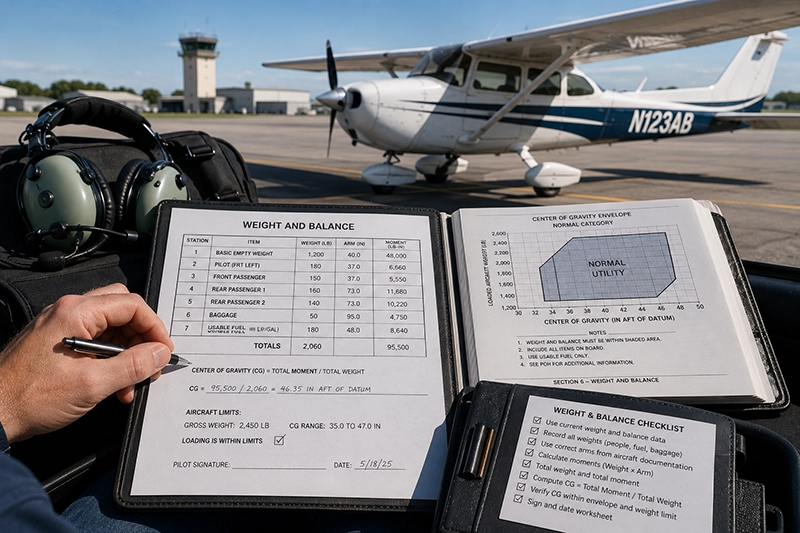
Aircraft weight and balance is a foundational topic for safe flight operations. Understanding how loading affects an airplane's center of gravity, handling, and performance helps pilots make sound preflight decisions and avoid hazardous flight conditions. For student pilots, flight instructors, and active aviators, mastering weight and balance reduces risk and increases confidence during planning and operation.
This guide explains the core concepts, shows how pilots perform practical calculations, highlights common mistakes, and offers operational takeaways. It focuses on clear explanations and realistic application without assuming a specific aircraft. Always consult the aircraft flight manual or pilot operating handbook for the correct weight and balance data for any particular airplane.
What Weight and Balance Means
Weight and balance describes two related elements of aircraft loading: the total mass of the airplane and items aboard the airplane, and the distribution of that mass relative to a defined datum. Weight determines loads on the airframe, limiting structural and performance margins. Balance describes the position of the center of gravity relative to the aircraft's longitudinal reference point and allowable envelope. Both influence stability, control, takeoff and landing performance, and stall behavior.
Key terms pilots should know include:
- Weight: The force (commonly expressed as mass in pounds) due to gravity acting on the airplane and everything on board.
- Arm: The horizontal distance measured from the aircraft datum to the item’s center of gravity, typically in inches.
- Moment: The product of an item's weight and its arm (Moment = Weight × Arm). Moments are summed to find the aircraft's total moment.
- Center of Gravity (CG): The point where total aircraft weight is considered to act. Calculated by dividing the total moment by the total weight.
- CG Envelope: A range of allowable CG positions over which the airplane is certified to fly safely. It is listed in the aircraft documentation.
- Useful Load: The portion of the aircraft's weight capacity available for pilot, passengers, usable fuel, and baggage. Useful load equals maximum gross weight minus the empty weight.
Why This Matters in Real-World Aviation
Weight and balance directly affects pilot workload, aircraft controllability, and safety margins. An aft CG can make the airplane more pitch-sensitive, reduce longitudinal stability, and complicate stall recovery. A forward CG increases stick forces and may raise stall speed, requiring longer takeoff and landing rolls. Operating outside the published CG envelope or above structural weight limits can result in unusual control responses or structural overstress.
Beyond handling, weight affects performance metrics such as takeoff distance, rate of climb, and fuel burn. Heavier aircraft take longer to accelerate, require more runway, and climb more slowly. For performance planning—especially at high-density-altitude airports, in hot weather, or on short runways—accurate weight and balance calculations are part of sound aeronautical decision-making.
How Pilots Should Understand This Topic
Approach weight and balance as a simple arithmetic process tied to real-world measurements. The basic workflow is:
- Identify the reference datum and arms for each station (pilot seat, passenger seats, baggage compartments, fuel tanks). These are provided in the aircraft documentation.
- Record actual weights for items aboard the airplane: pilot, passengers, baggage, and usable fuel. Use current scales or reliable occupant estimates. If the aircraft has been modified or reweighed, use the updated empty weight and moment values.
- Compute moments by multiplying each weight by its arm.
- Sum weights and moments; then compute the CG by dividing total moment by total weight.
- Compare the calculated CG and total weight to the aircraft's allowable limits in the flight manual or weight and balance supplement.
Mathematically, the CG formula is straightforward: CG = (Sum of Moments) / (Total Weight). Keeping calculations organized and double-checking arithmetic prevents many common errors. Use a weight and balance worksheet, a spreadsheet, or an approved electronic tool that matches the aircraft's official data.
Common Mistakes or Misunderstandings
Even experienced pilots can make avoidable weight and balance errors. Common issues include:
- Assuming published weights are current. Aircraft can gain or lose weight after maintenance, modifications, or additions. Rely on the aircraft's current weight and balance records.
- Forgetting fuel burn changes. Fuel is consumed during flight, and CG can shift as fuel tanks empty. For long flights or flights that use asymmetric tanks, account for fuel burn when necessary for the planned phase of flight.
- Mismatching units. Arms in inches but weights in kilograms, or using different weight-per-volume values for fuel, leads to errors. Standardize units before calculating.
- Using approximate seating assumptions. Occupant weight varies. When weight is critical, obtain actual weights rather than relying on generic averages.
- Ignoring baggage distribution. Heavy items placed aft in a small aircraft can shift CG significantly. Know the arms for baggage compartments and distribute loads accordingly.
These mistakes can produce a CG outside the approved envelope or cause the aircraft to exceed its maximum allowable weight for certain operations. Both scenarios increase risk and degrade predictable handling.
Practical Example
The following worked example shows the calculation method. It uses hypothetical weights and station arms for a generic light single. This example is for instruction only and does not reflect any specific aircraft's limitations. Always use the official data for the aircraft you are flying.
Assume the aircraft's documented empty weight and moment are known from the current weight and balance record. For clarity, the example uses round numbers.
Hypothetical loading scenario:
- Basic empty weight: 1,200 lb at arm 40.0 in (moment = 48,000 lb·in)
- Pilot (front left seat): 180 lb at arm 37.0 in (moment = 6,660 lb·in)
- Front passenger: 150 lb at arm 37.0 in (moment = 5,550 lb·in)
- Rear passengers: two occupants 160 lb and 140 lb at arm 73.0 in (moments = 11,680 and 10,220 lb·in)
- Baggage: 50 lb at arm 95.0 in (moment = 4,750 lb·in)
- Usable fuel: 30 gallons; if using 6 lb per gallon, fuel weight = 180 lb at arm 48.0 in (moment = 8,640 lb·in)
Step 1: Sum the weights.
- Total weight = 1,200 + 180 + 150 + 160 + 140 + 50 + 180 = 2,060 lb
Step 2: Sum the moments.
- Total moment = 48,000 + 6,660 + 5,550 + 11,680 + 10,220 + 4,750 + 8,640 = 95,500 lb·in
Step 3: Compute CG.
- CG = Total moment ÷ Total weight = 95,500 ÷ 2,060 ≈ 46.35 in aft of datum
Step 4: Compare CG to the aircraft's CG envelope and total weight to published limits. Since this is a hypothetical example, we do not compare to specific limits here. In real operations, consult the aircraft's official weight and balance documentation to determine whether the loading is acceptable.
This example shows how relatively small weight changes, particularly in aft stations, can noticeably shift the CG. It also demonstrates why pilots should perform the calculation for each flight when loading varies significantly.
Best Practices for Pilots
Adopt habits that make accurate weight and balance part of routine preflight practice.
- Keep current weight and balance data. If the aircraft has been modified or had equipment installed, ensure the weight and moment records are updated and certified.
- Use scales periodically and after major maintenance or repairs. A reweigh is required after structural changes or installation of equipment that affects empty weight.
- Always use the aircraft's official arms and datum. Do not substitute generic station locations from another model.
- Record actual occupant weights when practical, especially for flights near loading limits or when flying with many occupants and baggage.
- Account for fuel weight and planned fuel burn. For short flights with minimal burn, use takeoff fuel; for long flights, consider the weight and CG at critical phases such as takeoff and landing.
- Verify calculations by a second person when operating close to limits, or use an approved electronic tool that matches the aircraft's weight and balance data.
- Plan loading to keep the CG near the center of the allowable envelope when possible. That aids predictable handling and reduces trim drag.
How Weight and Balance Affects Flight Training
For instructors and students, weight and balance is more than math. It is a practical discipline that affects training outcomes. Teaching scenarios should include loading variations to demonstrate handling changes: for example, how an aft-loaded aircraft behaves during stall recovery or how forward CG affects rotation on takeoff. Trainers should insist on accurate calculations as part of preflight planning and use flight simulators when available to show the aerodynamic effects in a controlled environment.
Additionally, initial training often occurs in school aircraft that see frequent configuration changes. Maintaining careful records and updating weight and balance sheets prevents inadvertent exceedances and reinforces good airmanship.
Common Safety Risks and How to Mitigate Them
Operating outside weight or balance limits creates clear risks. An overly aft CG can lead to pitch instability and difficulty recovering from stalls. An overly forward CG can cause excessive nose-down trim, higher stall speeds, and difficulty flaring on landing. Structural overload from excessive weight can stress airframe components during maneuvers or rough-field operations.
Mitigation strategies include accurate preflight computations, conservative loading practices, reducing fuel or payload to get weight within limits, and redistributing baggage or passengers to move CG toward the center of the envelope. When in doubt, consult an instructor, maintenance personnel, or the aircraft's manufacturer-approved documentation.
Tools and Resources
Pilots have several practical tools for weight and balance tasks:
- Official weight and balance form or the aircraft's pilot operating handbook supplement.
- Approved electronic calculators and apps keyed to the aircraft's documented stations and empty weight data.
- Spreadsheets configured to compute moments and CG based on entered weights and arms.
- Accurate scales for obtaining occupant and aircraft empty weights when reweighing.
When using third-party apps, verify that the app's data match the aircraft's official records. Tools are only as reliable as the input data and the underlying aircraft information.
Frequently Asked Questions
How often should I perform a weight and balance calculation?
Perform a weight and balance calculation whenever the loading changes materially from the prior flight. This includes different passenger combinations, adding or removing baggage, or significant changes in fuel load. If the aircraft's empty weight or moment has changed due to maintenance or additions, update the official weight and balance records and reweigh if required by the manufacturer or a certificated mechanic.
Does fuel burn during flight affect CG significantly?
Fuel burn can affect CG depending on the location of the fuel tanks relative to the datum and the amount of fuel consumed. In many light singles, the change is modest for short flights, but for flights with significant burn or unbalanced tank usage, CG may shift and should be considered when planning critical phases of flight. Account for fuel weight and consider the expected fuel at landing if it affects whether the aircraft will be within limits during landing.
Can I use average passenger weights for planning?
Average weights are acceptable for routine planning but can be unsafe when operating near weight or balance limits. When margins are small, obtain actual weights for passengers and baggage. Many flight schools and operators maintain current average weights for ramp planning, updated periodically to reflect population changes; follow your operator's guidance.
What should I do if my CG is outside the allowable envelope?
If the computed CG is outside the allowable envelope, take corrective action before flight. Options include moving baggage or passengers, reducing fuel or payload, or, if feasible, changing the seating arrangement to shift the CG. Do not fly until weight and CG are within the aircraft's published limits.
Do modifications require reweighing the aircraft?
Yes. Structural modifications, installation of heavy avionics, or any permanent change that affects empty weight or moment requires updating the aircraft's weight and balance records. A reweigh or calculation based on manufacturer-approved data is necessary to maintain accurate records and safe loading.
Key Takeaways
- Practical takeaway: Compute weight and CG for each flight with significant loading changes to ensure safe handling and performance.
- Safety takeaway: Operating outside published weight or CG limits degrades control and can increase the risk of loss of control or structural overstress.
- Training/regulatory takeaway: Keep official weight and balance records up to date; reweigh after modifications and use the aircraft's approved data for calculations.
Weight and balance is an area where simple arithmetic, careful recordkeeping, and conservative decision-making combine to create safer flights. Make it part of your standard preflight routine and rely on official aircraft data to guide loading decisions.