AI in flight training is reshaping how pilots learn, instructors teach, and organizations manage proficiency. For pilots, student pilots, flight instructors, and aviation training managers, understanding what artificial intelligence can and cannot do is now essential. This article explains practical applications, operational value, and training implications so aviation professionals can use AI thoughtfully and safely.
The goal here is practical. I will explain key AI technologies, how they integrate into simulators and classroom training, what operators should expect, common pitfalls to avoid, and how to keep human judgment central to safe flying. The content is written for people who operate, teach, or are learning to fly, with an emphasis on training outcomes, safety, and pilot decision-making.
What AI Means for Flight Training
At a basic level, artificial intelligence means software systems that perform tasks which historically required human judgment. In flight training this includes adaptive practice plans, scenario generation, automated debriefing, performance assessment, and real-time decision support during simulation. The technologies most relevant to aviation training are machine learning models that recognize patterns, natural language processing that interprets speech and text, computer vision that analyzes video of pilot actions, and reinforcement learning used for scenario optimization.
These technologies are modular. An AI model can power a scoring engine that rates pilot performance on a simulated approach, or it can drive a virtual instructor that asks the student questions and provides tailored guidance. Integration with existing training devices, learning management systems, and flight data sources is a practical challenge and an operational requirement for meaningful adoption.
Why This Matters in Real-World Aviation
Flight training is expensive and time intensive. AI can increase efficiency by focusing student time on weaknesses rather than repeating mastered skills. It can provide more consistent, objective feedback than a single instructor might, and it can generate scenarios that are difficult, rare, or costly to reproduce in live flight. For operators and flight schools, AI tools can standardize curriculum delivery and provide data to inform syllabus improvements.
Safety and judgment are central in aviation. AI can create realistic threat-based scenarios for risk recognition and decision-making practice. It can identify subtle trends in a trainee's performance that predict future errors, allowing instructors to intervene earlier. For recurrent training, AI-driven adaptive programs can maintain proficiency by concentrating on skills that degrade between check rides.
Maintenance and operations also benefit. AI that analyzes simulator or flight data can flag recurring procedural deviations or system mismanagement that suggest gaps in training or maintenance issues. When used appropriately, these insights support safer operations and better allocation of training resources.
How Pilots Should Understand AI Capabilities and Limits
AI tools are powerful pattern detectors but not omniscient decision-makers. They excel at consistent scoring, data-driven pattern recognition, and generating large volumes of practice scenarios. They do not possess situational awareness like an experienced instructor who understands context, nonverbal cues, and the full operational environment. Pilots should treat AI output as supplemental diagnosis and instruction, not as replacement for human judgment.
Key limitations to keep in mind include model bias, data dependency, and opacity. AI models reflect the data they were trained on. If the training dataset underrepresents certain aircraft types, environmental conditions, or pilot populations, the AI may perform poorly in those contexts. Models may also be difficult to interpret; when an AI recommends a corrective action, it might be unclear why it arrived at that recommendation without careful tool design.
Interpreting AI recommendations requires basic technical literacy. Pilots and instructors should know how the system defines metrics, what data inputs it uses, and how to verify its conclusions by cross-checking against real-world flight experience and instructor judgment.
Core AI Applications in Flight Training
Practical AI features that are already appearing in training environments can be grouped into several functional areas:
- Adaptive tutoring: Systems that tailor practice content and difficulty to individual trainees based on observed performance.
- Automated debriefing and scoring: Tools that generate objective performance metrics for maneuvers and procedures and provide narrative feedback.
- Scenario generation: Algorithms that create realistic, varied scenarios including weather, failures, and air traffic interactions for both simulators and desktop training.
- Speech and checklist analysis: Natural language processing that listens to crew calls, checklist usage, and radio communications to evaluate procedural compliance and CRM skills.
- Computer vision: Cameras that analyze stick-and-rudder inputs, control technique, and cockpit scan patterns during simulator sessions.
- Decision-support simulation: AI opponents or automated ATC agents that provide evolving challenges and evaluate pilot decision quality.
Each capability supports different training aims. For example, adaptive tutoring shortens the feedback loop for students by giving immediate, focused practice on weak areas. Automated debriefing allows more frequent objective assessment so instructors can concentrate on coaching higher-level judgment and reasoning.
Integrating AI into Existing Training Programs
Integration should start with defined training objectives. Identify which learning outcomes need improvement and whether an AI capability maps to that outcome. For example, if students struggle with approach stabilization, an AI scoring engine that quantifies deviations and prescribes drills may produce measurable gains. Conversely, avoid adopting AI solutions because they are novel; align them to documented gaps and measurable performance goals.
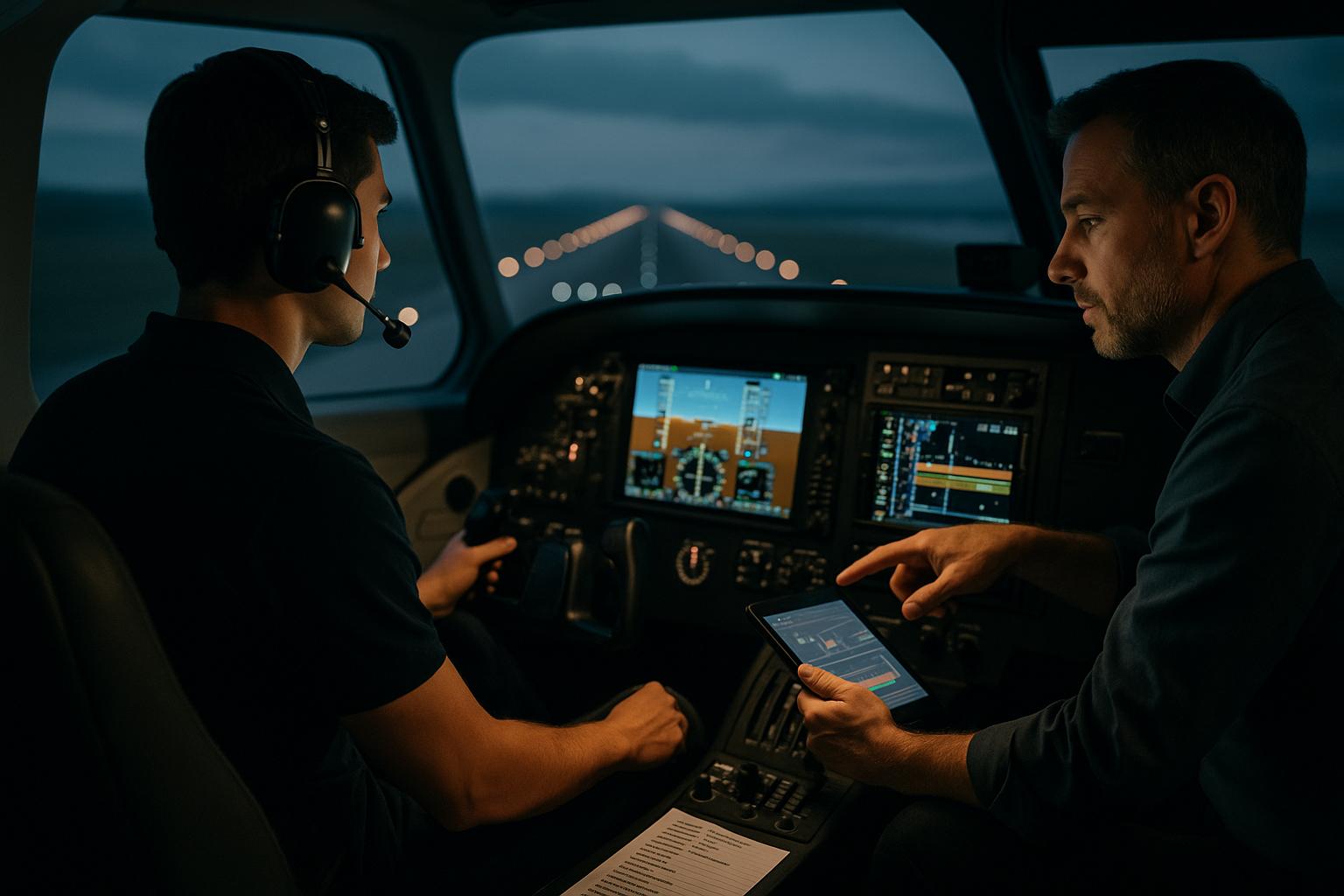
Instructor involvement is essential. AI tools are most effective when paired with instructor-led reflection. The instructor interprets AI-generated metrics, contextualizes results, and guides learners through corrective strategies. Training managers should ensure instructors receive both technical training on the tools and pedagogical training on integrating AI feedback into coaching conversations.
Data governance matters. Training organizations must decide what data is captured, how it is stored, who can access it, and how long it is retained. These decisions affect privacy, personnel management, and legal risk. Use clear policies that protect trainee privacy and ensure that assessment data supports development rather than punitive measures unless explicitly agreed.
Human Factors and Instructor Roles
AI changes the instructor role more than it replaces it. The most valuable instructors will evolve into interpreters of AI output and coaches for decision-making and judgment. Instructors should develop skills in data literacy and learn how to question model outputs. They should also remain responsible for validating training outcomes in live flight where appropriate.
There is a risk of automation complacency where trainees or instructors begin to over-rely on AI outputs. Good human factors practice requires that trainees practice without automated aids on regular intervals to confirm manual proficiency and decision-making under stress. Maintain a balance between AI-assisted training and traditional hands-on flying.
Common Mistakes and Misunderstandings
When introducing AI in flight training, organizations repeatedly make avoidable mistakes. Recognizing these helps mitigate operational and safety risks.
- Overreliance on metrics. Treating AI scores as absolute truth can obscure nuanced performance elements that the model does not capture, such as leadership and crew coordination in multi-crew scenarios.
- Underestimating data quality needs. Poor sensor calibration, incomplete datasets, or mismatched flight regimes produce misleading AI feedback.
- Lack of instructor training. Deploying AI without training instructors on how to interpret and question outputs undermines the tool's effectiveness.
- Poor change management. Rolling out AI as a disruptive technology without clear goals, communication, and pilot buy-in causes resistance and misuse.
- Ignoring legal and privacy considerations. Using recorded audio, video, and performance data for assessments may require consent and clearly defined use policies.
- Assuming one-size-fits-all. AI models trained on one fleet, environment, or student profile do not automatically generalize to others.
Practical Example: Using AI in a Complex Training Scenario
Imagine a flight school introducing an AI-assisted training route for instrument rating cross-country practice. The AI platform integrates the school's full-motion simulator, voice recognition for ATC interactions, and a learning management system that tracks student progress. During an approach scenario, the AI dynamically introduces moderate turbulence and an unexpected partial electrical failure while the virtual ATC issues a late runway change request. The system monitors control precision, checklist discipline, communication clarity, and threat-and-error management.
After the session the AI produces a debrief that quantifies deviations from stabilized approach criteria, identifies missed checklist items, and transcribes key communications where phraseology was nonstandard. The instructor reviews the AI debrief with the student, focusing first on decision points rather than raw metrics. Together they replay critical segments, discuss why certain choices were made, and practice a focused drill on approach stabilization with the AI adjusting difficulty until the student demonstrates consistent recovery behavior.
In this example AI accelerates learning by creating repeatable, measurable practice opportunities. The instructor remains the essential interpreter of context and helps the student translate simulator performance into safe habits for actual flight.
Best Practices for Pilots and Instructors
Adopting AI tools successfully requires operational discipline and a focus on learning outcomes. Practical steps include:
- Define specific, measurable training objectives before selecting AI tools.
- Ensure instructors receive training in tool operation, limitations, and data interpretation.
- Use AI to augment, not replace, live instruction and real-world flight practice.
- Validate AI outputs against instructor evaluation and real-world performance regularly.
- Maintain manual flying practice and scenario exposure without AI assistance to prevent skill fade.
- Create transparent policies for data collection, retention, and trainee access to assessment records.
- Start small with pilot programs, measure outcomes, then scale based on evidence.
Evaluation and Validation: How to Know an AI Tool Works
Not all AI vendors are equal. Training organizations should evaluate tools using operationally relevant metrics. Useful validation steps include parallel testing where trainees receive traditional instruction and AI-augmented instruction under controlled conditions, monitoring if AI-trained students show improved transfer to live flight or better retention of critical skills. Regular audits of AI scoring against instructor judgment and record reviews help detect drift or bias over time.
Ask vendors about their training data, testing regimes, and edge-case performance. If a tool provides automated recommendations, demand explainability features that show which inputs influenced the recommendation. Where explainability is limited, insist on conservative use and instructor oversight.
Regulatory and Safety Considerations
Regulatory frameworks for training are evolving. Organizations should consult their national aviation authority guidance and internal compliance teams before using AI for required training credit or certification steps. Using AI as a supplemental training aid carries different considerations than deploying it as an approved means of meeting regulatory training requirements.
From a safety perspective, incorporate AI systems into your existing safety management practices. Treat AI as another operational system by conducting hazard analysis, failure mode reviews, and human factors assessments. Develop contingency plans for model failures and ensure that pilots maintain core competencies if the AI system is unavailable.
Manual review of regulatory interpretations and local approval pathways is recommended to confirm whether any AI-based approach is acceptable for formal training credit in your jurisdiction. This article does not assert any regulatory approvals or requirements and flags such specifics for review.
Common Questions Pilots and Instructors Ask
Will AI replace flight instructors?
No. AI will change instructor roles and workflows but not replace the instructor's responsibility for coaching judgment, applying context, and validating skill transfer to live flying. Human oversight remains essential for nuanced feedback and safety-critical decisions.
Can AI be used for formal training credit or checkrides?
Rules differ across jurisdictions and certification authorities. Many organizations use AI to supplement training, but whether AI can substitute for regulated training elements depends on local regulations and approvals. Confirm with your regulatory authority and training department before relying on AI for required certification steps.
Are AI assessments objective and fair?
AI can improve objectivity by consistently applying the same scoring rules, but fairness depends on the training data and model design. If datasets are incomplete or biased, AI assessments can unfairly penalize certain students or flight conditions. Ongoing validation and instructor review are needed to maintain fairness.
What are the main safety risks when using AI in training?
Main risks include overreliance on AI outputs, misleading feedback due to data errors, model bias, and privacy or misuse of recorded performance data. Effective mitigation includes instructor oversight, data governance, conservative deployment, and continuous validation.
How should a flight school evaluate AI vendors?
Evaluate vendors on data transparency, model validation, explainability, integration capability, instructor training support, and privacy controls. Run pilot programs to measure training outcomes and support decisions with empirical results rather than marketing claims.
Key Takeaways
- Practical takeaway: Use AI to target training gaps and accelerate skill acquisition while keeping instructors central to interpretation and coaching.
- Safety takeaway: Maintain manual flying practice and validate AI recommendations to prevent overreliance and detect model bias or data errors.
- Training and regulatory takeaway: Align AI adoption with clear learning objectives, instructor training, and local regulatory guidance before using AI for formal training credit.
Final Thoughts and Next Steps for Training Organizations
AI in flight training is not a single technology but a set of capabilities that, when thoughtfully applied, can improve training efficiency, consistency, and scenario realism. Adoption should be incremental, evidence-driven, and instructor-centered. The most successful programs will blend AI-driven analytics and scenario generation with instructor judgment and real-world flight experience.
If you are a flight instructor or training manager, start by identifying the highest-value training gaps in your program. Pilot a small, well-scoped AI tool with clear success metrics, train instructors on interpretation and pedagogy, and iterate. Over time, the data produced by these systems can help make training safer, more efficient, and better tailored to each pilot's learning needs.
AI offers exciting possibilities but also demands disciplined implementation. Keep the focus on learning outcomes, preserve human judgment, and treat AI as a powerful assistant rather than a substitute for the nuanced craft of teaching and flying.