
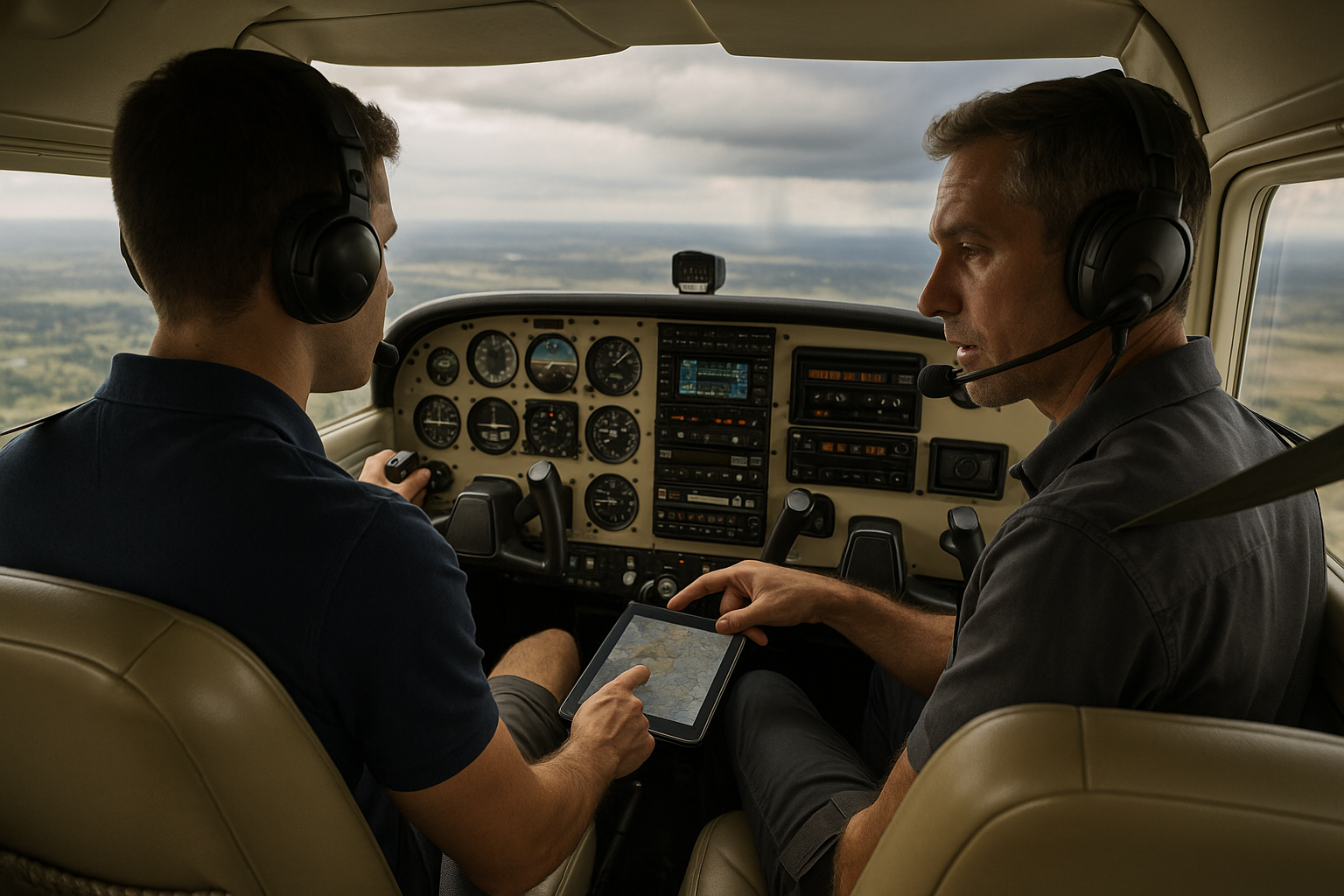
The 3P model is one of the most practical aeronautical decision-making tools a pilot can carry into the cockpit because it turns judgment into a repeatable habit: perceive, process, and perform. Instead of waiting for a problem to become obvious, the pilot actively looks for changing conditions, thinks through their meaning, and takes timely action. That simple structure is valuable in training flights, cross-country operations, instrument flying, crew environments, and everyday general aviation decision-making.
For student pilots, the 3P model helps organize a busy cockpit. For certificated pilots, it helps prevent routine flights from becoming passive. For instructors, it gives a clear way to teach risk management without reducing judgment to memorized slogans. The value of the model is not that it solves every problem by itself. Its value is that it prompts the pilot to keep asking the right questions while there is still time, altitude, fuel, runway, weather, and mental bandwidth available.
What the 3P Model Means
The 3P model stands for perceive, process, and perform. It is commonly used in aeronautical decision-making and risk management training to help pilots identify hazards, evaluate risk, and choose an appropriate course of action. The model is intentionally simple because cockpit decision-making rarely happens in a quiet classroom environment. It often happens while the pilot is talking on the radio, monitoring traffic, interpreting weather, flying an approach, managing passengers, and staying ahead of the airplane.
The first step, perceive, means noticing the factors that can affect the safety or outcome of the flight. These factors may include weather, aircraft status, pilot readiness, terrain, airspace, fuel, passenger pressure, runway conditions, avionics behavior, or ATC instructions. Perceiving is more than seeing a problem after it has already developed. It means maintaining enough situational awareness to recognize early cues, such as a lowering ceiling, a rising oil temperature indication, an unexpected headwind, or a feeling that the workload is becoming excessive.
The second step, process, means evaluating what those factors mean. A pilot may perceive a lowering cloud layer, but processing asks the next questions: Is the flight still legal and safe? Is terrain clearance becoming a concern? Is there a better route? Is a diversion appropriate? Is the pilot beginning to rationalize continuing because the destination is close? Processing requires both technical knowledge and honest self-assessment. It is where the pilot turns observations into risk evaluation.
The third step, perform, means taking action. That action may be as simple as slowing down, asking ATC for assistance, using a checklist, delaying a departure, adding fuel, changing altitude, diverting, discontinuing an approach, or handing off tasks in a crew environment. Performance is not limited to physical control inputs. It includes communication, resource management, workload management, and follow-through. A decision that remains only a thought is not yet risk management.
In practice, the 3P model is not a one-time sequence. It is a continuous loop. A pilot perceives a condition, processes the risk, performs an action, and then perceives the results of that action. The airplane may be stable, the weather may improve, or a new issue may appear. Good pilots do not run the model once during preflight and then forget it. They cycle through it repeatedly as the flight evolves.
Why This Matters in Real-World Aviation
Aviation rarely fails because a pilot has never heard of risk. More often, trouble develops when risk changes gradually and the pilot does not update the plan. A departure that was reasonable at 0900 may not be reasonable after a maintenance delay and a convective forecast update. A cross-country that looked routine in the briefing room may become more demanding when turbulence, passenger discomfort, and unexpected headwinds combine. The 3P model matters because it gives pilots a disciplined method for noticing when the original plan no longer matches the actual flight.
Real-world flying includes uncertainty. Weather forecasts are useful, but actual weather can vary. Aircraft systems are reliable when properly maintained and operated, but abnormal indications still require attention. Airports may be familiar, but traffic patterns, runway usage, NOTAMs, temporary flight restrictions, and local procedures can change. Even a highly experienced pilot can be surprised when several small factors combine at once.
The 3P model is especially useful because it encourages pilots to treat risk as dynamic. Preflight planning is essential, but risk management does not end when the wheels leave the runway. A pilot who uses perceive, process, and perform in flight is more likely to detect trends before they become urgent. For example, noticing that groundspeed is lower than planned is a perception. Recognizing that the fuel reserve may be affected is processing. Landing earlier than planned or reducing the route risk is performance.
The model also supports a safer training culture. Instructors can ask students what they perceive, how they process it, and what they plan to perform. This helps move the student beyond rote responses. Instead of simply saying, “the weather is marginal,” the student learns to explain what specifically is marginal, how it affects the flight, and what action is appropriate. That is a major step in becoming pilot in command rather than merely manipulating the controls.
How Pilots Should Understand the 3P Model
The best way to understand the 3P model is to view it as a cockpit conversation with yourself and, when applicable, with your crew or instructor. The pilot asks: What is changing? Why does it matter? What am I going to do about it? These questions are short enough to use in flight and deep enough to expose weak assumptions.
Perceive begins with attention. Pilots should be alert to information from the aircraft, the environment, and themselves. Aircraft cues include engine instruments, electrical indications, flight control feel, avionics messages, fuel state, and navigation accuracy. Environmental cues include clouds, visibility, wind, turbulence, traffic, terrain, runway condition, and airspace constraints. Personal cues include fatigue, stress, confusion, task saturation, dehydration, illness, and pressure to complete the flight.
Processing requires more than identifying a hazard. It means assigning meaning and consequence. A tailwind on final is not just an interesting observation. It may affect groundspeed, landing distance, runway selection, and the decision to go around. A passenger who is anxious is not just uncomfortable. That passenger may create distraction, pressure, or a need to change the plan. A GPS routing change is not simply a button push. It may affect terrain clearance, airspace entry, fuel planning, and workload.
Perform is where many pilots need the most discipline. It is possible to perceive a risk and process it correctly, yet delay action because the situation feels awkward, expensive, embarrassing, or inconvenient. The 3P model helps overcome that hesitation by making action part of the decision cycle. If the correct action is to ask for vectors, declare an emergency, discontinue an approach, divert, or return to the airport, the pilot should not wait for the situation to become dramatic before acting. Early action usually preserves options.
It is also important to understand that “perform” does not always mean making a bold change. Sometimes the correct performance is to continue while adding controls. For example, if a weather deviation adds distance to a route but fuel remains adequate and the pilot has a suitable alternate plan, the action may be to continue with closer fuel monitoring, updated weather, and a predetermined decision point. The model does not require pilots to cancel every flight with any risk. It requires them to manage risk deliberately.
Using the 3P Model Before Takeoff
Many pilots associate decision-making models with in-flight emergencies, but the 3P model often works best before the airplane moves. Preflight is where the pilot has the most time, the lowest workload, and the easiest opportunity to change the plan. A strong preflight 3P review can prevent the pilot from carrying avoidable risk into the air.
Before takeoff, perceive includes reviewing weather, aircraft condition, runway environment, route, fuel, passenger needs, pilot fitness, and operational constraints. The pilot is not just collecting information. The pilot is looking for anything that may make the flight more demanding than expected. A forecast ceiling near personal minimums, a short runway with high temperature, a deferred avionics item, or a tight arrival schedule may not be a reason to cancel by itself. But each factor deserves attention.
Process means comparing the situation with the aircraft, the pilot, and the mission. A highly capable aircraft does not make a fatigued pilot more alert. A legally qualified pilot is not automatically proficient for every condition. A runway that is adequate under normal conditions may deserve a closer look when density altitude, wind, weight, or surface condition are unfavorable. Processing should include both objective data and honest personal judgment.
Perform before takeoff may involve delaying the flight, changing the route, taking more fuel, removing unnecessary weight, briefing passengers, selecting a different runway, calling for updated weather, asking for a clearance that reduces workload, or choosing not to launch. The key point is that performance before departure is often cheaper and safer than performance after takeoff. A pilot who uses the 3P model on the ground gives the flight a better starting point.
Using the 3P Model En Route
En route decision-making is where the 3P model becomes a moving picture. The original plan should be treated as a hypothesis that must be checked against reality. The pilot perceives what is actually happening, processes how it affects the margins, and performs adjustments as needed.
Common en route perceptions include deteriorating visibility, stronger-than-expected headwinds, rising terrain ahead, passenger discomfort, radio congestion, unexpected airspace complexity, turbulence, or fuel burn that differs from the plan. Some of these factors are normal. Others can become serious when combined. The pilot’s job is to identify the trend early enough to keep options open.
Processing en route often involves asking whether the flight is still comfortably inside safe margins. Is the pilot staying ahead of the airplane? Is fuel still sufficient for the intended route and a prudent reserve? Are escape options available if weather worsens? Is the workload manageable? Is the next airport a better choice than the planned destination? The answers should be based on current information, not optimism.
Performing en route might include turning around, diverting, climbing or descending as appropriate, requesting assistance, slowing down to reduce workload, activating additional navigation resources, or landing to reassess. In many cases, the safest decision looks uneventful from the outside. A diversion may feel disappointing, but it is often evidence of good command judgment.
Using the 3P Model in the Traffic Pattern and Approach
The traffic pattern and approach phase are high-value places to use the 3P model because altitude, time, and options are decreasing. Pilots should actively perceive stability, spacing, wind, runway alignment, airspeed, descent rate, configuration, traffic, and mental workload. A stabilized approach concept is closely related to this thinking, even though specific criteria may vary by operation and aircraft.
Processing on approach asks whether the airplane is where it should be, doing what it should be doing, with the pilot in control of the situation. If the airplane is high, fast, unconfigured, drifting, or unstable, the pilot should not process that as a minor inconvenience. The correct question is whether the approach can be made safe and stable with normal corrections. If not, the appropriate performance is usually to go around and try again.
The go-around is an excellent example of the 3P model in action. The pilot perceives an unsafe or unsatisfactory approach condition, processes that continuing would reduce safety margins, and performs the go-around procedure. The decision is not a failure. It is a normal maneuver that preserves options. Instructors can strengthen this habit by treating go-arounds as routine command decisions rather than rare events.
Common Mistakes or Misunderstandings
One common misunderstanding is treating the 3P model as a memory item rather than a thinking process. A student may be able to recite “perceive, process, perform” but still miss the point if they do not apply it to real cues in the cockpit. The model should be practiced during ordinary flights, not reserved for checkrides or emergencies.
Another mistake is perceiving hazards too narrowly. Pilots often notice obvious factors such as weather and mechanical issues, but overlook human and operational factors. Fatigue, distraction, schedule pressure, passenger expectations, unfamiliar avionics, and lack of recent experience can be just as important as visible clouds or crosswinds. If the pilot does not perceive those factors, they will not be processed honestly.
A third mistake is processing with confirmation bias. Confirmation bias is the tendency to favor information that supports the decision already desired. In aviation, this may sound like, “the weather looks good enough,” “we are almost there,” or “the airplane always does that.” The 3P model is strongest when the pilot uses it to challenge the plan, not defend it.
A fourth mistake is delaying the perform step. Some pilots recognize a developing problem but wait too long to act because they do not want to inconvenience passengers, disappoint a customer, admit uncertainty to ATC, or spend money on an unplanned stop. That delay can shrink the pilot’s choices. Performing early often feels conservative in the moment, but it usually keeps the flight manageable.
A fifth misunderstanding is assuming that the 3P model replaces aircraft checklists, performance calculations, regulations, or standard operating procedures. It does not. The model is a decision-making framework that supports those tools. If a checklist applies, use it. If performance data must be calculated, calculate it. If a procedure or regulation governs the situation, comply with it. The 3P model helps the pilot recognize when those tools are needed and how to apply them thoughtfully.
Practical Example: VFR Cross-Country with Lowering Weather
Consider a private pilot flying a daytime VFR cross-country in a familiar single-engine training aircraft. The preflight briefing indicated visual conditions along the route, with a possibility of lower ceilings later in the day. The pilot departed on time, the aircraft was operating normally, and the first portion of the flight was uneventful.
About halfway to the destination, the pilot notices that the cloud bases ahead appear lower than expected and visibility is not as clear as it was behind the aircraft. That is the perceive step. The pilot also notices that the terrain gradually rises along the route and that the destination is still far enough away that continuing would reduce the number of easy alternate airports behind and below the route.
The pilot then processes the situation. The key issue is not simply whether the flight is still technically possible at this exact moment. The better question is whether the trend is reducing safe margins. If the ceiling continues to lower, terrain clearance, navigation flexibility, and turn-around options may become more limited. The pilot considers personal minimums, current fuel, nearby airports, weather behind the aircraft, and the possibility of landing before the situation becomes uncomfortable.
The perform step is a timely diversion to an airport behind the weather trend, along with a radio call as appropriate and a revised plan on the ground. The pilot may wait out the weather, obtain updated information, call a flight instructor or more experienced pilot for advice, or end the trip for the day. Nothing dramatic happens. That is the point. The 3P model helped the pilot act while the situation was still manageable.
This example also shows why the model should be used as a loop. After diverting, the pilot perceives the new airport environment, processes the runway, wind, pattern, and fuel state, and performs a normal arrival. Once on the ground, the pilot perceives updated weather, processes whether the remaining flight is still advisable, and performs the next decision. Good aeronautical decision-making is continuous.
Practical Example: Training Flight with Task Saturation
The 3P model is not only for weather and cross-country decisions. It is equally useful in local training. Imagine a student pilot practicing ground reference maneuvers with an instructor. The student is trying to hold altitude, correct for wind, divide attention, talk on the radio, and remain oriented to the practice area. The instructor notices that the student’s scan is narrowing and altitude control is becoming inconsistent.
The student may perceive only one problem: “I am not flying the maneuver very well.” A more complete perception includes increasing workload, reduced situational awareness, and a possible loss of orientation. Processing those cues means recognizing that the training value is decreasing and the safety margin may be narrowing if the student continues to overload. Performing could mean leveling the wings, climbing to a more comfortable altitude, pausing the maneuver, reestablishing position, and then restarting with a clearer briefing.
For instructors, this is a powerful teaching moment. Instead of simply taking the controls or correcting the maneuver, the instructor can ask the student what they noticed, what it meant, and what action would reduce workload. The student learns that risk management includes managing attention and mental capacity, not just avoiding thunderstorms or mechanical problems.
Best Practices for Pilots
The best way to use the 3P model is to make it part of normal cockpit rhythm. It should not feel like a separate academic exercise. Pilots can use it during preflight, before taxi, before takeoff, at top of climb, at route checkpoints, before descent, during approach briefing, and any time the flight begins to feel different from the plan.
One useful habit is to verbalize the model during training. A student might say, “I perceive the wind is pushing us toward the runway centerline on base, I process that we may overshoot final if I delay the turn, and I will perform by correcting earlier and keeping the bank angle within safe training limits.” This kind of verbalization builds judgment because it connects observation to action.
Another best practice is to set decision points before the workload increases. For example, before departing on a marginal weather day, a pilot might decide that if ceilings are lower than expected by a certain checkpoint, the flight will divert or return. Before an approach, the pilot may brief conditions that will trigger a go-around. Before a night cross-country, the pilot may identify airports suitable for a precautionary stop. These are not signs of fear. They are signs of professional preparation.
Pilots should also use the 3P model with other risk management tools. Personal minimums, preflight planning, aircraft checklists, performance charts, passenger briefings, weather products, and standard operating procedures all provide structure. The 3P model helps the pilot decide when those resources need attention and when the plan needs to change.
In everyday flying, the following habits support effective use of the model:
- Scan for changing conditions rather than only confirming the original plan.
- Include pilot condition, passenger pressure, and workload in the risk picture.
- Process trends early, especially weather, fuel, performance, and fatigue trends.
- Take timely action while multiple options remain available.
- Review decisions after the flight to strengthen future judgment.
For instructors and training organizations, the model should be applied in realistic scenarios. Instead of asking only theoretical questions, instructors can build short decision points into lessons. What would the student do if the destination weather changed? What if the alternator warning appeared? What if a passenger became airsick? What if the approach became unstable? The more often students practice perceiving, processing, and performing in a realistic context, the more natural the model becomes.
How the 3P Model Relates to Other ADM Tools
The 3P model is one of several aeronautical decision-making tools used in aviation training. Pilots may also encounter models that help identify personal risk factors, evaluate external pressures, or structure choices during abnormal situations. These tools are not competitors. They are different ways of improving the same core skill: making timely, informed, and safety-oriented decisions.
The value of the 3P model is its simplicity in motion. Some tools are excellent for preflight self-assessment. Others are useful when comparing multiple options. The 3P model works well throughout the flight because it follows the natural sequence of awareness, judgment, and action. A pilot can use it quickly without looking anything up.
For example, a pilot may use a personal readiness checklist before departure, then use the 3P model en route as conditions change. If an abnormal system indication appears, the pilot may use the aircraft checklist while still applying the 3P structure: perceive the indication, process its significance, and perform the appropriate checklist and operational response. The result is not more complexity. It is better organization.
Teaching the 3P Model Effectively
Flight instructors should avoid presenting the 3P model as a definition to memorize. The better approach is to make it part of scenario-based training. When students are placed in realistic but controlled situations, they learn to connect cues with consequences. That is where judgment develops.
A good instructor might begin with simple prompts: “What do you perceive right now?” “What does that mean for our flight?” “What are you going to do about it?” Over time, the student should begin asking those questions without being prompted. This transition from instructor-led analysis to student-led decision-making is central to developing pilot-in-command habits.
Debriefing is just as important as in-flight practice. After a flight, the instructor can review moments where the student used good judgment, missed a cue, or delayed an action. The tone matters. The purpose is not to embarrass the student. The purpose is to help the student see decision-making as a skill that can be practiced, evaluated, and improved.
Instructors should also model the behavior they want students to adopt. When an instructor says, “I am noticing the turbulence is increasing near the ridge, I am evaluating whether this still meets our training objective, and I am going to move us to a smoother area,” the student sees professional decision-making in real time. That modeling is often more powerful than a lecture.
Frequently Asked Questions
What does the 3P model stand for in aviation?
The 3P model stands for perceive, process, and perform. In aviation use, it helps pilots identify changing conditions, evaluate the risk or meaning of those conditions, and take an appropriate action. It is a practical aeronautical decision-making framework rather than a checklist for one specific aircraft or operation.
When should a pilot use the 3P model?
A pilot can use the 3P model before departure, during taxi, en route, in the traffic pattern, during approach, and after landing. It is especially useful whenever conditions change, workload increases, uncertainty appears, or the original plan no longer feels as strong as it did during preflight.
Is the 3P model only for emergencies?
No. The 3P model is most valuable when used before a situation becomes an emergency. It supports routine decisions such as delaying departure, taking extra fuel, changing altitude, diverting for weather, going around from an unstable approach, or pausing a training maneuver when workload becomes excessive.
How is the 3P model different from a checklist?
A checklist tells the pilot how to complete specific actions or verify aircraft configuration. The 3P model helps the pilot decide what situation exists, what it means, and what kind of action is needed. In many situations, the perform step may include using the appropriate aircraft checklist.
Can student pilots use the 3P model before they have much experience?
Yes. Student pilots can begin using the 3P model early in training because it builds the habit of observing, thinking, and acting deliberately. The instructor provides guidance at first, but the goal is for the student to gradually develop independent pilot-in-command judgment.
What is the biggest risk when using the 3P model?
The biggest risk is treating it as a phrase to remember rather than a process to apply. A pilot must honestly perceive the situation, process it without wishful thinking, and perform a timely action. Skipping or delaying any part of the model reduces its value.
Key Takeaways
- The 3P model helps pilots turn situational awareness into action by asking what is happening, what it means, and what should be done next.
- Its greatest safety value comes from early use, before weather, fuel, workload, aircraft status, or approach stability problems become urgent.
- Flight instructors can strengthen pilot judgment by teaching perceive, process, and perform through realistic scenarios, not just definitions.